



I have never fully understood in the field of electric guitars what defines the word “icon”. In other words, when is it possible to say that a guitar is an icon?
Usually the term refers to instruments whose sound and shape are well defined, little (or not at all) modified over the decades, to the point of characterizing not only an era but a style.
So the average guitarist associates the word "icon" with two well-defined guitars:
- Fender Stratocaster / Telecaster,
- Gibson Les Paul / SG / 335.
These two shapes have been present on any stage from the year '60, both in form and sound, and so far they fully meet the above definition, especially considering that these guitars are particularly used by musicians active in the most listened to genres on the planet (at least looking at commercial distribution): blues, rock and country.
So if you are a rocker you always end up finding these guitars. But what if you decide to go further?
In 1987 a guitar from Japan arrived, with a strong character, with a thin neck, a technically avant-garde solution aimed at the future, which was born for a new type of guitarist, the shredder, the virtuosist, the visionary, L'Ibanez RG was destined to become the guitar icon for a market that was turning towards hard rock, heavy metal and its most extreme derivations.
If you wanted to be ready in the world of distortion, the Ibanez RG was the perfect ax.
Over the years, many models have been created, suitable for any pocket, and have made Ibanez a leading brand, whose business philosophy (later adopted by many other houses) was:
- A competitive price
- A construction made to last
- A racing handle
- A bridge ready for any excursion.
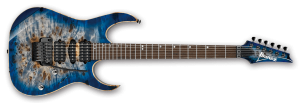
So we come to today, with the top model in the catalog of Ibanez: the new RG 1070 Premium, a guitar with a beautiful aesthetic, with a series of really interesting solutions and a much higher-end guitar equipment.
Aesthetic Considerations
"The eye wants its part" is a saying that apparently understood very well in Japan: the guitar has a truly overwhelming look in its Cerulean blue burst color, immediately catches the eye and goes very well with the grain of the top in poplar, while the headstock in the same color as the pearly Ibanez logo makes an impression.
The neck is an incredible wooden composition, where you can see all the veins of the various woods used to assemble it, and also the fingerboard has beautiful wenge veins that make it elegant, while remaining essentially aggressive enough.
The form factor is that of the superstrats that in the 80s made the history of the guitar, simple and unmistakable.
On the aesthetic level it is definitely promoted, you can hardly see such beautiful guitars from an aesthetic point of view.
Technical Considerations
Let's start with the main features of the tool:
- Body: American Basswood
- Top: Poplar Burl
- Binding: Rosewood
- Neck: 11 pieces of wenge / bubinga / maple / purple heart
- Neck Profile: Wizard
- Fretboard: Wenge with mother-of-pearl inserts and fluorescent dot markers
- 24 Jumbo Frets With Premium Treatment And Crowning
- Nut Depth: 43mm
- Scale: 648 mm (25.5 ″)
- Pickups: DiMarzio "Air Norton" - humbucker (neck), DiMarzio "True Velvet" single coil (center) and DiMarzio "The Tone Zone" humbucker (bridge)
- Controls: 5-way Blade Switch and 500k Tone and Volume Potentiometers
- Bridge: Edge-Zero II tremolo
- Hardware: Cosmo black
- Color: Cerulean blue burst
One of the things that can give you thought is the construction of the neck, especially for those who, like me, come from the school of the monobloc or of the maximum 2/3 pieces.
This type of handle is sturdy, it uses a typically European type of construction if I am not mistaken, which gives, in addition to a notable aesthetic impact, also excellent stability for extreme use. The structure is that of an Ibanez ultra wizard, thin and with a modern radius, you do not feel the strings under the fingers during the arpeggios: therefore it is a neck that will not excite the traditionalists of the Stratocaster or Les Paul very much, but after a little practice risks creating “addiction”.

Another very interesting point of the Ibanez lies in the pick-up compartment, which presents a set of DiMarzio divided as follows:
- Air Norton
Wiring: 4 Conductors
Magnet: Alnico 5
Output: 270 mV
DC Resistance: 12.58Kohm
- True Velvet
Wiring: 2 Conductors
Magnet: Alnico 5
Output: 130mV
DC Resistance: 6.21Kohm
- Tone Zones
Wiring: 4 Conductors
Magnet: Alnico 5
Output: 375mV
DC Resistance: 17.31Kohm
As for the two humbuckers, the type of sound is widely known (the Tone zone has been on the market for over 25 years) while the True Velvet is among the most recent.
The only drawback is that there are no switches that make the pickups splittable in the first and last position, nothing serious, it would have been an additional standard option, but it is a modification that costs a few euros and we could deal with it in a future article .

In addition to the mere technical description of the instrument, there are some particularly appreciable features.
First of all, the shielding of the electronic compartment: both the jack output and the compartment in which the whole circuit is located is shielded inside by a copper sheet, and the same applies to plastics. I really appreciated this: the shielding normally has to be done by hand to avoid background noise and still represents a cost, small or large.
The type of body-neck joint in this case is not symmetrical, it is not the classic square, but it has a shape that gives easy access to the most extreme parts of the neck, a solution dedicated to shredders, which together with the ultra wizard handle makes this guitar a racing car.
The multi tool is an included accessory that I found much more useful than the various keys supplied and contains everything: a ruler for adjusting the height of the pick-ups, two screwdrivers for the various screws, wrenches of any size for adjustment. of the bridge, What more could you want to adjust the instrument in any situation?
This multi tool costs about 15 euros and is supplied as standard.
The supplied bag is shaped, padded and very small, it simulates a hard case in terms of size and form factor, but it turns out to be quite light and beautiful to look at, has two comfortable pockets and an internal compartment, very modern and without any frills, comfortable , functional, minimalist.
It is a full optional guitar, DiMarzio pick-ups, Gotoh self-locking tuners, Edge Pro zero II bridge (which is still a very good and extremely adjustable bridge).
There is no point wrong with the equipment, Ibanez treats you with velvet gloves.
Sound Considerations
Much more rock than you might expect.
From the shape and type of pick-up and hardware one could imagine a guitar born almost exclusively for extreme genres, instead it is much softer than expected and despite the general sound giving its best with fairly pushed crunch sounds, it is not a guitar exclusively for metalheads, you get a much more varied and much less violent sound palette than instruments born almost exclusively for that genre.
The types of sounds for each pick-up position can be defined with a test is very simple, anyone with a sound card can do it.
Simply Guitar -> Linfaudio Platinum Way cable -> Arturia Audiofuse
The audio samples in this article are for reference only for the pick-up, there are no amplifiers. For the rest, separate audio samples were made.

1 Position
Very warm neck pick-up, a lot of presence in the mid-low frequency spectrum, very full-bodied sound and maybe a bit dark.
It has a very wide, big and round sound, I expected it a little more old style but it is quite precise in the clean parts, very nice for arpeggios and clean rhythm sections.
In overdrive in my opinion it lacks a bit, it is perhaps excessively mixed with respect to its counterpart in the bridge, but in clean it gives a lot of satisfaction, especially on the melodic.
Most suitable uses:
- Pop
- Ballad
- Rock
Let's listen to the Sample Audio and see the spectrum analysis:


2 Position
I particularly liked this position for its amount of attack and for the lack of excessive compression, which is often found in the second position of stratoid guitars; manages to take a useful part of the low-mid range of the neck pick-up, while also managing to maintain a very pleasant attack and dynamics without exceeding volume.
Let's listen to the Sample Audio and see the spectrum analysis:

3 Position
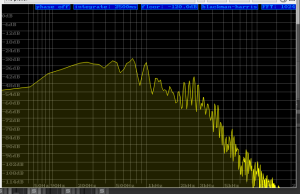
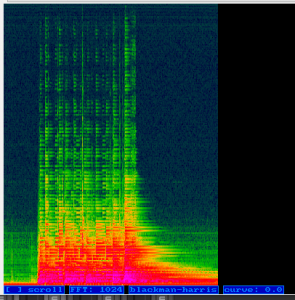
True Velvet turns out to be the coldest of all, and that's what I liked relatively least because you feel the difference in "warmth" between it and the intermediate positions. Of course, this doesn't make it a bad pick-up, you can get sounds for different genres that need a sound that's not too full of twang.
Although it is cold, the True Velvet is somewhat balanced and manages to give a good response across the spectrum, attack in the norm and a lot of sustain to be obviously a single coil, the output is higher than other more vintage-style single coils, which allows you not to keep it too high compared to the two humbuckers, but putting it at the same volume level could be a burden.
It has a nice portion of mid-highs, where it is somewhat crystal clear and crisp, and it doesn't stick even when you tend to smudge the sound with a little gain, although for me it gives the best with clean solutions.
I found this pickup useful for solutions:
- Blues
- Pop
Let's listen to the Sample Audio and see the spectrum analysis:
4 Position
This is a very interesting position which helps balance the True Velvet to the already higher output quantity of the Tone-Zone; manages to give a good response on the mids and with a gain in terms of volume much more pronounced, it maintains the attack of the single coils managing to have a more sensitive dynamics and more volume.
With this position it is possible to obtain sounds very close to soft-rock and Brit pop, when looking for a more nasal sound and a tad lighter and less violent.
Useful for styles:
- Classic rock
- British pop
Let's listen to the Sample Audio and see the spectrum analysis:


5 Position
The bridge pick-up is really very nice, it has that old style tone without having too sharp highs and a nice presence on the lows, especially when the guitar is used with a drop D; it has a very high output and must be handled with care as well as having a fairly round sound, but it is capable of giving a lot of satisfaction with a warm amplifier and an overdrive kept with the gain just over half.
I found this configuration optimal for:
- Hard Rock
- Heavy Metal
- Nu Metal (Dropped in D)
The pick-up is not excessively mixed, on very strong rhythms you do not hear very mixed sounds between low and medium frequencies, it does its job and does it well; on the melodic instead it has a discreet attack and a good sustain for the solo parts. The flaw consists in the fact that it is very lacking in averages, for some it could be excessively dry or in any case it might need an equalization adjustment.
Let's listen to the Sample Audio and see the spectrum analysis:


First try
The first test is obviously carried out to test the clean sound of the guitar, the two contexts taken into consideration are one "Jazzy" and one "Funk Blues" in a jam session as an "On the road" test, even if it is not exactly the genre more suitable for this type of guitar.
For the jazzy context I used the neck pick-up, which, while not giving the impression of an archtop, with a good management of the tone allows you to obtain at least approachable sounds; certainly you don't feel that typical cream and warmth but in terms of dynamics it gives enough satisfaction.
In the second case, I wanted to try the guitar in a blues-funk context using the pick-up in the center: it certainly has a good attack and a certain dynamics but perhaps the sound of True Velvet may not please everyone.
It was the most "strat-oriented" solution I have seen, I am not entirely sorry but it is not a very classic sound for the genre.
On the clean side it is not bad at all, but I personally find the basic sound perhaps a bit dark compared to other instruments with a distinctly more "Bright" nature.
Let's listen to some audio samples of the pick-ups only with a Hughes & Kettner Edition Tube amplifier with this configuration:
- Volume - 4
- Bass - 5
- Middle - 5
- Treeble - 5
- Reverb - 3
Second test
In the second case I wanted to test a slightly worse sound on a decidedly rock base, obtaining a sound with a fairly high gain and a well-defined boost.
I tested like this:
Guitar -> Cable -> Tubescreamer -> Amplifier -> Sm 57 -> Recorder.
The amplifier setting is the same as the previous one, the tubescreamer instead has been set as follows:
- Gain - 7
- Tone- 5
- Volume - 4
On the most driven sounds this guitar objectively gives the best of itself, warm, powerful, present and defined enough to play many rock-oriented and metal-oriented genres. I found a good response in the low frequencies and not too sharp highs, perhaps slightly too compressed due to the pick-ups.
I repeat that this guitar is very interesting for the quantity of rock sounds obtainable, you can reach heavy metal and nu-metal without too many problems, but I don't think it is suitable for more extreme genres than these.
Let's listen to some sound examples of the playlist:
Economic Considerations
Price range: about 1300 euros.
In this historical moment, when prices tend to soar, compared to the new standard models from Gibson and the professional ones from Fender, this guitar is almost a gift.
This is part of a very functional business choice for the end user, a more than decent tool at an affordable price. In the same price range we can find:
- Fender
- Gibson
- Schecter.
Buying an instrument like this in 2017 at this price is a rather rare thing and does honor to a brand that, although on the market for many years, has never succumbed to economic policies that are harmful to the customer's wallet.
Final considerations
An extremely rock guitar that manages to go even further, objectively a good combination both constructive and aesthetic.
PRO
- Incredible aesthetics
- Very comfortable handle
- Many solutions above the norm
AGAINST
- Non-splittable pick-ups in positions 1 and 5
- Intermediate positions lose a lot of output relative to the rest

Author's Note
Personally I call this guitar an RTG, or a Reference Tone Guitar: its sound is one of those that anyone has in their auditory memory, especially for those who listen to records after the 70s, in which it is widely used, and falls within that headstock sound that should always be mentioned in conjunction with Strat sounds or Gibson sounds.
The constructive context puts it in an all too attractive and perhaps little appreciated range, due to the historical affection of many guitarists who hardly associate it with an "icon". But it costs much less than a current professional Strato and has little to envy, especially in terms of electronics and hardware.
I admit that I can hardly part with it, it has almost everything.
USEFUL INFORMATION
Producer: Ibanez Guitars
Distributor: Mogar Music
Model:RG 1070
Advised price: 1279 euros including VAT


