

How many times have you heard yourself ask: "Do you want to try my guitar?".
Well, I never expected such a request for signatures!
It all happened during the Padua Guitar Show with the guitar built by Giovanni Blanco for Nick di Donato, former collaborator for the article on IR on Musicoff.
So I tried one telecaster which welcomes various ideas from the classical and modern world.
Aesthetic Considerations
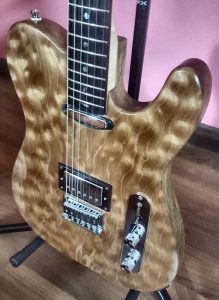
The guitar, from an aesthetic point of view, appears to be a basic model, without many frills that create chromatic games, probably a choice also by Nick, but this does not mean that a simple and minimalist line still has its charm.
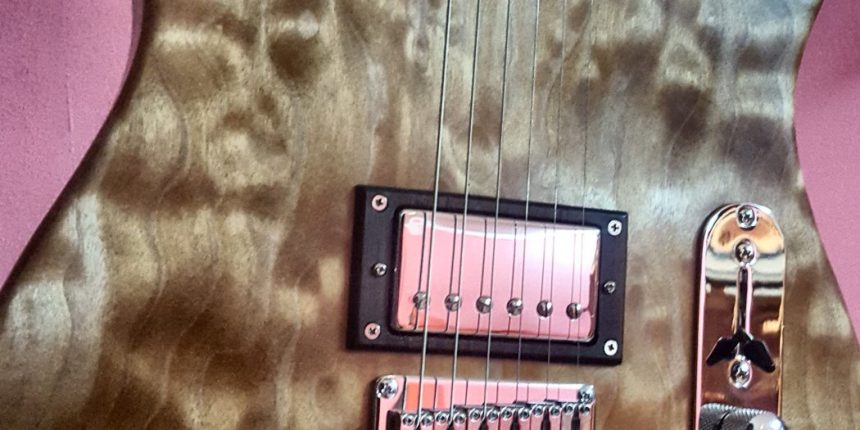
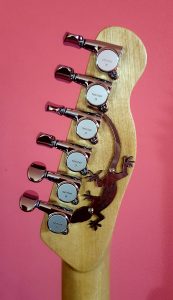
Totally exposed wood, no pickguards and only the classic electronic compartment of the Telecaster, reverse headstock and the top that turns into a real business card.
Honestly, from an aesthetic point of view, it reminds me of the APS Guitars Stratocaster, with decidedly retro and classic elements in some ways, combined with small peaks of modernity both from an aesthetic and functional point of view. In the end, it presents itself as an instrument of a certain elegance, avoiding shades that are too flashy or found bizarre on inlays or abalone.
Simple, a bit modern and with its own subtlety, I couldn't say more.
Technical Considerations
The equipment does not differ much from other types of instruments, but the choice of woods is interesting.
Let's take a closer look:
⦁ Body - Black Lymba
⦁ Top - Quilted Maple
⦁ Neck - Maple
⦁ Nut - Bone
⦁ Frets - Sintoms in nickel and steel
⦁ Fingerboard - Rosewood
⦁ Bridge Pickup: Bertozzi VG-1 (Nick Di Donato signature), 7.5 Kohm - 4.2 Henries, alnico 5 bar.
⦁ Neck pickup: Bertozzi Single coil 6.8 K-ohm - 1.8 Henries alnico 5 poles of 5mm negative polarity at the top.
A special mention is for the electronic equipment, which I personally have already had the opportunity to test with the APS Studio: the magnets are an absolute certainty to obtain a vintage stamp warm and dynamic.
Sound Considerations
We are talking about an instrument with strong vintage connotations, and therefore, consistently, from the point of view of the sonority we have nothing modern, as if we had never gone beyond the years '60 e '70. The sound of the Bertozzi takes with both hands from the Tele 52 and the PAF in the old style and this means that the instrument has strong, and also obvious, connotations of blues, rock, country and in some ways even a little pop. I take the liberty of making reservations on this last genre, because it always depends to a large extent on the sound paste you want to obtain.
Bridge Magnet Considerations
The VG1 is a pick-up that I really like, because although it is not a magnet with a great output, given its construction, it has a nice yield in terms of harmonics, in addition to the fact that it is not too compressed.
Very dynamic, it is one of those pick-ups that greatly enhance the player's hand and allow very few dynamic errors to pass; the sustain is normal and on the crunch of an amplifier it obviously gives the best result, managing to create a thick and creamy sound without mixing the mid-high area or, even worse, giving too much emphasis to the high frequencies.
Suitable for the following genres:
⦁ Classic Rock
⦁ Country rock
⦁ Blues
Handle Magnet Considerations
In this case we are talking about a classic of the vintage-oriented sounds of the Telecaster, which however, while maintaining that typical tone, manages to be a little softer and less "ferrous" than some magnets that can be mounted on some industrial Telecaster.
This magnet gives its best in country and with the use of the chicken picking; it has a strong attack and a good dose of volume despite being a single coil anyway; for the rest, the Telecaster is part of that slice of sound palette typical of blues and country.
Suitable for the following genres:
⦁ Country
⦁ Blues
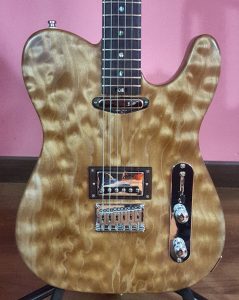
The use of black limba as wood intrigued me at first, not being used to seeing it on the Telecaster, but the overall sound manages not to be too melodious, which at first I feared a little, it is a very resonant guitar.
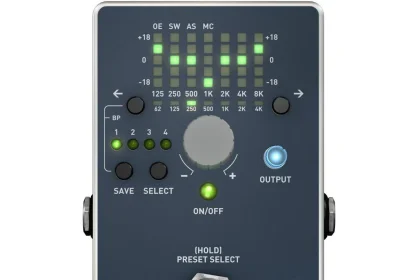
Let's now see some spectrographic analyzes of the various sounds obtainable from this instrument.
The audio chain is very simple, provided in collaboration with Nick di Donato himself:
Guitar -> Kemper -> Michael Britt's Marshall sl100 72 profile and BurnFx L Dynamic Overdrive pedal effects loop
Spectrum Handle
The response is congruent with what I expect from a Telecaster 52 style magnet, strong presence of very defined mid-bass.

Central spectrum
Here we take part of the two sound worlds that make up this guitar: the resulting spectrum takes a good part from the sound of the magnet to the neck, adding a dose of mid-highs and the additional signal, giving a decidedly interesting combination, more particular and less rattling.
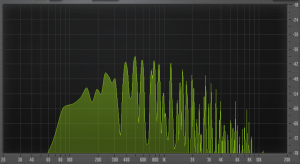
Spectrum Bridge
This is the most complete and interesting spectrum, the magnet covers a very wide spectrum of frequencies up to almost 12kHz, the resulting sound is the one described above, a complete and versatile sound in rock contexts.

Last but not least, I am attaching the audio tracks to give a more precise idea, the audio chain is the same as described above:
Economic Considerations
The starting price is around 1800 euros, but for the model under consideration we are talking about a sale price of 2300 euros.
Like many other instruments I have tried, it is not within everyone's reach, or at least it is not an expense that is possible to do very lightly, but when it comes to lutherie, in front of certain choices you know 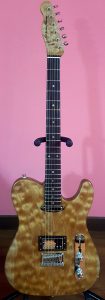 that resale may not be a variable in favor; at the same time, a similar tool is not only a whim but also a work and earning tool, which will amortize its cost in one or two years.
The competition is well known, let's talk about the Fender custom shop, Standard Gibson, some elite always from Fender, Schecter custom shop used, which however do not give the possibility of having something truly customized.
Final considerations
Pro
⦁ Comfortable
⦁ Electronics of excellent level
Cons
⦁ Aesthetic rendering perhaps too minimal in many ways