


In this article we will delve into the world of synthesizers from the point of view of guitarists. What makes a guitarist or bassist want to make their instrument sound like a synthesizer?
- What drives us to use a guitar synth or a bass synth?
- Why was there not the commercial diffusion that the producers of musical instruments were hoping for?
- What are the most efficient tools available today?
- What are the techniques for detecting the vibration of the string?
- Examples of historical passages in which it was used
- The history of the guitar synth and its evolution up to the present day
- Some of the Guitar Synths that were most widely used and widespread in the second half of the 70s:
- ROLAND GR-500 (1977)
- ARP Avatars (1977)
- 360 Systems (1979)
- ROLAND GR-300 (1979)
- The MIDI revolution
- Let's describe the mechanism:
- ROLAND GR-700 (1984)
- Roland GM-70
- Ibanez X-ING IMG2021
- Yamaha G50
- AXON AX 100 and AX 50
- Fishman Triple Play
- To complete the list, we mention some guitar productions with a hexaphonic pick-up mounted as standard:
- Explanation of the physical phenomenon of latency
- Let's try to describe the process in an extremely simplified way:
- The current situation
- Examples of use with the Bass Synth
- Conclusions
What was the history of the evolution of guitar synths? Why hasn't the commercial impact that the producers hoped for? What are the most efficient tools available today? Let's try to answer these questions from our point of view.
What drives us to use a guitar synth or a bass synth?
The main answer is certainly a timbre research in order to broaden one's palette of sounds, perhaps adding one's original sound to the synthesized one or replacing it entirely. In fact, we often get to the guitar synth through a search matched with traditional effects.
But it is not only this, for example there is the desire or the need to use the typical timbres of keyboard players, or the possibility of emulating other instruments such as strings and winds (something that keyboard players also do). Finally, it can be considered more simply as a "controller" to have the ability to drive keyboards for various needs such as the lack of manual skills on the keyboard or more simply to have one less musician in the band, etc.

But let's move on to the most painful question that will provide us with some of the main themes of this article:
Why was there not the commercial diffusion that the producers of musical instruments were hoping for?
Why haven't guitarists and bassists become so passionate about these systems? Why hasn't the passion and consequently the GAS taken off?
1Technical difficulties, largely solved only in recent years, such as:
• the "latency" that is the time delay between the plucked string and the production of the sound.
• the optimization of note detection systems. In the first systems there were errors in the recognition of notes.
As far as the electric bass is concerned, there are greater difficulties for the management and eventual resolution of the latency problem since in general the notes played on thicker strings are more difficult to "detect" and "transduce". This has led bass players to move away from this world almost entirely. It is my opinion, however, that today at the state of the art of the systems on the market and by adopting technical strategies on the instrument, this obstacle can be overcome and even bass players can take advantage of this technology. As a demonstration of what was written towards the end of the article we will offer you some musical examples of synth bass made with the GR-55 and VB-99 of Roland.
2. In the first systems it was necessary to make specific "set up" interventions by a luthier for the installation and optimization of a hexaphonic pick up (later we will see what it is). Furthermore, not everyone liked the installation of this pick up on their instrument, especially in the case of guitars of a certain historical and economic value. As we will see later, the evolution of technology has led us to no longer have the need to install a hexaphonic pick-up.
3. High cost of the first systems. Fortunately, today we have the opportunity to take the first steps towards this technology by investing very low figures compared to the past.
4. It requires a change of technical approach to playing that is not appreciated by all. The guitarist felt frustrated that he could no longer use the typical physical and technical approaches to the instrument. Approaches that are often the basis of the main historical repertoires of the guitar. For example, the management of "bending", "palm mute" and "ghost notes". More generally, there is a need for a “cleaner” technique of the left hand to avoid incorrect detections by the hexaphonic pick-up and therefore the execution of unwanted notes.
5The difficulty of finding a role, a space for the synth guitar in certain “classic” styles, especially in those where the traditional guitar plays a leading and / or specific historicized role.
6The guitarist and bassist are typically not prone to "tweaking" equipment by nature. They prefer a more direct and simplified approach to their instrument than their fellow keyboard players, for example.
7The need to study other theoretical disciplines such as:
• Acoustic Physics
• The techniques of sound synthesis, its processing and more generally the bases of electronic music from a theoretical and historical point of view
• The MIDI protocol
• Elements of Musical and General Informatics
What are the most efficient tools available today?
1. Boss / Roland hardware with and without hexaphonic PU
2. Triple play Fishman
3. RMC and Ghost (Piezoelectric PU)
4. JAMGUITAR software
What are the techniques for detecting the vibration of the string?
(with and without hexaphonic PU)
The conversion technology pitch to voltage is that Pitch-to-MIDI Notes. We will talk specifically about these two technologies when describing the historical-technological evolution of the guitar synth
Examples of historical passages in which it was used
Among the most famous guitar synth users we can mention:
A. Summers (Police), P. Metheny, R. Fripp (King Crimson), A. Belew (Bowie, King Crimson), J. Page (Led Zeppelin), P. Townshend (The Who), E. Clapton, S. Hackett (Genesis), A. Holdsworth
Here are some of the most famous songs in which you can listen to these artists struggling with the guitar synth:
• “Don't Stand So Close to Me” The Police, Zenyatta Mondatta, 1980
• "Are You Going With Me?" Pat Metheny ,offeramp, 1982
• "Ashes to Ashes" David Bowie 1980
• "Atavachron" A. Holdsworth, 1986 Album
• “Discipline” King Crimson, Discipline, 1981
• Jimmy Page - Death Wish - Soundtrack 1981
• “Never Make You Cry” Eric Clapton, Behind the Sun 1985
• “Racing in A” Steve Hackett, Please Don't Touch 1978
The history of the guitar synth and its evolution up to the present day
In reality it all starts with the development of synthesizers by dthe Robert Moogs which presented its first synthesizer to AES in New York in 1964. Small curiosity, Moog was preceded in 1962 by the Italian-Polish sound engineer Paul Ketoff who starts building synths for the Cinecittà Italian film industry. Actually Moog at first invites Ketoff to America to collaborate with him but he refused.
The basic concept of synthesizers was to have simple (sine) and complex (Square, Saw, Triangular, etc.) waveform generators on board. These waveforms are the source of the sound which is then processed (enveloped, filtered, etc.) and treated in different ways according to the synthesis techniques (Additive, Subtractive, Amplitude Modulation, Ring Modulation, FM etc.). These synthesizers also have external sound sources (microphone and line inputs) to be used as an alternative to complex waveforms. So why not enter it with the Jack of the guitar? So here is David Gilmour, always a great experimenter, with the expensive EMS Synthi Hi-Fli used in the recordings of “The Dark Side of the Moon” (1973).

This equipment included a series of filters and sine oscillators to obtain the Ring Modulation as well as two pedals to be used as pitch and parameter controllers. The principle is to modify the sound of the guitar as we do today with the pedals (even today Moog Music produces excellent pedals dedicated to guitarists). We are still in the phase in which the sound of the guitar is processed by circuits that are normally found on board synthesizers.
The real breakthrough comes when the conversion technology is introduced "pitch to voltage"That is a circuit capable of interpreting the pitch of the incoming sound and on the basis of that produce a"Voltage Control". The latter are electrical signals which, based on their voltage, are capable of varying the value of certain parameters within a synthesizer, such as the pitch of an oscillator. Our guitar thus becomes a controller capable of driving, for example, a “square wave” (Square) or “saw tooth” (Saw) oscillator inside a synthesizer. In short, the guitar replaces the black and white frets of the keyboard.
However, there was a drawback, the "pitch to voltage" conversion circuit was capable of interpreting only one note at a time and since at the beginning the traditional output signal of the guitar was used, it was forced to perform monophonic and could therefore not be play chords. Later a "hexaphonic pickup"(A combined system of 6 pick-ups, one for each string as for the piezoelectrics of amplified acoustic guitars) in order to have 6 distinct signals, one for each string, and therefore being able to play several notes at the same time.
Some of the Guitar Synths that in the second half of the 70s had a greater use and diffusion:
ROLAND GR-500 (1977)
The GR-500 had its own dedicated guitar and was already equipped with a hexaphonic Pick-up although it remained a partially polyphonic system. Roland entrusted the part of the lutherie to FujiGen Gakki (famous in the 70s for the copies of Les Paul even more accurate than the original Gibson of the period). Famous users of the GR-500 were among others S. Hackett, R. Fripp, A. Summers. One of the best known songs in which it was used is certainly David Bowie's “Ashes to Ashes” played by C. Hammer. The GR-500 also allowed “infinite sustain” to the traditional guitar sound.

ARP Avatars (1977)
The ARP Avatar did not have a dedicated guitar but was supplied with its own dedicated pick-up to apply to your instrument. Among the main users we find J. Page e P. Townshend. Both the ARP Avatar and the Roland GR-500 were mostly monophonic and only partially polyphonic.

360 Systems (1979)
The first of this period to be fully polyphonic was the very expensive one 360 systems

ROLAND GR-300 (1979)
A step forward was taken with Roland's famous and more performing GR-300, still used today by famous artists. It is a system with dedicated guitar and hexaphonic PU fitted as standard, it included 4 models still produced by FujiGen. The GR-300 is fully polyphonic.
Used among other things by P. Metheny, A. Summers, R. Fripp, A. Belew, E. Clapton and many others.
There was also the Roland GR-100, simplified version of the GR-300

The MIDI revolution
At the turn of the '70s and' 80s the whole world of synths is hit by the digital revolution and the trend is to abandon the analog: the oscillators become digital, the "Voltage Controls" are replaced by numerical messages and so on.
Furthermore, with the advent of the technology called "Thinking Instrument Digital Interface”(Unveiled to the public in 1983 at NAMM), generally known as MIDI, there was a further transformation and optimization of digital music systems. MIDI is a protocol that establishes rules for the creation of messages capable of carrying information from one digital device to another. In this way, two or more digital machines can communicate and exchange information (in the form of binary numerical messages) such as notes to be played, parameter settings and much more.
We then begin to build digital guitar synths and with the ability to exploit the MIDI protocol: we thus move on to conversion technology "pitch-to-MIDI".
We describe the mechanism:
• a hexaphonic pick-up collects and transmits 6 electrical signals (one for each string so that you can play polyphonically) through a 13-pin multi-polar cable.
• These signals arrive at a conversion circuit (pitch-to-MIDI) capable of translating these electrical signals into MIDI messages containing information such as pitch, velocity and other control signals.
• These MIDI messages will drive a digital synthesizer which in most cases is integrated into the same rack unit containing the conversion circuit. We also find MIDI In / Out ports to communicate with the outside of the machine and to drive additional external synths
As previously done, we describe the machines that use this new technology and that had the greatest diffusion
ROLAND GR-700 (1984)
Still equipped with dedicated guitar (G-707) but also usable with the GK-1 hexaphonic pick-up applicable to any guitar. Used by J. Page, King Crimson, A. Summers, Cirrus, Sigue Sigue Sputnik, P. Daniele and many others. There was also the bass version, the GR-77B with dedicated bass (G-77).

Roland GM-70
Rack unit that can be driven from GK-1 pickup to be mounted on any model of guitar. It is useless to describe specifically from this moment on all the models that have followed one another from the mid-80s to today. Let's mention just a few:
The GR series from ROLAND including rack units and pedal boards GR-1, GR-50, GR-30, GR-33, GR-20, GR-09, GR-55 (currently still in production) etc. driven by the GK-2 pickup and its successor GK 3. There is also the GK-3B for bass.

Ibanez X-ING IMG2021
The Ibanez IMG2010, like all Roland "guitar synthesizers" of the 80s, was built in the same factory Fujigen which produced many of the best Japanese guitars of that era. The designers of the IMG2010, the latest of Roland's mass-produced compatible controllers, benefited from studying the weaknesses and strengths of Roland models.

Yamaha G50
Pilotable from G1D pick-up made by Yamaha but compatible with Roland GK-2 and GK-3. There is also the pick-up B1D for bass
AXON AX 100 and AX 50
Can be driven by both Roland and Yamaha pick-ups. The AX 50 in particular is not equipped with a sound source but only acts as a converter. When it came out it had the best pitch tracking algorithm while minimizing latency time. Axon was later absorbed by Terratec which after a short time decided to discontinue production. The Axon project will be the basis of the Fishman TriplePlay converter that we will see below.
Fishman Triple Play
It is the umpteenth step forward, in addition to the improved transduction system derived from the Axon, the converter is housed inside the pick-up box that is fixed on the body of the instrument. Furthermore, not using the traditional “13-pin multicore” cables, the MIDI messages are sent Wirelessly to a USB key to be connected to a computer in order to be able to interface with synths in VST format. There is also a separately purchased hardware receiver for interfacing with physical synths.

To complete, we mention some guitar productions with a hexaphonic pick-up fitted as standard:
Fender GC1
Fender Stratocaster, which perfectly managed the GR-3 controller and other compatible 55-pin devices via Roland GK-13 pickups. Unfortunately the project was very short-lived.
Fender Fishman Triple Play Stratocaster HSS
As with the DC1 model, Fender creates a model with the Fishman system already integrated. Also in this case there was no great commercial success.
CASIO PG-380
We can see her embraced by JJ Cale as she duets with E. Clapton on the stage of the Crossroad festival organized by Clapton himself.

MOOG Guitar
Note the large use of electronics to the detriment of the lutherie section. The main feature of the instrument is the possibility of having an infinite sustain.

Returning to the structure of the hexaphonic pick-up, there are other signal detection systems for single strings, that is the traditional piezoelectric (high-end price) mounted in the bridge of the acoustic instruments. Some of the best manufacturers of these Pick-ups, like RMC e graphtech they also begin to produce circuits to be applied to the output signal of their pick-ups capable of sending adequate signals to the converters.
GODIN Multiac
The Godins are fitted as standard with the piezoelectric RMC pick-ups and in some models such as the Multiacs and LGXs they also mount the circuit to enter the converters.
BOSS SY-1, SY 200, SY-300, SY-1000
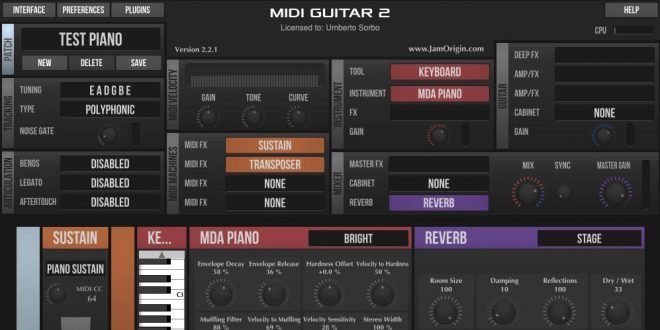
In recent years the pitch recognition algorithm has improved considerably and it has been possible to return to using the traditional guitar output signal (as at the beginning of the experimentation). It is therefore possible to avoid the use of hexaphonic pick-ups and at the same time have the possibility to play in a polyphonic way. In this direction we find two main systems, one in hardware format, the SY series by BOSS, and one software, Midi Guitar by the Jam Origin software house.

Jam Origin Midi Guitar
Also some DAWs like ABLETON they have internal detection functions of the pitch. .
Review: Jam Origin
It is necessary to mention guitar-shaped MIDI controllers, so not real guitars. These have been designed for the guitarist who wants to play synthesizers and who is not willing to give up his guitar technique: YAMAHA G10, Casio DG20, Stepp DG1, SynthAxe, the latter made famous by Alan Holdsworth.
JAMSTICK
The JAMSTICK produces a controller and also a guitar with a pitch detector.
RORGuitars e MANSON GUITARS
Finally, it is worth noting the tendency in recent times to build traditional instruments with not only hexaphonic pick-ups and pitch transducers on board but also pad XY and percussion pads capable of transmitting control signals. The Manson Guitars in particular are used by the singer guitarist of Muse.
Explanation of the physical phenomenon of latency
When a string vibrates it produces a series of oscillations. These oscillations have a frequency measured in Hz. In other words, according to the pitch of the sound (acute or low) these oscillations are more or less “frequent” in the space of time of one second. A low E VI string guitar will oscillate fewer times per second than a high E I string. Now, consequently, a low E will take a few milliseconds to perform just one of these vibrations, but a high E will take much less. To do its job, a pitch-to-MIDI signal converter has to wait for at least one complete oscillation to unfold… that's the delay time and latency.
So let's try to describe the process in an extremely simplified way:
• The system must wait for at least one complete swing
• The pick-ups must detect the wobble and send an electrical signal to the converter
• the algorithm inside the converter must calculate the duration of the oscillation time to understand its pitch and translate it into a numerical value called "midi note"
• the algorithm inside the converter must calculate the intensity of the signal and translate it into a numerical value called "velocity"
• the midi note and velocity values in the form of a Midi message must reach the oscillator which must produce the relative signal
The system latency is therefore the sum of the times required to perform these operations.
It follows from what has been said that the lower notes, which have longer oscillation times, will have greater latency than the higher notes.
The hexaphonic pick-up is mounted as close as possible to the bridge because that is the point where the vibration is easiest to detect as it is less wide.
Using thinner strings helps a lot in signal transduction for obvious reasons since a thinner string has less inertia, having less mass, and therefore takes less time to vibrate.
The concepts described up to now are reported in a very simplified way to allow an understanding of the mechanism in principle.

The current situation
As we have already mentioned, the systems currently in use are much more performing than in the past, but always if you are willing to approach them with an open mindset and using a "cleaner" playing technique for both hands. Most of the past problems have been overcome so much that today even bass players with some precautions can use these systems. The state of the art is today, as already mentioned, represented by Roland GR-55, from the Boss GP-10, from systems SY always of the BOSS and the software Jam Origin Midi Guitar.
In particular as regards the BOSS systems, in addition to using the traditional synthesis techniques (AM, RM, FM, PCM etc.) they make use of the “Physical Modeling Synthesis” or the “synthesis for physical models”. It consists in emulating the physical behavior of traditional instruments through complex algorithms. So in these appliances of the BOSS we will find both digital oscillators with traditional waveforms (Saw, Square etc.) to be used with synthesis techniques that are now historicized, and realistic sounds of stringed instruments made through the technique of physical modeling. Thanks to the "Physical Modeling Synthesis" within these machines we also find emulations of amplifiers and effects among the most famous and requested by guitarists and bassists. We will therefore find under fancy names for copyright reasons emulations of amplifiers, pedals, basses and guitars of the most prestigious brands such as Gibson and Fender, Marshall, Vox, Boss etc.
Il with Midi Guitar also has enormous potential and is in continuous development; it has a very intuitive interface and is rich in features, it also has the ability to load Impulse Response for the simulation of microphone cabinets and for the simulation of environments and reverbs.
Examples of use with the Bass Synth
To demonstrate the efficiency of the new signal detection and transduction systems, we report musical examples using the bass, thus complicating our lives as much as possible. The examples were played by me using handcrafted 5-string basses from the Italian brand Sciuscià guitars & ideas and a 6 string Court Artisan, all three specially set for this use.

Of course these settings can be made by expert luthiers on any bass type. The strings are quite thin, for the 5 strings a scale of 0.35 - 0.55 - 0.70 - 0.90 - 0.120 has been used for both the fretless and the fretted. A separate discussion is for the 6-string which is tuned like a guitar (E - A - D - G - B - E) but all one octave below and with a scaling 0.18 - 0.28 - 0.40 - 0.60 - 0.80 - 100. All the basses are equipped with a Roland GK-3B hexaphonic pickup and the machines used are the GR-55 and the VB-99 from Roland.
Bassline made with the GR-55
In this particular example everything except the drum was made using synth bass
Theme and bassline with the GR-55
Bassline made with the VB-99
Fretless bassline with the VB-99, Fretted bassline with the GR-55
Much attention must be paid to the programming of the timbre and to the possible mixing of this with the original sound of the instrument as many confuse incorrect programming with latency problems. The latter also in some cases can even be masked with an adequate setting of the synth parameters. But this is a very large topic and deserves a series of in-depth studies that will be carried out in subsequent articles.
Conclusions
It is my opinion that today guitar synth systems have technologically reached a maturity that deserves greater attention from musicians and those who produce music. They represent the umpteenth technological evolution for the guitar that was born acoustic and with gut strings in its six-string form around the 18th century at the hands of the Neapolitan luthiers. Through the centuries up to today the guitar has been able to evolve always earning its space in different musical genres and this umpteenth evolution should, in our humble opinion, be exploited to the fullest. The genres currently in vogue are created mainly by programming software instruments and include less and less the human element, thus depriving the performance of that imperfection that represents the characterizing element of music: human imperfection makes music more alive.
Even the first electronic instruments and equipment (synths, drum-machines, sequencers, etc.) were imperfect and plagued by many technical problems, but those defects gave that something more that today we all look for through the software emulations of analog machines (which even imitate defects). Hence the synth systems, applied to guitar and bass and more generally to stringed instruments, thanks to the performer, can again introduce the human factor and carve out a space as a protagonist in current musical genres (hip hop, rap, trap, neo soul, electronic etc.). We therefore hope that guitarists and bassists, thanks to these machines, no longer look mainly at historicized musical genres that are now half a century old and take their space, indeed influence current musical genres.
As happened for centuries, music and technology have always influenced each other, musical needs have created new instruments and modern technologies, at the same time new technologies in turn have generated new forms and styles of music.


