

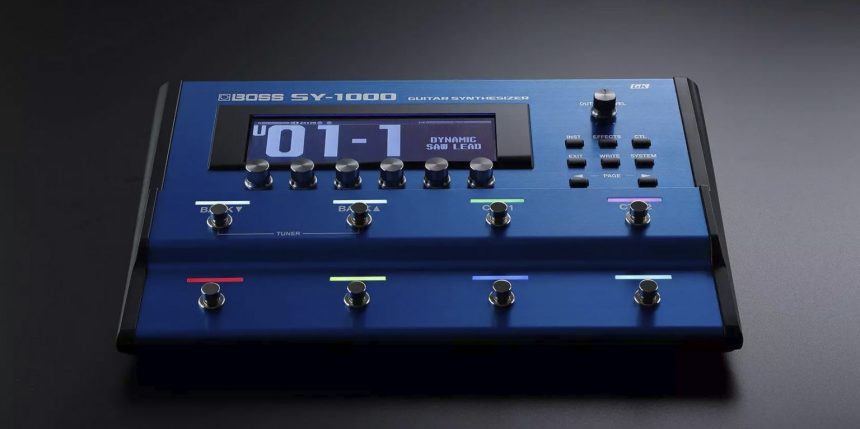
Boss guitar-synth flagship model, the SY-1000, is a creative machine capable of transforming the sound of your guitar or bass into intense analog-style leads, warm PAD sounds, moving synth textures, acoustic and electric tones. physical models, even all together at the same time.
With more analog synth sounds than other models and a good effects processor, it is based on a 48kHz DSP/32-bit 6 times more powerful than that used for the SY 300.
I hear the demos - great sounds and a lot of inspiration. Good! I am convinced that this is the case for guitar and bass, but I want to challenge it, I want to try it with an instrument that is a little different than usual.
“SY-1000 I want to test you with my Chapman Stick! "
… “Am I too unfair? "
"Ah, do you agree? Uhm "
OK! Let's see how it ends.
Controls overview
The SY-1000 features eight footswitches, which basically select patches / banks and can be assigned to a variety of functions. A fairly large LCD with buttons for navigating, selecting and editing pages is available for patch setup. Six rotary knobs, but which also act as buttons, are present below the screen and control the related parameter drawn on the screen. A master output level control is present in the upper right corner.

As I said, the footswitches, by default, select four patches, select banks, and provide two types of control that may depend on the patch. So, for example, we could control the parameters of an effect, the sequencers, the muting of the parts and many other functions. Each footswitch has an LED bar indicator that changes color according to the selected function.
Back panel
There are stereo outputs on the rear of the unit Main and Stereo sub assignable, an external effects loop and the five-pin MIDI DIN I / O connectors. The USB port allows a connection to the Mac / Windows computer and therefore the use of the SY-1000 as an audio recording interface. Dual control jack inputs are available for additional control pedals, allowing you to connect up to four controllers. As for the input for the guitar / bass, we have a TS jack input and a 13-pin input for the GK pickups.

Global settings allow you to equalize the output to suit different types of amps, including guitar or bass combos and PA systems. The outputs Main and Sub normally used for stereo signals, they can be reconfigured as four single mono outputs, with dedicated equalization for each output.
Patch
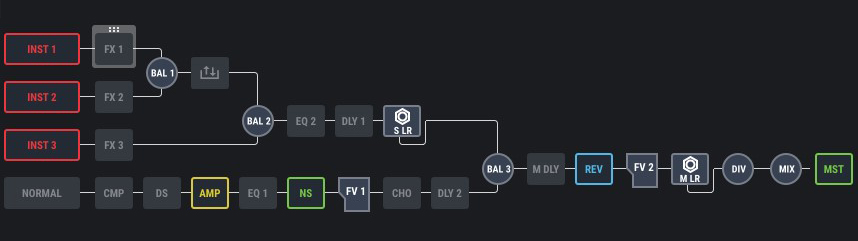
The settings are organized as patches, each consisting of one to three separate “instruments” plus the sound of the guitar input, mixed together to create the final patch sound. For each instrument, various sound sources are available and in GK mode it is possible to use all the available synth models:
• DYNAMIC SYNTH is a synthesizer that produces a sound that dynamically responds to your touch while you are playing.
• OSC SYNTH is a synthesizer that detects pitch and attack in the input sound and produces output signals using an internal oscillator.
• GR-300 (ANALOG GR for bass) is the Roland GR-300, the famous analog polyphonic guitar synthesizer of yesteryear. Provides hex-distortion, with a hex-VCO and VCF (variable frequency filter) generating independent sawtooth waves for six strings.
• E.GUITAR provides a variety of electric guitar sounds (13 types of guitars and 31 types of AMP).
• ACOUSTIC provides a variety of acoustic guitar sounds (10 guitar types and 31 AMP types).
• AC LOW provides acoustic bass sounds (in bass mode).
• E.BASS provides a variety of electric bass sounds.
• VIO GUITAR adds nuances (harmonics), creating a soft and distinctive tone (13 types).
• POLY FX is an effects processor that independently processes the signal of each string.
In Normal mode, i.e. using a normal guitar / bass jack cable, you can use the amps, cabinets and effects, as well as the Dynamic Synth. All instruments in a patch can be routed through separate effects before mixing and can be adjusted independently.
For the GK patches, there are settings for each individual string to achieve something very similar to the splits you do on keyboards, for example, to have different sounds on the strings. You can save up to 200 patch organized in 50 banks of 4 patches each. Basically there are 50 factory patches, which cannot be overwritten but can be edited and saved in the user slots. To speed up patch creation, you can save instrument and effect settings in “Variations,” a library that allows you to use elements from one patch in another.

The presets are divided into Normal and GK variants - most of the factory presets are GK and will only respond if a GK or compatible 13-pin pickup system is detected, but for Normal presets it is only the last 12.
The most common alternative guitar tunings are also available as presets:
• Open
• Drop
• Modal
• Nashville
• 12-string emulation
You can also create your own tunings, which can be used on guitar or synth sounds. A patch is also editable via the top panel controls and is fairly easy to do using the LCD display. Obviously, editing is much more immediate using the “Boss Tone Studio” editor, a free downloadable software, which also allows access to new patches via Boss Tone Central. Clicking on an instrument accesses the pages to modify its parameters: it is possible to select the instrument type, the waveform, the LFO control, the sequencer and the envelope parameters for adjustment. Processing blocks can be moved by drag-and-drop and, next to reverberations, delay, chorus, EQ and noise gate, three special effects blocks provide access to a wide range of effects.
The effects loop can be moved to different points in the signal path.
At first I had some problems with “Boss Tone Studio”, the data transfer from the pedalboard via USB was very slow and the software was somewhat unstable when modifying even a single parameter.
I have encountered this problem on both Windows that of Mac.
Fortunately, I was able to overcome the problem by using a USB hub, the introduction of which made the editor's behavior acceptable, but this solution is related to my computer and I cannot guarantee that it applies to anyone.
Things to know (normal input / hexaphonic pickup):
SY1000 it accepts two types of input, one from a hexaphonic pickup with its 13-pin cable and the other via a normal audio jack (called “Normal Input”).
I would like to specify
• With Normal input you can ONLY use the Dynamic Synth sound engine.
• With Normal input it is not possible to do GUITAR TO MIDI.
You can adapt the SY-1000 to the instrument you are playing. This involves entering measures relative to the instrument's scale length and positioning the GK pickup relative to the guitar bridge, and selecting between guitar and bass as the input source. The sensitivity setting also allows you to balance string levels and only needs to be done once, unless you change guitar or reposition the GK pickup. If you have more than one GK-equipped guitar, you can save them up to 10 settings.

SY-200
SY 200 is a product recently released on the market and is the solution for those who DO NOT have a hexaphonic pickup. It sounds great and works right out of the box with ANY instrument I've tried: guitar, bass and STICK.
It has no arpeggiator function.
For further information, I refer you to the excellent articles by Maurizio Zoccola (Link)
The challenge
My Chapman Stick is an instrument from the 90s, which I bought used in London in those years. The most modern Sticks have a predisposition to place a hexaphonic pickup (however a custom version due to the different inter-string compared to the guitar) inside a small channel created at the end of the fretboard.

Unfortunately, in my instrument there is no such channel nor the space to be able to place something. The only solution is to place the pickup above the strings. Another difficulty to take into account is that I don't intend to make any new holes in the wood of the instrument, that is, I want to make something that can be totally removed and restore the instrument to its original state.
First try
The first thing I had to do was create a support structure for the hex pickup. Disassembling the pickup I noticed the presence of two screws to adjust the height. I immediately discarded the idea of lengthening the screws, since I wouldn't even know where to look for screws with that American pitch. I used two longer and thinner screws, with the countersunk head and on the other side I hooked the metal bracket.

My first attempt was to try and create a custom hexaphonic pickup, with a 8,5 mm. I then cut the magnets from a GK2 to re-solder them on one breadboard in glassnite 2mm x 2mm, found from a single supplier as the standard pitch is 2,5mm. After having thinned it well, I managed to get the feet of the magnets to come out on the other side to weld them.

Everything was going well, were it not for my eyesight which has deteriorated very closely and I must have made a few missteps. My hearing, still discreet, unfortunately warned me of continuous "hum" ... Looking carefully with the magnifying glass I noticed that a magnet was unfortunately interrupted!
Second try
I bought a used GK3, with the aim of recovering the magnet to be replaced from it. But then I moved towards another solution. I thought of mounting the whole pickup with an additional support structure, diagonally. The first doubts came to me by observing the geometric arrangement of the magnetic poles. The heaviest chord would have had a distance from the bridge greater than 6 cm (3 cm is the maximum that can be set on the SY 1000).

Would it have worked?
Also, the curve of the pickup would have remained that of a guitar, so with a nice bow and not a straight line.

Test
First of all, the diagonal adjustment of the pickup, seen from "above": it was enough for me to take as a reference point some references to dots that are below the base of the pickup and let the string stay between the two points. Given the limited space available, I had to hold the pickup in place using an additional bracket so that I could still adjust it. To do this I used the lid of a canister with a color that I really like. According to the height of the pickup, by adjusting the wing nut that I mounted on the metal bracket, I was able to get a good distance. On the SY 1000 I set the sensitivity to maximum.
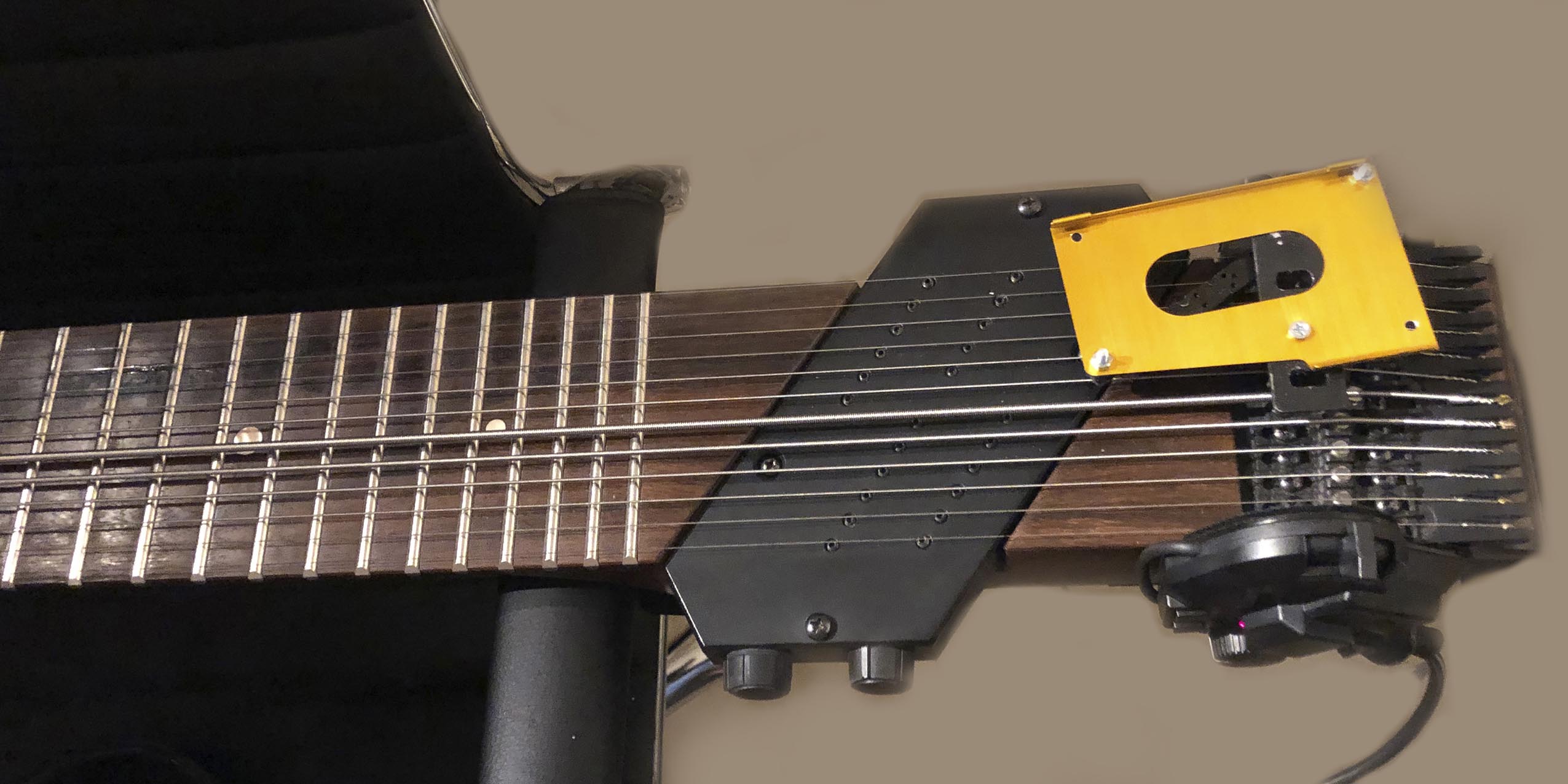
It is easy to tell if the distance is right, because when a string is too far from its magnet, the synth preset works the same, but the sound has a very low dynamic, with a sound always directly in its release phase. What can I say, the pickup can follow whatever I am going to play!

Conclusions
It's amazing how powerful the overall + SY 1000 hex pickup system is, not only for the use of synth and guitar-to-midi, but also for the ability to reshape the sound of the pickup. This surprised me, because it also works well on a system for which not only was it not really designed, but whose parameter settings differ a lot from the expected values (pickup distance from bridge, inter-string, tuning, etc. .).
In conclusion, with this setup I was able to add to my setup:
• Analog synth sounds
• Sounds other than those produced by the pickup (e.g. STRAT, acoustic guitar, etc ...)
• A new chain of effects
All integrated into my previous one, using SEND / RETURN and MIDI commands. I thank Cav. Music House Quinto Fabio (SA) who gave me the machine to allow me to do this test and write the article.
Useful Information
Producer: Roland Boss
Distributor: Roland Italy
Model: Boss Sy1000
Advised price: 999 Euro including VAT