



Telefunken, Fairchild, Pultec and the myth of tube systems. Because it's not the valves that create the sound, but the systems that control them.
- Telefunken V72 – Stability as an Aesthetic
- Fairchild 660/670 – Compression that tells a story
- Pultec EQP‑1A – Equalization as a Physical Gesture
- Three design cultures, three different characters
- Germany – Order and repeatability
- America – Cultural Industry and Practicality
- Russia – Technical Survival
- Why these machines became “timbre material”
- The modern mistake: imitating the valve, not the circuit
- The real limits of valves (the real ones, not the romantic ones)
- Conclusion
Anyone who's worked with tube machines for any length of time knows this: a tube is never "the sound." Seeing a bulb light up isn't enough to understand a machine's character. You have to listen to how it reacts when the voltages stabilize, how it curves transients, how it changes as the transformers begin to heat up.
The first few minutes are never the ones where you make a decision. You turn on the power, you wait, you listen to the background noise subside, you check to see if a tube has become microphonic. It's a small ritual, more mental than technical, that prepares you for a critical look at the signal.
That's when you know you're going to be working with a well-designed machine.
Because a valve alone doesn't tell you anything. It's the machine that forces it to behave a certain way.
Il Telefunken V72 he does it with discipline.
Il Fairchild 670 it does so with an almost organic behavior.
Il Pultec EQP‑1A It does this by sculpting the body of the sound before even recovering the level.
These machines were created in different eras, with different philosophies, and with components that are almost impossible to find in the same condition today. Each one embodies a specific way of understanding audio.
Telefunken V72 – Stability as an Aesthetic
The V72 was born in post-war Germany, when broadcast modules had to work for years without surprises. Stability, repeatability, and continuity were more important than "personality." It had to always respond the same way, regardless of the model or the temperature. The result is not a "hot" machine in the modern sense of the term. It is a machine that puts things in order in the signal. After a V72, a voice or guitar sounds firmer, more believable, more stable.
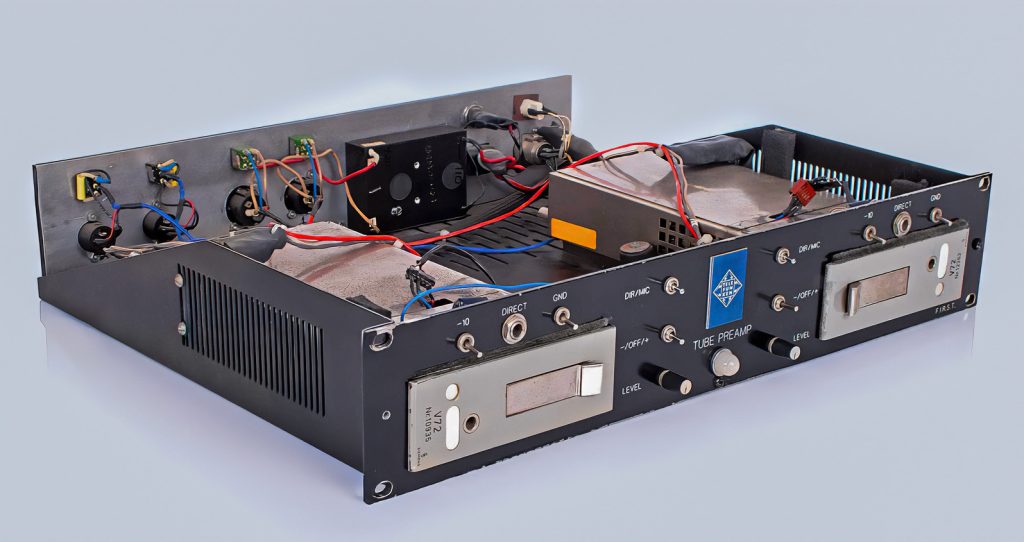
Character comes from specific choices:
- transformers designed with attention to bandwidth and magnetic saturation,
- robust power supplies that are not prone to drift,
- discrete and linear valve stages,
- rigorous design modularity.
The V72 doesn't add magic. It simply doesn't lose control. And that's what allows it to give the signal a perceptible stability, an authority that doesn't come from an effect but from the project coherence.
Fairchild 660/670 – Compression that tells a story
The Fairchild 670 is one of the few machines I've ever heard in its original form. Not a reissue, not a clone, but one that has endured decades of sessions, maintenance, and period components. And when you hear a real 670, you immediately understand: this machine doesn't "compress."
Organize your time. The attack is never rigid. The release seems to know in advance where it wants to go.
The dynamic bends, but does not give in: it moves as if it had an intention.

Many ask me why every Original Fairchild sound different, while modern clones like the Heritage Audio Herchild 670 and others often sound very good but more coherent with each other.
The answer is simple and technical:
the originals are no longer new machines, they are machines lived.
Here's why they differ:
1. Tolerances of the time
In the 50s, component tolerances could fluctuate by as much as 10–20%.
Two Fairchilds were similar, not identical.
2. Repairs accumulated over 60 years
Almost every specimen had:
- capacitors replaced,
- out-of-spec resistors changed,
- repaired or rewound transformers,
- NOS or modern valves inserted at different stages of its life.
3. Physiological wear of materials
A '59 transformer no longer reacts like one that just came out of the factory.
Valves age, wiring degrades, connections change over time.
4. Different technical interventions for each machine
Every technician, in every era, has left his own mark on the circuit.
That's why every original Fairchild is a one-of-a-kind.
And because a modern clone is much more consistent: it's built with modern components, tight tolerances, clean power supplies, and predictable construction. It's not a question of "better" or "worse." It's a question of identity.
The original Fairchild is a story.
The clone is a photograph.
Both can be beautiful, but they are two different things.
Pultec EQP‑1A – Equalization as a Physical Gesture
The Pultec EQP‑1A is loved for one simple reason: it sounds good.
Not because it adds valve, but because it works in two distinct phases:
- The passive LC network sculpts the body of the sound by subtracting energy.
- The tube stage recovers the level and restores coherence.
The famous "boost and cut" low-frequency trick isn't magic. It's two curves that don't cancel each other out, but overlap in a creative way. The result isn't stronger bass: it's more readable bass.

As with the Fairchild, age has changed each specimen here too:
- inductors replaced,
- repaired capacitors,
- aged transformers,
- valves changed over time,
- very wide original tolerances.
This is why each vintage Pultec has its own character, while modern reissues are more coherent.
Not because it lacks "soul", but because it lacks Wear and wear and tear, in vintage, is a kind of signature.
Three design cultures, three different characters
Germany – Order and repeatability
Telefunken, Siemens, TAB. Modules as measuring instruments.
Sound: stable, clean, predictable.
America – Cultural Industry and Practicality
Fairchild, Pultec, Universal Audio.
Machines built for music, not broadcast.
Sound: musical, spacious, physical.
Russia – Technical Survival
Robust military valves, less sensitive to noise but very durable.
Sound: energetic, unpredictable, dense.
These cultures are felt in the sound.
They are technical aesthetics, not narrative ones.
Why these machines became “timbre material”
The V72 gives structure.
The Fairchild shapes time.
Pultec rearranges the spectrum.
The records we love pass through these signatures.
And our ear recognizes that way of behaving even before we know where it comes from.
We're not looking for "tube warmth."
We are looking for that kind of answer.
The modern mistake: imitating the valve, not the circuit
Many products put an exposed valve and promise “heat”.
But the valve, by itself, is not a system.
The real sound comes from:
- solid foods,
- correct transformers,
- coherent topologies,
- tight tolerances,
- clean layout,
- controlled wear.
A valve without architecture is merely aesthetic.
The real limits of valves (the real ones, not the romantic ones)
Indispensable matching
Two valves of the same type are not enough: they must react in the same way. under signal.
Physiologically slow attacks
The valve has thermal inertia and slew limits.
Sometimes it's musicality, sometimes it's a loss of precision.
Thermal drift
A cold and hot tube machine doesn't sound the same.
Microphonics
The glass vibrates. If not handled properly, it leaks into the audio.
Constant maintenance
Tubes, bias, wiring, transformers: no tube circuit is “set and forget”.
And yes: the originals change over the years.
And that's also what makes them fascinating.
Conclusion
The tube is not nostalgia.
It's not the orange light in the dark of the studio.
It's a way of interpreting the signal through a chain of technical choices, materials, limitations, solutions, and, over time, even repairs. Historic cars are legendary because they are consistent as a project and imperfect as individuals. Modern clones, on the other hand, are consistent in their production and predictable in their response.
Neither world is “better”.
They are simply two different ideas of how a machine should speak to music.
And if there's one thing that the tube teaches, it's this:
It's not the tube that creates the sound. It's everything around it.
To the next article


You've hit on a really important point about the systems. It's the interplay between the valves and the EQ that creates the character, not just the valves themselves.
Timeless machines that, in my opinion, still have that extra edge despite the numerous software emulations!
Finally, someone says it. I'm so tired of the 'magic tube' marketing fluff. If you've spent any real time behind a rack, you know it's the iron and the circuit topology doing the heavy lifting, not just the glow.
Take the V72—it's not 'warm' in the way kids on forums think. It's just German over-engineering at its best. It's got that NFB and massive iron that just locks the low-mids in place. It's about stability, not distortion.
And man, the 670 talk is spot on. A vintage Fairchild is a living, breathing (and sometimes temperamental) beast. You can't replicate 60 years of component drift and those original 6386 curves with modern off-the-shelf parts. Clones are great for reliability, sure, but they're 'static.' They don't have that weird, moody response to the program material that makes an original feel like it's actually mixing the song for you.
Same with the Pultec. Everyone talks about the 'low end trick,' but it's really about that weird phase shift in the LC network that clears out the mud while adding the weight. The tube is basically just there to keep the lights on after the passive circuit eats the gain.
Great to see an article focusing on the bench-spec reality instead of the voodoo.
Finally, someone who says it clearly! As a sound engineer and designer (I tinker with both tubes and solid state), I often struggle with the marketing myth of "tube warmth," where simply slapping a randomly lit tube on the wall is enough to make a miracle happen.
You nailed it: the tube is just one piece of the puzzle. The real character comes from the transformers, the power supply, the way you manage impedances... in short, the circuit. The point about the wear and tear of vintage gear is also wonderful: it's true, many vintage machines today sound divine partly because the components have aged and acquired their own unique "signature," impossible to replicate in series production.
You've made me think about a dilemma I often bring to the workbench: does it still make sense today, for us designers, to go crazy chasing that 'worn-out' sound of the past, or should we have the courage to offer modern machines with a whole new personality? How do you see it?
Finally, some real truth and less commercial speculation. The valve is just one component of a much larger project.
Having had the good fortune of frequently using the Heritage Audio Herchild 670 abroad, I understand this concept perfectly: it's an excellent clone of the Fairchild, not because of some supposed tube magic, but because the entire circuit and transformers work at a stratospheric level. There you can see firsthand the immense gap compared to software emulations from UA or Waves. On a machine like this, I would never dream of replacing the stock tubes in search of theoretically "warmer" ones: it sounds perfect as is, because the entire ecosystem of the circuit is in perfect balance.
The real "extra edge" of these machines is the engineering rigor of a design that forces the components to work that way. Less marketing and more circuitry designed to really sound.
Luke M
I found the article really interesting. I'm 23, I study in Milan, and I'm working on becoming a good studio engineer, but I realize I still have a lot to learn. I've never had the opportunity to try a Telefunken V72, a Fairchild 670, or a Pultec EQP-1A; so far, I've only used cheap hardware clones and software emulations.
What struck me most was the section "The Real Limits of Tube Amplifiers." No one had ever explained to me so well the true problems of this type of equipment, nor the reason why old analog outboards each sound so different. I didn't know that, beyond component tolerance, so much depended on the repairs and replacements made over the years.
Congratulations on the quality of your Music Magazine!
I agree with the content and conclusions of the article, which I found very interesting and balanced in the comments.