

Welcome to the Age of Audio pages. The following article aims to give some little advice on how to optimize your audio material in view of the complex process of printing on vinyl. In recent years we have seen the return of this physical medium which is giving new life to independent labels and the music market thanks to its sonic and aesthetic characteristics.
WHAT TO PRINT.
Unlike the digital world where the duration is fairly relative, given the large capacity of the supports, for vinyl printing it is the exact opposite. The incision duration defines the (rather limited) surface on which the signal is “written”. A shorter duration corresponds to a greater width of the groove. Exceeding the limits recommended by pressing plant generally we run into problems such as unfavorable signal-to-noise ratio and greater distortion; the latter translates into a lower yield on the other supports which instead adapt to these durations.
Broadly speaking, these are the times on which we should design our vinyl prints for the most common formats on the market:
12 ″ 33 laps recommended duration per side
12 ″ 45 laps recommended duration per side
10 ″ 33 laps recommended duration per side
7 ″ 45 rpm recommended duration per side

Another parameter to consider is the distortion due to the angle of the stylus as the record comes to an end, starting from the outside and going inwards. The unfavorable rotation angle makes the tracks more and more distorted as the grooves of the record become narrower; therefore, to balance this defect, it is customary to order the tracks on the vinyl so that those with greater dynamics are on the outside and those with less dynamics inside, at the end of the record.
CHOICE OF THE TYPE OF ENGRAVING AND SUPPORT.
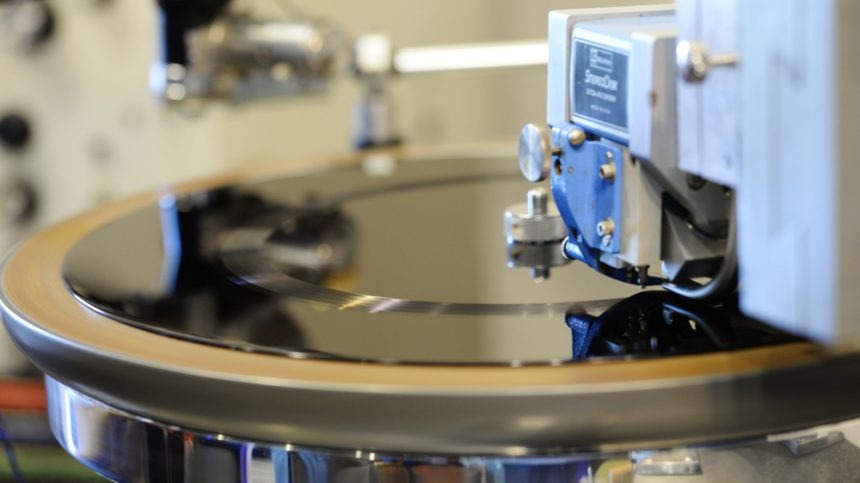
For mastering on vinyl we can choose between engraving techniques DDM ed electroforming.
In DMM (DDirectly Met al Master), the first incision is made on a copper plate from which to directly derive the subsequent molds.
In 'electroforming instead a cut is made on aluminum lacquer covered with nitrocellulose which is first engraved and then electroformed with nickel and silver to obtain the subsequent molds.

The advantages and disadvantages of the DMM are:
- a factory that uses DMM has shorter print queues as it avoids the electroforming step
- high frequencies are often referred to as brighter (sometimes excessively) in a DMM etching than in an electroforming etching
- the amount of background noise is reduced since the spraying phase of the electroforming is not present
- the DMM can introduce weak pre-echoes (echoes that occur before an event at about 1,8 seconds or the duration of a groove at 33 laps) due to the influence of a groove on the adjacent ones
It is therefore up to the manufacturer to choose the type of engraving according to their needs
As for the choice of weight, it is necessary to make some fundamental considerations.
The weight of a disc varies from less than 100 grams to a maximum of 200 grams. There is no difference in treatment when engraving between a lighter and a heavier disc. Nonetheless, there are factors to consider:
- a heavier record is commonly considered better because the budget for the realization is greater as well as the care taken in the work. On a heavier disc, center positioning will almost certainly be perfect.
- the greater weight of the disc contributes to giving the head a more stable reading position and probably also greater isolation from environmental vibrations.
- Thicker media can increase the performance of a read head by increasing its vertical tracking angle.
- The type and depth of the grooves between two discs of different weight are absolutely identical.
- A heavier disc is more durable and solid.
Let's focus now on the much-maligned colored vinyl, a topic of great discussion. Does it really sound worse?
Generally in the production of vinyls the 70 % of virgin vinyl and the 25 %/30 % of vinyl recycled from previous castings to increase the cohesion of the cast. Keep in mind that recycled vinyl carries with it small dust particles which can increase background noise. A lower quantity of recycled vinyl therefore corresponds to less background noise but at the same time lower density of the fusion and consequently a lower durability of the support.
At this point it goes without saying that if I use a color made especially for me for a print, until I get enough recycled colored vinyl to mix with the virgin one, my print run will not be homogeneous enough; under these conditions a small colored edition will always sound worse.
WHERE TO PRINT.
In Europe there are numerous printing plants including the few DDM plants left in the world (being the German patent).
The parameters to be evaluated to choose the printing system that best suits our needs are:
- evaluation of printing and shipping costs
- communication skills and speed of the administrative team
- quality of cuts and graphics
- any special offers proposed by the factory on specific runs such as white labels (they are very common),
- evaluation of ancillary services (test press, cromalin, etc.)
- the evaluation of the print queue
This last parameter is perhaps the most important. In fact, it must be borne in mind that for a small label facing a print queue can mean waiting from 5 (in very rare cases) to 15 weeks

THE TEST PRESSING
The test pressing allows to evaluate the continuity of the sulcus.
For those starting to practice mastering for vinyl, test pressing are certainly important as they allow you to analyze the variations in the sound spectrum after cutting; their primary purpose, however, is to evaluate the presence of writing irregularities such as distortions, jumping furrows and so on and so forth.
Generally Test Pressings are provided by printing houses in at least 3 copies. A good practice is to acquire them all digitally while listening to them and while taking note of all the pops, any jumps and background noises not present in the original signal. It is easy to take note of a certain event by measuring with a ruler from the center of the disc the distance in millimeters to the point you want to analyze. When you notice an annoying event, it is useful to compare the listening copy with the others of the test pressing to understand if the defect is related to this copy or to the master.
If a furrow jump occurs on a single copy, it is good to report it to the manufacturer for possible checks, but it is not something that should worry us too much since it is probably an error relating to the single copy; on the contrary, we may have run into a more serious problem if an error were to repeat itself on all copies.
It should be borne in mind that the machines used for the test pressing are hand presses used exclusively for that purpose, often dusty; this could reflect on the test pressing generating random noises even very loud (not recurring in the various test pressing copies) due only to the state of the press and which, therefore, should not worry us.

LIMITS THAT BECOME ADVANTAGES
We conclude with an analysis of the physical limits of vinyl, limits that in the digital age may on the contrary be its strong point.
Il first limit it concerns the dynamic range (the ratio between the background noise and the maximum volume) which in vinyl hardly exceeds 45 db, against i 96 db of a 16-bit file or the 144 of a 24-bit file. As a result, digital media are ideal for music with very wide dynamic ranges, such as classical, acoustic or soundtracks. Conversely, vinyl is ideal for music with a more limited dynamic range (often for purely aesthetic reasons), such as rock, pop and other genres of modern music.
Il second limit it is constituted by the passband, a limit that becomes evident when a master is recorded with a spectrum extremely emphasized on the medium and high frequencies, typical of the harmonic distortion of the current mastering (despite the current era of loudness normalization).
Currently, when we bring in a press plant our audio master, we are used to the simplest of procedures. Our DDP (Disk DEscription Protocol, i.e. the disc image for duplicating cd media) will be used to create a copy identical to the master supplied by us.
It had never been possible to implement this process with such linearity before the advent of Compact disc. Previously in fact i audio premaster, supplied on magnetic or digital tape, underwent a phase of transfer, which provided an optimization for the various formats (non linear compared to the original premaster) for box, Lp e CD.
Personally I have found, comparing dozens of digital masters gone with their respective vinyl copies, an effect that can be identified as one low pass filter with a slope of 6 db on 5khz (I'd like to have a confrontation with a cutting technician).
Often this non-linearity of the cut compared to our digital pre-master results in a soft and dynamic rendering, because once the harmonic distortion present in the high frequencies has been removed, the less crushing of the medium-low frequencies is revealed, which was hidden by the pressure mid-high frequencies. Is printing on vinyl a way like any other to fight the loudness war?
Another operation to be mentioned concerns the optimization of the width of the furrows, a process obtained through the use of a equalizer with a standard deemphasis curve called a curve RIAA (Recording INDUSTRY Aassociation of America) applied before writing and reapplied in reemphasis when reading in the inputs phono. This process ensures the linearity of the signal between the input and output, while reducing the size of the grooves.
I hope this little guide of mine can help you in your choices regarding vinyl printing. Thank you for reading and I refer you very soon to the next article.
Young Rome