



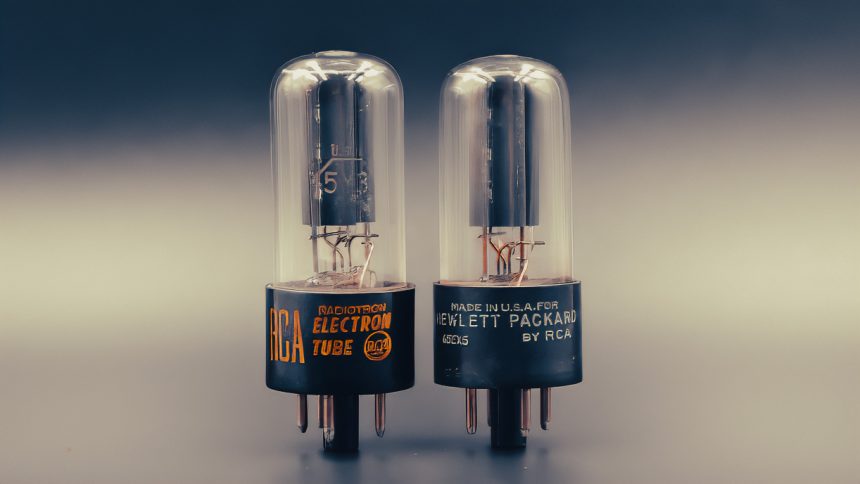
There's something deeply intriguing about the glow of a valve turning on in a dimly lit recording room. It's a veritable initiation rite.
As the filaments turn to that amber-orange color, the engineer and the artist share a silent breath: the sensation that the signal isn't just passing through components, but is being "baptized," purified, almost brought to life. But in this almost spiritual scenario, we must ask ourselves: are we really listening to electricity, or are we simply projecting our deepest desires onto a lit bulb? The answer lies in the subtle and often blurred line between auditory perception, circuit engineering, and psychology.
Why do we perceive tubes as “musical”?
The seduction of the valve is not an illusion at all audiophiles nostalgic, but it has deep roots in our psychoacoustics. The human auditory system is intrinsically not linear: when we listen to sounds at high volume, our ear generates a natural form of compression and introduces harmonic distortions.
The valve, unlike the transistor (which tends to cut the signal sharply and “surgically” once it reaches the limit), responds with a soft clipping which mimics this behavior surprisingly closely. When a triode saturates, it introduces even-order harmonics that our brain doesn't interpret as "distortion," but rather as "thickness," "body," or "presence." It's a form of harmonic correlation that the tube adds; it integrates information that "completes" the timbre, making it denser and, ultimately, more similar to what we perceive in nature in high-fidelity listening contexts. SPL.
This happens because the even harmonics are musically consonant with the fundamental signal: they tend to strengthen its tonal structure without introducing perceptual tension. On the contrary, the odd harmonics, more typical of hard clipping or less linear circuits, often sound more “sharp” and unnatural to the ear, as they create less stable relationships with the fundamental.
The Nostalgia Market: “Light” versus “Sound”
The pro-audio market has understood this almost irrational fetishism, but has often stripped it of any real substance. Today, we're literally surrounded by cheap pedals and interfaces that ostentatiously display a vacuum tube behind a protective grille, almost as if it were a jewel. And this is precisely where the great deception arises: the vacuum tube as a purely decorative element, a promise kept only visually.
In the vast majority of these cheap devices, we are faced with the Starved Plate Dedesign (starved plate circuit). A 12AX7 valve, designed to work in an optimal range between 200V and 300V to best express its characteristics of linearity and headroom, it is powered in a completely insufficient way at mere 9V o 48V.
Under these extreme operating conditions, the tube can no longer guarantee either the ample headroom or the expected linearity. It is not "playing" in the noble sense of the term; it is simply suffocating the signal in an asphyxiating, compressed saturation that often has flat acoustic connotations. Furthermore, in this scenario, the harmonics generated are not necessarily the "musical" ones associated with the classic valve saturation, but they can degenerate into a messy combination of harmonic distortion and intermodulation, often less predictable and less pleasant to listen to. It's a real stage trick: our eyes perceive the reassuring light, but our ears are listening to a component operating far outside its normal range of glory, devoid of any of its intrinsic qualities.
The Tube Swapping Myth: Why a NOS Won't Save a Poor Circuit
There is a common misconception, often fueled by superficial discussions on forums, that replacing the stock tube of a cheap device with a high-quality vintage unit OUR (New Old Stock) can radically transform the sound of your hardware. The technical reality is unfortunately much more pragmatic: if the design is lacking, the noble valve cannot work miracles.
Spending big bucks for a legendary Mullard ECC83, a Telefunken "smooth plate” or a RCA “black plate” to be inserted in an entry-level preamplifier is often an unnecessary operation. If the valve works in a context of starved plate, or at low tension, the subtle characteristics that make a vintage component magical remain literally frozen. We can think of this situation as fitting Formula 1 tires to a small car. You'll never feel the extra grip simply because the vehicle doesn't have the power to stress the compound and bring it up to operating temperature.
In a low-end circuit, the gross distortion caused by the lack of voltage acts like an opaque veil that blurs the distinction between a modern Russian tube and a rare collector's item. Without high-quality output transformers and a power supply capable of propelling electrons, the prized tube will simply do what the cheap one does: glow and choke, never truly breathing. Before replacing the glass, it's crucial to ensure the iron and current are up to the challenge.
The Project Makes the Difference: From Pultec to the “Fake” PRE
Because an old and timeless Pultec EQP-1A or a preamplifier Universal Audio 610 Do they sound “huge,” “warm,” and “musical”? It's not just the tube itself, isolated from its surroundings, but the overall circuit architecture that surrounds and supports it. In these iconic designs, the tube is critically supported by a suite of the highest-quality components.
Superior quality transformers: sometimes underestimated components, which add that magnetic density and "depth" to the sound, often mistakenly confused with mere "tube warmth." Their presence contributes significantly to impedance management and the desired harmonic coloration.
Oversized power supplies: These true "beating hearts" of the circuit are capable of delivering constant, high, and noise-free voltages, ensuring the valve has the ideal conditions to work and express its maximum dynamic potential. This is where the true "valve headroom" lies.
See you next time on the world of valves.
Antonio Campeglia





Dearest Antonio, you hit the nail on the head, that is, “one swallow does not make a summer.”
When multiple components come into play, it is the quality of the individual components that must be balanced, just as good design is fundamental, which also includes the basic choice – valves or no valves…
Kudos to Antonio for this masterful contribution. It's rare to read an analysis that so accurately separates vintage charm from electroacoustic reality.
The article rightly highlights how our perception of "natural sound" is actually a cognitive bias fueled by decades of saturated listening. It's crucial to reiterate that harmonic distortion is a signal alteration, however pleasant it may be to our auditory system.
A food for thought:
I wonder if tube saturation isn't becoming, in the era of plugins, a sort of "Instagram filter" for audio: an aesthetic shortcut that standardizes modern productions. Perhaps the true avant-garde today lies in knowing how to manage dynamics without the "trick" of the tube, seeking a purity that hi-fi marketing seems to have forgotten.
Very lucid article, dear Antonio.
I completely agree about the scourge of starved plates, which have deluded an entire generation of home studio producers. However, as someone who grew up with tube mixers and tape machines, I'd like to offer a provocative point for the second part: it's not just a question of anode voltage and transformers.
The real breaking point between a real tube (powered properly) and any cheap emulation or "hybrid" circuit is the dynamic response to transients. A 12AX7 operating at 300V doesn't just "warm up," it changes the way the microphone reacts to sound pressure. I often hear that digital has won, but when I put a high-end preamp on a vocal, I hear a three-dimensionality that isn't "distortion," it's life.
In the second part, I'd like you to address a thorny issue: does it still make sense to spend €25.000-€30.000 on an old Fairchild in 2026, when plugins claim to have achieved 99% fidelity? Or is that remaining 1% precisely what makes the difference between a "clean" mix and a moving record?
I'm waiting for the technical part on transformers, because that's where the real iron game is played.
Really lucid article, Antonio.
You've brought order to a narrative that in recent years has become almost dogmatic, especially in the home studio world. The part about starved plates is meticulous: finally, someone explains, without romanticism, what's really going on inside those circuits.
As a clinician, I was struck by the implicit parallel with the physiology of listening: that nonlinearity of the auditory system you mention is precisely the key point. We never listen "neutrally," and perhaps the true appeal of the tube lies precisely there—not so much in what it adds, but in how well it can interact with our perceptual distortions.
You've hit a nerve with the market: these days, I increasingly see instruments that sell aesthetics before their electrical behavior. The valve is seen as an icon, rather than an active component. And it's a distinction that few have the courage to make with such clarity.
However, I'll take Giuseppe's provocation a step further: in my opinion, the key isn't just how much the tube distorts or how it generates harmonics, but when it does so. Transient management, that micro-dynamics in the first milliseconds, is where the sensation of sonic "materiality" comes into play. It's something that's rarely explained well, but is immediately apparent when listening.
So the real question, perhaps, is not whether digital has reached 99%, but whether that famous 1% is actually the domain of time rather than of the spectrum.
Very curious about the second part, especially about transformers: because yes, in the end, "heat" is never just glass... it's iron, electricity, and design.
I completely understand the importance of that moment. The visual effect and the wait before the sound are truly crucial to the recorded experience.
Finally, a serious article that sheds light and dispels the false myths and commercial fetishism that too often surround the world of tube audio. For the vast majority of enthusiasts, the word "tube" has become an automatic synonym for "audio warmth." The reality, as well explained, is that the component itself doesn't work miracles: without an excellent circuit to support it in terms of voltages and coupling, it becomes nothing more than a pure marketing ploy to justify inflated prices (just think of LED-backlit tubes operating at ridiculously low voltages).
From an engineering perspective, if you're looking for that specific saturation and dynamic range without falling into commercial traps, it makes much more sense to leverage well-designed solid-state hardware, perhaps based on JFETs. As voltage-controlled devices, JFETs mimic the characteristic curves and operating point of the triode, offering true analog character and even harmonics without the economic speculation that currently surrounds the tube world.
Compliments!
Dearest Antonio, you couldn't have been clearer. 👍👍👍
I fully agree with the article.
There's too much ignorance and marketing surrounding the world of tubes, both in musical instruments and in Hi-Fi. We don't listen anymore, we only read reviews.
Stefano