

The first thing that comes to mind when thinking about the new Native Instruments format is that I am really grateful to them, because this way of selling the files will make it institutional to go mastering with at least 4 separate groups, which is a huge boost. qualitative for the optimization of material with high loudness content.
The second thing that comes to mind is a fairly complex consideration that I will talk about after describing how stem and its compiler works.
The Stem format is a file that contains a Track divided into 4 separate streams (stereo), each of them containing a "stem", that is a coordinated set of audio tracks, such as the "drum" or all the "samples" or the bass or the set of items. The file is compiled using a free software; at this link we can see a video tutorial by Native Instruments Native instruments (link to video is the tutorial to create them) which we will briefly summarize for non-English speakers.
The really important feature of this format is that its encoding is not covered by copyright and everyone can do it by themselves using this "MCP pipeline". Stem can be 'lossy' encoded as mp4 a 256 kbps with AAC coding, VBR (variable bit rate) with the extension .stem.mp4 and therefore managed like a normal mp3, but also in "lossless" format with ALAC encoding (apple lobsless aaudio codec) which does not make it only the prerogative of Apple being the ALAC supported by Windows 10.
Stem actually contains 5 stereo streams;
il first, which is categorically always assigned to the first "slot" of the compiler (which we can see in figure number one) is the mixed version of the stem, the true stereo mastering, and is in that specific "slot" to allow software such as itunes or others, who do not read the multitrack, to play the file. The other 4 "slots" can contain any material chosen by the manufacturer. In the example of a classic piece of house music, the first slot will contain the full version, the second the "drum“, The third the bass, the fourth all the synths and the fifth“ slot ”the whole group of voices. In any case, the tracks contained in Stem will remain irreversibly in synchronization. The Stems can be assigned colors and names which will then be reported in the final multitrack version sold in the "stores", together with the whole "tag" section, that is the name of the track, the artist, the icon image, the year and so on.
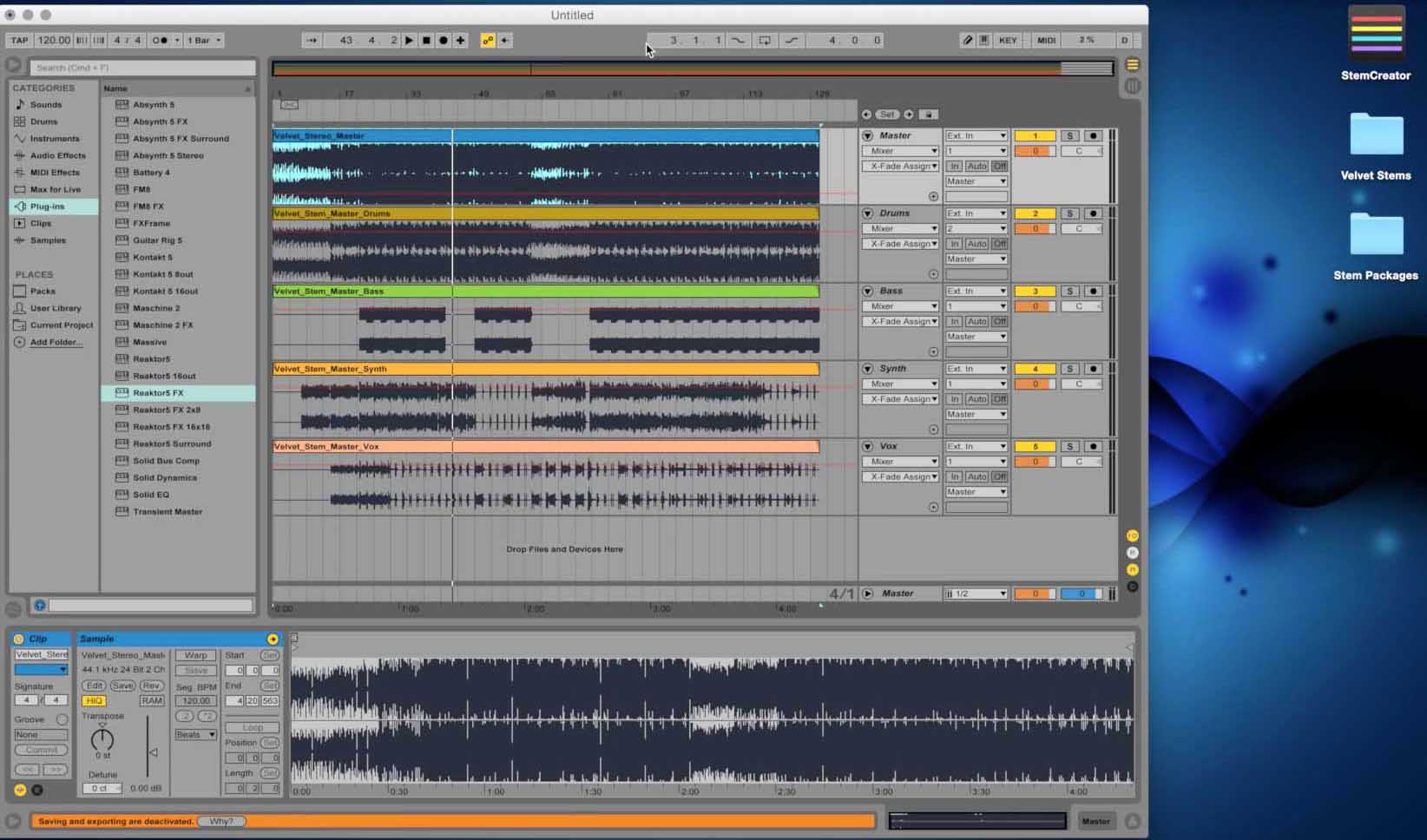
In the lower section of the compiler we find perhaps the most important "settings", which are those relating to the compression and limiting of the multitrack (which obviously are not reapplied to stereo mastering as well). These settings, related to compression and limiting, are NOT rendered on the multitrack, but their parameters (whose effect we can always hear through the compiler) are saved together with the "tags" to be reapplied by the compressor/limiter of tracktor or equivalent software capable of reading the multitrack.
It's time to talk about the famous second thought that came to my mind at the beginning of the article. Anyone who is familiar with the management of post mastering stems will have realized that there is something wrong and this something becomes clear when in the video "linked" above, the Native Instruments technician states the ideal procedure to compile the stems.
Lo stem post mastering is used for several reasons ranging from simple back up, to the need of certain artists to have the instrumentals of the pieces, necessary in the "performances" or single parts for the use and consumption of "remixers". When you manage these files you begin to realize that the weight of the mastering (understood as the sum of all its "gain reductions"), Drastically transforms the content of the stems when they are not processed simultaneously. To give a very simple example, when I process a mastering consisting of 5 stems, the "gain reduction" of the compressors and limiters works adequately, only with the presence of bass medium e high content in the totality of the mix; turning off the "drum", the bass and the synths, the voice for example will undergo a process totally different from the one it had in the original increases the volume uncontrollably, completely flattening that minimum of dynamics that we had left, but also altering the balance with the rest of the tracks and introducing much more harmonic distortion.
In the example given by Native Instruments technician, it turns out that the sum of his stems well exceeds zero, which gives us the certainty that his stems have been exported leaving the mastering that was used for the complete track unaltered.
Now, to put it in the mother tongue "each bit between chell 'che o pass p'a capa" (everyone can do what their head suggests) especially in this area where science does not dictate the canons of work but the microcosms made up of the various habits linked to the sound of one genre of music or another. But the obvious problem that manifests itself in the procedure suggested by Native Instruments is that not only the stem tracks will be more compressed and saturated, but their "volume" balance will certainly be compromised, and we will apply one more stage of limiting/compression, not foreseen in the original master. (Native Instruments specifies on its website, in the stems tab, that no type of mastering process has yet been standardized.This article is not intended to be any kind of note to their work.)
The presentation video also shows one important thing, namely that the compiler does not have the volume fader related to each single stem, and in fact the technician starts by processing the tracks in ableton live, lowering the sum until it reaches zero dbfs, but the balance of the traces is already compromised at this stage.
In my opinion it would be much simpler, in export phase, after printing the stereo master, leave all processors on, except the central compressor andlast limiter (if you use more than one limiter downstream from the master, for example 3 limiters that break down 2 db each, it is better to turn them all off). To avoid further "processing" and leveling, in extreme cases, during the export of the stems, it would be useful to insert a "brick wall" to 0.1dbfs that protects us from any peaks given by the absence of a limiter (we just turned it off). This procedure will ensure that all the stems, once exported, will give something very, very similar to the sum of what the stereo master. There will no longer be a need to worry that the sum gives a much higher value than zero dbfs or that the stems have lost any volume relationship between them. Once these files have been exported, they can be inserted directly into the compiler on which compressor / limiter "settings" similar to those of the original master and each single element will be made, playing in real time under the compressor + limiter di Tractor, it will behave adequately responding perfectly whether you play with the original tracks, or play along with other elements from a different “track”.

At this point of the speech it is better to specify a fact (fact intended as irrefutable truth) the sum of the stems cannot be equal to the original master, and this is because the tools to impose the final compression and limiting will always be compressor and limiter of tracktor.
Probably we do not even expect that the master and the sum of the stems are exactly identical because if you use this tool you do it to take parts of them and reuse them in other contexts; and in any case we are talking about a use in performance of “tracks” which become in effect performance “tools”.
With these considerations of mine, I leave you, expressing my gratitude to Native Instruments for continuing to push the boundaries of creative djing. Such a step allows to explore new points of view and creates new needs also in the audio processing market.
John Rome