

In a previous article I introduced the Overloud GEM SERIES, introducing Tapedesk. Today I will continue to talk about this series by introducing you DOPAMINE, a plugin that emulates a system related to tape recorders.
DOPAMINE emulates some famous ones noise reduction systems inspired by two models in particular: the 361 (Dolby) and the 180 (dbx).
"The origins of the myth"
These were designed to counteract the background noise of tape recorders, a significant problem.
The principle of operation is this: the system lightens or otherwise boosts the audio signal dynamically before entering the tape recorder, in such a way as to optimize the signal / noise ratio, thus staying as far as possible from the background noise of this device. This first phase is called coding phase.
There is then a second phase at the exit, namely the decoding stage, after which you return to the original situation.
So the original track is not altered and does not risk being "eaten" by the background noise at the end of the whole process.
How it is used in practice
Has anyone thought of using this system as a kind of enhancer, using only the encoding, which by the way is the one that is emulated by the plugin in question.
I then move on to the analysis of the individual models.
Model 361

Dopamine: the 361 model
The main interface is very simple to understand and consists of a few controls: DRY, WET and LEVEL, on which I will not dwell too much, given their simplicity.
The most important check is COMP: it controls the dynamics of the whole process and can be seen, if you like, as a compressor or anyway a dynamics processor, enclosed in a single knob, which can give the track a snap character, as it lets a good attack pass. So try to preserve the transients as much as possible. Much depends, however, on the source to which we are applying this processor, therefore on its spectral content and its envelope, since you cannot adjust the attack to your liking.
The device works with modules (cards) that we can virtually insert into the slot at the bottom right.
The 361 offers two interchangeable modules: A-TYPE e NOISE STRESSOR.
Each module has a different characteristic, which actually changes the behavior of the entire device.
361: the frequency response (A-TYPE module)
I use classic white noise to analyze the frequency response to see what happens when the COMP control changes. The white noise is at -14 dBFS, the wet signal will be 100%, so I will only focus on the process of this device. In practice, of course, everyone will mix dry and wet as they want.
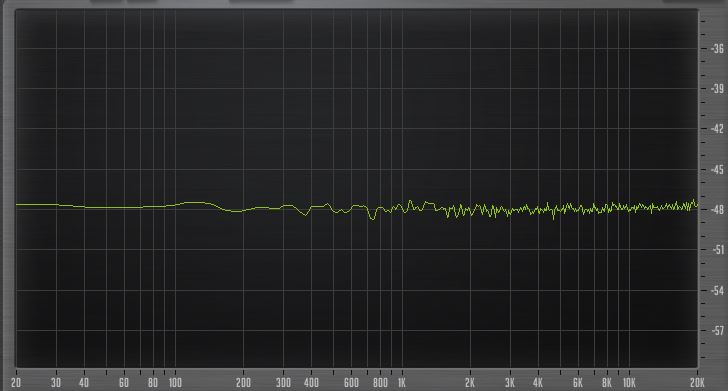
White noise
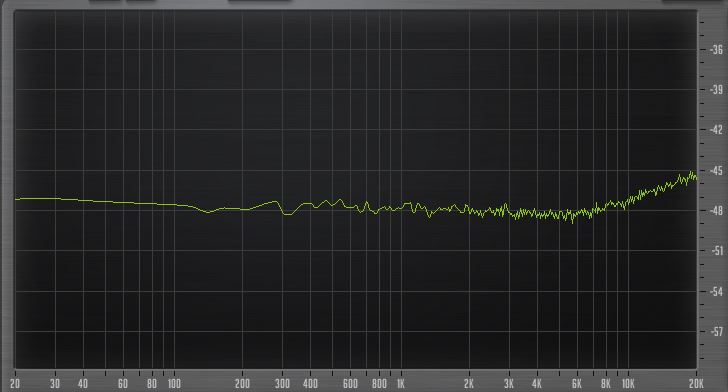
Frequency response of 361: COMP 0% - module A
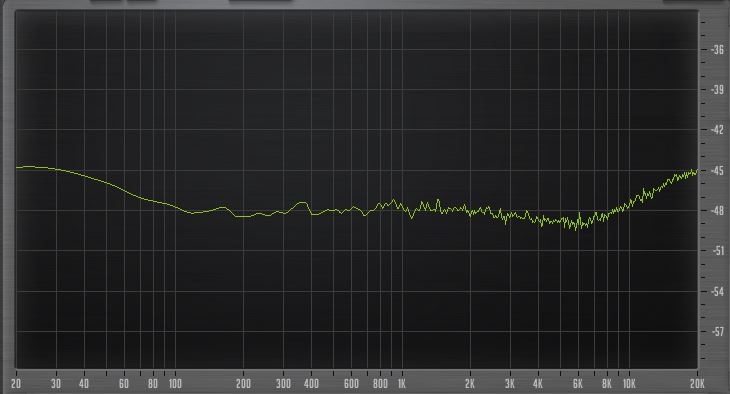
Frequency response of 361: COMP 50% - module A

Frequency response of 361: COMP 100% - module A
As COMP increases, the system changes its frequency response: working with the module A-TYPE I can boost the low range, but above all the high range, in addition to the fact that the dynamics undergoes that increasingly marked process (as this control increases) which I spoke a little while ago.
As you can see, as I increase COMP I go to boost the two extremes of the band in an increasingly decisive way, using two shelving (low and high) that look a bit like the resonant ones.
This system has a frequency response which therefore tends to pull back the midrange, especially when you overdo it with COMP.
So imagine how the signal is colored when it enters such a device. This can obviously be mixed with the unprocessed signal.
361: the frequency response (NOISE STRESSOR module)
Also for this module the principle is the same: as COMP increases the equalization process becomes more and more marked (same for dynamics). For simplicity I am attaching only the graph of the frequency response with the control at 50%; in short, a middle ground.
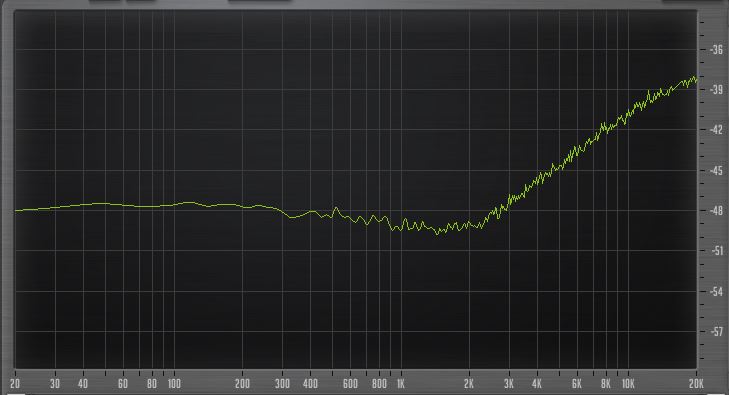
Frequency response of 361: COMP 50% - NOISE STRESSOR module
In this case we are dealing with a pseudo resonant hi shelving, which also involves a little bit of the mid-high range, and is clearly different from the previous one.
The frequency response in this case is unbalanced in the highs. Medium and low are obviously further back.
Such an answer is not too surprising, as already from the name “noise stressor” one could imagine a behavior of this type by the device.
In fact, the frequency range that is boosted represents from a psychoacoustic point of view a good part of the energy that constitutes the background noise.
361: THD (total harmonic distortion)
Let's see if this device confers harmonics on the signal and to what extent.
I use the classic 1000hz sinusoid at -14 dBFS as a test signal. For simplicity I will only consider COMP at 50%. Let's see the results obtained.

Sine wave at 1000hz
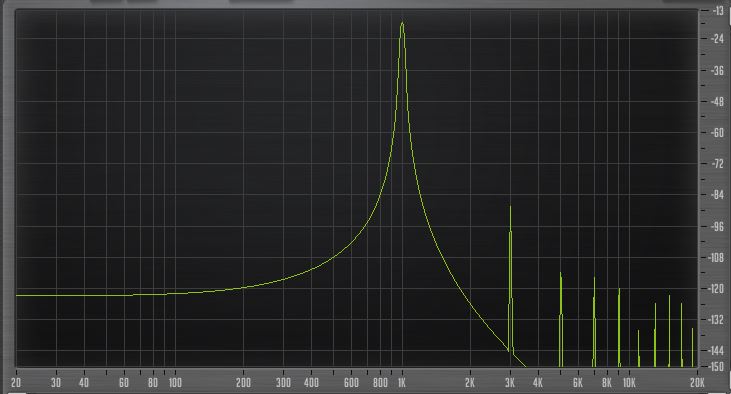
THD 361: 50% comp - module A
We are dealing with a non-linear system, as seen in the previous article.
There is an absolute prevalence of odd harmonics which give the signal a certain “warmth”.
These can be further increased by obviously increasing COMP. Certainly we cannot speak of a device capable of saturating the signal very clearly.
As far as the noise stressor module is concerned, the situation is the same, except that, with the same value (50%), the harmonics are in smaller quantities: therefore COMP must be increased to have a result similar to that shown in the image above.
Model 180

Dopamine: the 180 model
This device is even easier to use than the previous one. As you can see, there is no control that controls dynamics, and at the far right there is simply a meter showing the amount of process I am applying.
So just mix DRY and WET to your liking and then adjust the general LEVEL level. It should also be noted that the lack of dynamics control does not imply a lack, in this device, of compression or otherwise of something that handles transients in a certain way. In fact, even in this case there is that snap character I was talking about before.
180: the frequency response
In the same way and under the same conditions as before, I analyze the frequency response.

Frequency response of 180: 100% wet
Also in this case the frequency response has a profile that, in a certain sense, resembles that of the background noise from the psychoacoustic point of view.
Compared to the previous situation (361 with noise stressor module) this time I have a very large pseudo-bell, centered around 6khz. The lows are set back from all other frequencies.
180: THD (total harmonic distortion)
In the same way and under the same conditions as before, let's see if this device confers harmonics on the signal and to what extent.

THD 180: 100% wet
Here, too, there is an absolute prevalence of odd harmonics and the intensity of these (harmonic by harmonic) is similar to that of model 361. However, let us remember that, not having in this case a control similar to COMP, I cannot change the amount of harmonics to my liking; maybe i can try to lower / raise the level before entering the device.
So, all in all, from the point of view of harmonics, the two models behave in a similar way, obviously not exactly the same, considering also that they work in different frequency ranges.
Latency and CPU consumption
This plugin has very low CPU consumption and 0 latency. There is not much to discuss in this regard.
Nice functionality
This plugin also offers the possibility of inserting labels that can be renamed to your liking: just go to the menu at the top right and click on “add scribble”.
Conclusions
Wanting to use a less "audiophile" term, I can say that the 180 model has an "eye" for medium-high and medium frequencies, while penalizing the low. We will be able to listen to the 100% wet audio signal to realize the bandwidth limitation of this device.
The 361 with the form noise stressors instead it emphasizes the high frequencies, penalizing medium and low frequencies, therefore a limited band also in this case.
The 361 with the form type A it has a much wider bandwidth than the previous ones, it emphasizes the very high range and, if we want, even a little low range. However, the device is not intended to be used primarily as a bass enhancer. Much depends on the spectral content of the trace under consideration.
These models handle transients in a certain way, so we can see them as dynamics processors as well.
Both generate mostly odd harmonics and, I would add, in a non-artificial way, which a classic exciter does not do, for example. There is a certain naturalness in this type of intervention, but this does not imply a lack of character on the part of the devices.
They can then be labeled as enhancer who work largely in the medium - high / very high range spectrum (depends on which model I use).

This plugin costs 129 euros (watch out for any discounts) and, based on what we have seen so far, I list its main features:
- Low CPU consumption
- Ease of use and quick setting
- Good versatility, for the type of plugin in question (I have 3 in 1)
- All sounds are convincing and can be useful, especially in those situations where there is a need to intervene in the medium / high part of the spectrum.
It is a Plugin that we cannot simply define equalizer. The company prefers to call it dynamic equalizer, which is certainly correct, as it equalizes and at the same time manages the dynamics as well as the transients.
There are those who define it enhancer/excite, considering the fact that it generates harmonics (in a non-artificial way) that enrich a specific range of frequencies. Beyond the labels, the product is definitely recommended.
Also keep in mind that there are few competitors offering plugins inspired by these noise reduction systems, two of these, among other things, are Italian. I must admit, however, that I have not had the opportunity to test these products, so I cannot express any kind of judgment about it.
So I leave you to the part relating to the audio test, with all the relevant considerations.
That's all for today, see you next time.
Joseph Marrazzo
The audio test
I thank the studio "God Father Studio"And Mr. Massimiliano Pone for providing me with the audio material, to test this plugin. I will try to equalize and at the same time give some vitality, as well as character, to the track under consideration.
As we have seen, DOPAMINE has the potential to do these things. Obviously it will be necessary to experiment to find a setting that is 100% compatible with the track considered.
It will not be difficult, as the plugin is very fast to set up and is not distracting, from the point of view of the sounds that can be obtained.
In general (I will always repeat) there is no exact science when it comes to audio processing, whether it is done via hardware or software.
However, there are "good manners" that are acquired with practice, at the end of which you will find yourself doing things in a recurring and natural way.
So I'll try to clear the voice, emphasize the mid-high range of the bass, and finally always work on the bass, using this plugin as a bass - high enhancer and compressor. After all, let's not forget that this also acts as a dynamics processor; I will therefore exploit all its features.
The tracks have not been processed that much (excluding dopamine) so as not to distract attention from the plugin I am testing. Furthermore, the tracks were evaluated individually and not in the context of the mix.
Ps: the background noise present in the tracks of the electric bass it is not generated by the plugin in question. For some it may be an obvious thing: by clearing a track that does not have many high frequencies at the base, at the end of the whole process, one can arrive at a concrete increase in the background noise, which will give its psychoacoustic contribution. Much also depends on the signal / noise ratio (upstream), before entering the processor. In any case, everything must always be experimented and monitored, especially when making interventions of this type.
-361 A-type (electric bass): bass & high enhancer (comp 100%)
-361 noise stressor (voice): air vocal enhancer (comp 100%)
-180 (electric bass): high mid frequency enhancer
Links