

The transmission and management of data, parameters and more generally of information within a system or between multiple interactive systems, represent the first problems that electroacoustic musicians and composers have to face. The problem was so relevant that it affected the nature and genesis of the work itself; as always happens, important technical questions radically intervene in the compositional processes.
In this series of articles, we will try to trace a path that describes the most important steps in the history of data transmission means and protocols. It will start from Voltage Control then move on to the birth of MIDI protocol, we will mention other protocols that have tried to counter its hegemony (endorsed by the musical instrument industry) such as SKIN, the ZIPIA, FUDI (specific for Pure Data).
Finally, we will deepen and dwell at length on the latest born among the data transmission protocols: theCSO Open Sound Control. A lot of attention will be paid to the OSC since it is not a simple antagonist of MIDI, but a real revolution in the field of interaction between systems comparable in importance to that which occurred when we passed from Voltage Control (analog domain) to MIDI (digital domain).
We will omit the description of the various types of interactive systems, even if during the writing we will resort to the representation of some of them, but there are some fundamental aspects to highlight that all systems have in common:
• The need for a shared means and / or language of communication
• A processing chain consisting of three stages:
o Input
o Production
o output
• The temporal synchronization of communication processes
These points must be kept in mind during the description and in-depth study of the various communication tools analyzed.
Part one
Voltage Control
In the fifties, as you can imagine, the technological equipment of the studios was quite limited and the working methods were consequently influenced by it. The equipment that could be found were mainly waveform generators, white noise generators, filters, ring modulators and above all magnetic tape recorders.
We report a working methodology described by Gottfried Michael Koenig:
"When I entered the studio in Cologne there was only one sine wave generator, and this was not located in the studio either but in the maintenance department. The connection had to be made each time through the main switching room of the radio station, so that two assistants through a telephone connection could record individual notes to be synchronized later."
In practice, the processing of the sounds took place mainly through the manipulation of the tape and an intensive use of the recorder.
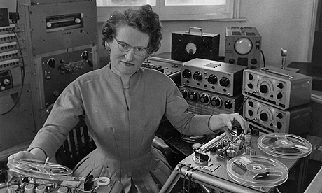
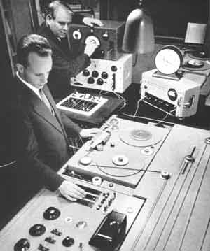
This was the main way to get exchanges pitch, envelopes, polyphony etc. With the advent of the transistor the technology of the Voltage Control which allowed to operate in a faster and more automated way. A control of electrical voltage applied to an oscillator (VCO Volder Cunrolled Oscillator) made it possible to change its pitch more effectively. The same thing applied to a device capable of controlling the amplitude (VCA Volder Cunrolled Amplifier) allowed to create envelopes. With i VCF one was able to control over time the trend of the parameters of a filter. With voltage control it was therefore possible to create control signals capable of driving other equipment. Furthermore, these control signals could be stored on the tape, could be reused several times to create sequences of sound events and be modified over time like audio signals. This point is fundamental since the automation of events will direct the interest of many researchers towards a process that will lead to computer music. Computers at that time were already technologically capable of performing sound synthesis but it was still a very onerous task to perform in computational terms, so the researchers initially headed towards the possibility of using computers to explore the automation of compositional and formal processes. Let's explore these concepts through Koenig's words:
“… Recent developments in devices, especially the variable function generator, have not only extended the possibilities of the composer. In the same way, the new machines are not only supplementary generators to produce sounds or envelopes: they allow the composer to carry out a relationship between various characteristics of the sound with others or even to derive others from them. This pattern, in the form of a programmed voltage curve, can be used with voltage controlled devices ...
Practical applications can be placed in three categories.
1 Recordings of manual actions.
It may happen that the composer wants to have a long sequence of sounds with a common envelope. Even if the sequence is based on a schematic form (eg crescendo / decrescendo), the composer will most likely want to interact with the envelope through a manual action to obtain an optimal shape. It is impossible to write this interpretation on a score or reproduce its envelope if the recording is lost. The voltage controlled amplitude modulator makes it possible to record the control in voltage so that the envelope can be reproduced at a later time. This methodology can be applied to all parameters of any equipment that is equipped with voltage control.
2 Various parameters with common curves.
The previous paragraph shows the importance of being able to register the Control Voltage. If it can be programmed, further possibilities arise. The composer can, for example, set certain curves and use them to control all parameters for which there are voltage controlled equipment. It can also modify the programmed curve in detail. This method could be called "indirect" because the composer no longer produces the sound directly by checking it by ear during production; he only produces the voltage curves whose effect on the sound characteristics has yet to be heard ...
3 Transformation of voltage controls.
A live control that has been recorded on tape can be treated in the same way as an audio signal. Theoretically this creates the ability to compose and record an entire piece of electronic music in the form of programmed and transformed control voltages. As soon as the recorded control voltages are synchronously reproduced and linked via the corresponding number of demodulators with the voltage controlled studio equipment, the piece becomes audible. This method is obviously even more "indirect" than the others, but it could attract composers interested in programming musical structures and who do not have computers available for the production of sounds.
However, voltage control as described above is only a link between traditional sound production in an electronic music studio and sound programming with a computer as the sound source. In Utrecht, initial efforts in this direction led to a number of advances. The computer does not perform the typical tasks of a traditional studio (with or without Voltage Control) such as producing sound spectra. There electronic music she was the first to give the term "sound" a new meaning - derived from instrumental music - without having been able to do justice to the implications that this entailed. The "sound" is no longer a distinctive term of polyphonic instrumental music, but simply indicates what it plays. However, the traditional studio has developed some technical means capable of adapting what it plays to musical arrangements schemes; in the electronic studio the composer also collides with “instrumental” boundaries. The task is, therefore, to compose the "sound", rather than with sounds. There is still little experience in this field, which is why "composing sound" with a computer is still a land of conquest. Before the composer can conceive and program these sounds, he must learn how programmable his own knowledge, experience and desire are. The programming of musical structures runs the risk of being overtaken by the programming of sounds. To this end, many programs for composition have been written in the Utrecht University studio, with which the composer can test models of compositional structures. Although such patterns occur in the macrostructure (which is the smallest musical unit in the range of rhythmic perception), they can then be transferred to the microstructure (the structure of the wave curve). This sound production method is just as "indirect" as those described in the voltage control section; this indirect approach is inherent in programming ... "
This is what happened at the Utrecht University Sonology Studio (funded by Philips) under the guidance of Koenig around the mid-sixties, in which we find the Variable Function Generator 50 steps (1964) made specifically by Stan Templars.
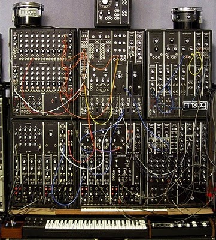
I wanted to bring back Koenig's important point of view in depth since his vision of the implications of Voltage Control, while fundamental from a compositional and research point of view, has historically taken a back seat. The innovation of Voltage Control, in fact, is known to most people above all for its use in electronic lutherie as regards the development of synthesizers. These in particular brought a new aid for studies but not only; with synthesizers it was possible to make the potential of a phonology studio available to other areas (such as radio, cinema and the recording market). The technology of the transistor, replacing that of the thermionic valve, made it possible to reduce the size of the equipment to the advantage of portability, improved their reliability and maintenance and reduced their costs. Robert Moog, Father Buchla, Alan Pearlman (ARP) and Peter Zinovieff (EMS) were among the main synthesizer developers in those years, being the first to understand the potential (including economic profit) of this instrument. Among these we must mention above all R. Moog who presented a document to the AES Conference in October 1964 in which he expounded the innovations of Voltage Control and above all standardized its operational values. On the same occasion, he also presented his modular synthesizer prototype. Examples of large modular units built in the late 60's and early 70's are the Moog 3P, Moog Modular 55, the EMS Synthi 100, the ARP 2500 and Buchla 200.
In fairness, the Italian-Polish engineer must also be mentioned Paul Ketoff, who in 1958, then before Moog, designed and built the Phonosynth at the request of the composer Gino Marinuzzi Jr for the creation of soundtracks for the Italian film industry, which was very prosperous at that time.
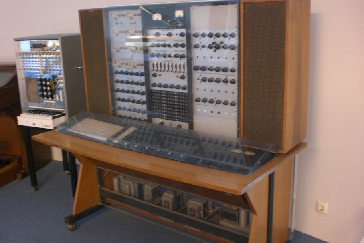
In fact, Moog at first invited Ketoff to move to America to establish a partnership, which was not Ketoff's will. After the Fonosynth, Paolo Ketoff created the SynKet for the nascent electronic music laboratory at the American Academy in Rome, a laboratory created in collaboration with Otto Luening.
The trend later became to miniaturize synthesizers so as to have machines with fewer operational possibilities but cheaper and more portable: Minimoog, ARP Odyssey, ARP2600, EMS-VCS3, etc. In this way the equipment dwindled and electronic music was preparing to leave the walls of the research studios; this technology allowed the birth of small private studios that no longer required huge investments by public or private institutions.
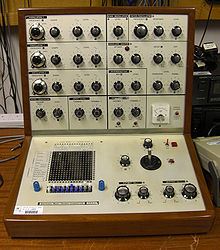
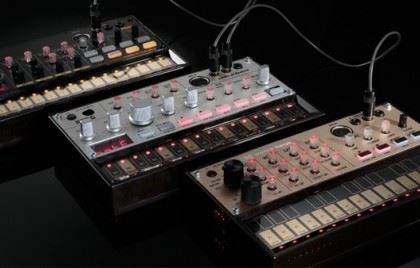
Returning to the technical aspects, the synthesizers were structured in a modular way: there was the oscillator section, the envelope amplifier section, the filtering section, etc. These sections were connected to each other for the most part by external wiring, in other cases by internal connections that could be activated by means of switches and switches. Control voltages were transmitted through these connections. In the case of the more compact synthesizers, expanding the concept of modularity, the voltage control signals were brought out of a single machine and then re-entered into other synthesizers so as to be able to drive two different devices with the same signal. Playing two synthesizers together resulted in more complex tones and envelopes. It must be remembered that most of the synthesizers were monophonic and the appearance of the first polyphonics made the situation more complex and managing two devices with the Voltage Control became a complicated thing. The synthesizer market consequently gave up on developing this possibility until the advent of MIDI.
With the advent of synthesizers a new market sector is born, consequently we will find ourselves talking about the musical instrument industry and its strategies to influence the research and development of new technologies. From an almost artisanal situation where technological progress, a direct consequence of artistic needs, was developed within the phonology studies (a place where the technician and the researcher, the engineer and the composer collaborated closely), we have passed to a context in which it is industry that determines the fields of technological development by influencing and limiting artistic research.
At the next episode that will deal with the MIDI (Musical Intool Digital Iinterface)