

The Vocoder was the first vocal synthesizer, even developed between 1928 and 1930 in the famous Bell Laboratories by Homer Dudley.
Since then the interest for this instrument has never waned even if the musical fashions have decreed a greater success in certain periods. Often confused by the less experienced with other voice manipulation techniques such as "autotune" or "Talkbox" over the years it has had several evolutions.
We analyze here a very interesting software version proposed by Reason.
BV-X Multimode Vocoder combines a powerful vocoder and a synthesizer with effects.
BV-X it comes with an easy graphical interface, designed to experiment and find the right sound for the music we are recording.
BV-X is included in Reason + and is compatible with Reason 10.1 and later.
Description
A peculiarity of the vocoder is to be able to choose between the classic multi-band hardware processing and the modern one based on FFT (Fast Fourier Transform). By hardware processing I refer to the type of sound the result of which you can hear in many recordings of the past ranging from Kraftwerk to Daft Punk. Operationally, it is obtained by choosing the number of filter bands to apply to the sound, the fewer bands are selected the more synthetic and elaborate the sound is.
In this plugin there is the mode Vintage which adds an extra low pass band for each grouping, resulting in a fuller sound than can be obtained with hardware vocoders.
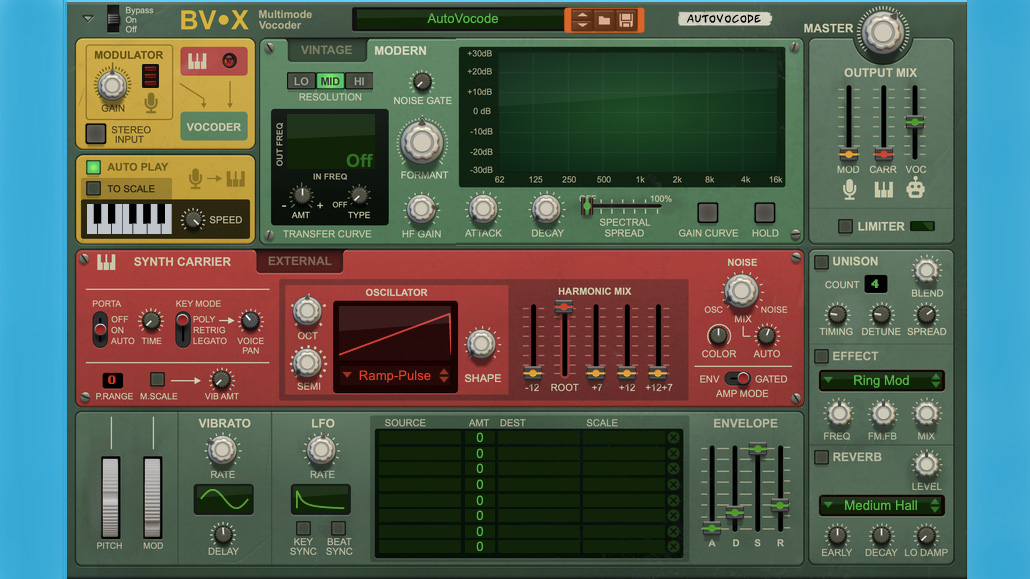
If you are not interested in emulating vintage hardware multi-band vocoders, there is a way to process the sound that makes use of modern techniques of DSP, with which a greater versatility of use is obtained. It is possible to work by acting on the formant by moving it up or down, but the most powerful tool is the “transfer curve”, that is, it is possible to choose a non-linear curve for the shifting of frequencies. The vocoder can be very useful when you want to support the lead vocal with chords.
In this regard, we find the cursor of the "Spectral Spread" which will widen the vocoder bands to the outer edges of the stereo field leaving space in the middle for the lead vocal. The button "Gain Curve" instead it allows us to draw the tone curve, where we can emphasize certain frequencies.
Integrated Synthesizer
In the plugin we have a built-in synthesizer that provides a wide palette of synths along with some special features designed to increase the intelligibility of sounds. The built-in synthesizer is not just a practical fact, because with vocoders, the hardest thing to get good sounds is knowing what kind of “carrier” signal to connect.
While it is always possible to connect an external synthesizer to the back, the built-in synth is more than enough to get great results using several oscillator waveforms to choose from.
The fewer bands you select, the more synthetic and elaborate the sound is, but unlike hardware vocoders and many other plugins that usually group the vocoder bands into 4/8/12/16, The mode Vintage adds an additional low pass band for each grouping. This extra low pass band brings a fullness of sound where hardware vocoders have historically been lacking. If you are not interested in emulating vintage hardware multi-band vocoders, the Modern eliminates the vintage limitation in band counting and uses the DSP to transform much more detail from the incoming audio to the outgoing synth sound. We find the possibility of shifting frequencies with a tool called "Transfer curve" where the frequencies of the incoming signals can be shifted differently across their range. Vocoder modeling tools can be extremely useful when a lead vocal is supported below with the help of chords.
The spectral spread will widen the vocoder bands to the outer edges of our stereo field leaving space in the middle for the lead vocal.
One of the most useful parts of the built-in synth is its noise section which works in tandem with the vocoder's audio analysis.
The noise oscillator of BV-X, when set to , it can inject additional noise when it detects unpitched consonants, that is, all those sounds that make speech understandable and that are often overlooked in a traditional vocoder. In this way these consonants will make the lines generated by the vocoder more intelligible.
It's worth pointing out that vocoders aren't just used to make synthesizers speak with human voice input.
By connecting BV-X to a drum machine we can get pulsating synths and rhythmic textures.
Conclusions
To top it all off BV-X offers an effects section equipped not only with reverb and limiter, but also with more creative effects such as unison, lo-fi ring modulation or the buffering effect to granularize and glitch sounds. There are more than 150 patch ready and for total control there Matrix Mod which allows the creation of extremely dynamic vocoders, for example controlling the amount of an effect on consonants.
With these characteristics the BV-X presents itself as a vocoder for all uses and tastes.