


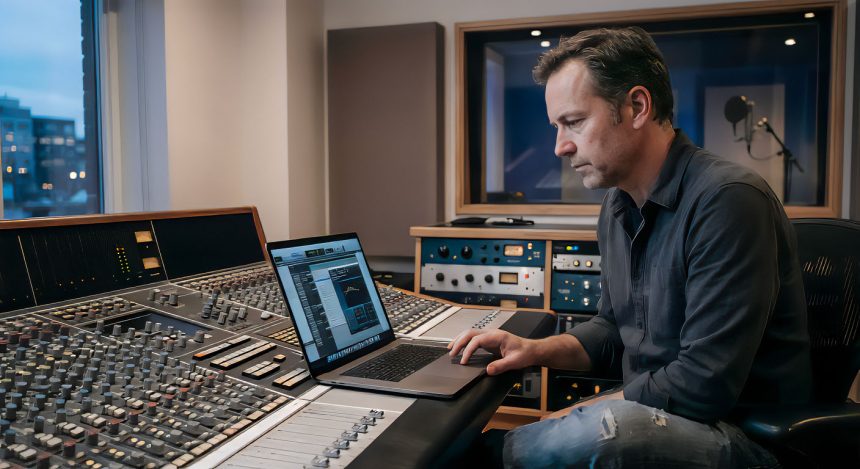
I spend my days interacting with engineers and musicians who work with analog outboards, plugins, and live sessions, navigating the frenzy of trap, the obsession of pop, and the rigor of classical music. In this creative chaos, there's one constant: we're terrified of making mistakes.
The "Total Recall"It was supposed to be a safety net. Today it's become a gilded cage: we can go back on everything, and that's precisely why we no longer close anything. As sound engineers and musicians, it's worth asking ourselves if this total freedom isn't leading our instincts into a dead end.
The eternal open session and listening blindness
There's a precise moment when a song stops being an emotion and becomes a file. Once upon a time, that file had a physical beginning and end: you left the studio, the tapes were put away, the deck was reset. Not today. The session remains open, always. It can be changed tomorrow, in a month, in ten years. The price? An enormous cognitive load.
By listening to a song over and over again, we stop truly listening to it. We no longer hear the song: we start chasing details, decibels, micro-variations. That total familiarity blinds us. It happens often, especially in a home studio: you spend hours searching for "the perfect snare," you try five samples, then five more, then you go back to the first one. Meanwhile, the song stalls. The initial energy dissipates. And when you finally start again, you add layers to fill a void that wasn't there before.
The result? A full, yet breathless track. Infinite reversibility has changed the relationship between artist and engineer. The client knows that "you can always reopen the session." And from there, everything changes: the mix becomes an endless buffet of variations.
“Let’s try another snare drum.”
“What if we raise our voices by half a dB?”
“What if we redo the drop?”
Each request, taken individually, is legitimate. But when added together, they destroy the focus. It's not just a question of timing: it's a question of intention. Every continuous change shifts the focus of the piece, making it unstable. Direction is lost.
Educating a customer today means having the almost therapeutic courage to say:
“This version works.”
We are not executors of orders. We should go back to being arbiters of decisions. Professional necessity vs. creative laziness. Recall It's a necessity. No one questions it. The problem is when it becomes an excuse. Take compression. In hardware, choosing means exposing yourself: if you compress too much, that sound is sealed. It becomes part of the song's DNA. It's a decision. In digital, however, we procrastinate. We open three different plugins, save presets, leave everything "open" for later. Not because it's better, but because we don't want to decide.
We've convinced ourselves that having all doors open is an advantage. In reality, it's often the opposite: it's precisely that closed door, that irreversible choice, that gives an album its character.
The art of closing: deciding is a discipline. Getting out of this dynamic requires a change of mentality. We must relearn how to "freeze" tracks, not only to save CPU, but also to protect our clarityCapturing a sound in audio is an act of trusting your instincts. Imposing limits isn't a sacrifice. It's a strategy. Creativity isn't born from abundance, but from selection. From choices made and no longer modifiable.
The courage of the irreversible
Music is a snapshot of time. A moment that happens only once. If we make it infinitely changeable, we take away its weight. We take away its truth. The true act of rebellion today isn't buying the latest software.
It's having the courage to press "Stop" and say: it's over. Leave the studio. End the session. Let the song exist, with all its imperfections. Because the best mix isn't the perfect one.
That's what had the courage to be concluded.
My Strategy: 3 Steps to Reclaim Your Instinct
Applying all this in everyday life isn't easy. But we can create small rituals.
The Emotional Freeze
When a sound resonates with you, capture it in audio. It's no longer a variable: it's a solid foundation to build on.
The Limit Contract
With yourself and the client: once the structure is defined, there's no going back. After dozens of listening sessions, your judgment will change. Trust your first intuition.
The Survival Kit Diet
Work with a few, select tools. Fewer options mean stronger decisions. It's a lesson hardware taught us, and one we've forgotten.
And you, how do you manage this total freedom in your workflow?
Are you still able to print and move on, or are you trapped in the endless search for the perfect dB?




Shareable, excellent article
I think this is a common and absolutely understandable reflection... I'd add that in my case, the good fortune was switching from ITB mixing to hybrid analog, which forced me to make choices without a parachute.
The theme of the article, in my opinion, is partially shared. If we're working on our own project, it can be useful to have a non-callable setup to force us to close projects and discard them when they take up too much time.
But in a situation where you have clients and maybe you don't finish the work right away—for example, you work on one project in the morning and another in the afternoon—having a recall is a godsend.
I personally chose brands like WesAudio, Cranborne Audio and Bettermaker precisely because I wanted to be able to digitally recall analog machines.
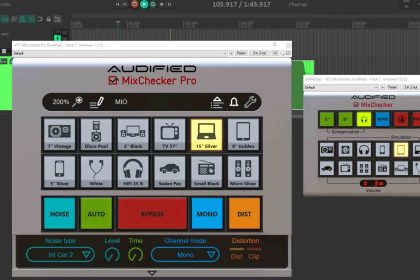
To achieve optimal values, in addition to hearing, I rely on various analyzers for reference on LUFS, dynamics, stereo, and balance. Software like iZotope RX is very helpful for visualizing parameters and editing audio.
I conclude by saying that, in any case, there are deadlines: the limit is not the setup, but time, for me.
Greetings to all,
great article!
It's a provocative idea, and I'd like to raise the emotional stakes with a couple of historical anecdotes about production times, a prehistoric glimpse into total recall, and, finally, a couple of reflections...
So, a little history:
Eurythmics' 1983 album 'Touch', which has sold nearly 2 million copies worldwide, was written and recorded in just three weeks.
To wrap up production on Peter Gabriel's 'So', Daniel Lanois (co-producer), after 10 months of intense work, locked everyone in the studio for the last two months and wouldn't reopen the doors until the song they were working on was finished mixing. 'So' was the fastest Peter Gabriel album produced of all his others (sic!). I'll spare you the details of the studios where the two albums were made; very interesting, but I fear further confusion... I'll only speak under torture, perhaps...
Total Recall, Italian-Style Prehistory:
Stone Castle in Carimate, late '70s, Renato Cantele filmed all the mixer channels, the entire outboard, the entire patchbay, etc. with a super 8 camera. Pure genius, not a joke!
Today: Blessed be Total Recall!!! As a Tool! Utility! Art must use tools, not be a slave to them…
One thing is: sound engineer, or rather sound engineer, third party -> undecided client -> extended processing times ->
increased earnings (😎)…
Another thing is (as it happens in many countries): sound engineer, producer/co-producer of the album, artistic director, able to say the final word on the project, if he thinks it 'sounds' as it should...
Just to avoid any strange misunderstandings, Peter Gabriel's latest works are always in two versions: Bight Side/DarkSide, if not even three with the addition of InSide... could it have something to do with indecision or is it an artistic choice?
What do you say? Has the stakes been raised?
Basically, I agree with the argument and I think it's a bit broader. I believe there are elements of psychoacoustics that come into play. How we perceive sound. How the brain responds to acoustic stimuli. The same thing we hear at different times seems different to us under the same listening conditions. And it's not just that. I believe there are also elements relating to how we try to communicate what we want. When we tell the sound engineer to lighten, darken, raise, lower, put in the foreground, in the background, etc. etc. Even if we think in numerical terms but what I hear is not what you hear, etc. etc., everyone tries to obtain the sound they have in mind, but in reality, I don't think the brain has the ability to remember a sound. And here we return to the use of total recall.
Great article, it hits a really sore point. As a musician and songwriter, I've lived in the comfort of total recall for years, but lately I've realized it's become a trap. It's made me waste hours fiddling with plugins instead of actually finishing the songs.
Less than a year ago, I made the leap: I got a Heritage Audio preamp and started recording everything (vocals, guitar, bass) through it. The difference was dramatic, not just in the sound, but in my head. Knowing that that warmth is imprinted and that if I want to change it, I have to redo the take forces me to choose. I'm finally making decisions instead of leaving them to the mix.
Fewer simulations, fewer digital "parachutes," and much more guts. Ultimately, the courage to finish a record also comes from the courage to accept a sound we've chosen ourselves, not a preset. The next step is another preamp with a different character, for even more color, but still "real." Thanks for the idea; it was worth talking about.
Man, this hits close to home.
I'm an engineer and producer based abroad, and let me tell you—this 'recall culture' isn't just an Italian thing; it's a global epidemic. Honestly, it feels like I'm constantly living a double life in the studio.
For my client work, I've had to build my entire workflow just to keep my head above water. I'm running a couple of SPL Crescendo 8-channel units for that clean front end, but then everything else stays 'in the box' with UAD Satellites and plugins. Why? Because clients now expect to be able to tweak a snare or a vocal level two days before the track hits Spotify. It's the death of commitment. When nothing is permanent, everything starts sounding like it came out of the same cookie-cutter mold.
But for my own electronic stuff? I go total 'caveman' mode. I'm still tracking to tape, doing manual edits, and leaning on my Lexicon PCM 70 for that actual hardware depth. No safety nets. No 'undo' button. I'm just printing it and moving on.
Someone mentioned the psychoacoustics of this earlier—they're spot on. The more we 'tweak' things, the more we lose the actual gut feeling of the song. The 'courage to finish' isn't about gear; it's about having the balls to say 'it's done' and sticking to it