



Ah, the Metal! Always the true phoenix of the rock scene, given up for dead countless times and surprisingly reborn from his ashes, ready to illuminate, without age discrimination, the music scene of the second millennium. IK Multimedia finally releases, we could say after an anxious wait from the public, Amplitube Metal, a spin off by now tested virtual processor for guitar, this time however specifically dedicated to the "hard guys". The high hipe has found justification in the fact that the attention not only of pop, rock and metal guitarists, but also of electronic musicians and composers of soundtracks converge on the product. For all those who want to get an idea of what we mean by using metal guitars in soundtracks, just refer to the blockbuster "300", a skilful mixture of ethnic, metal and ambient.
The software: installation and protection
Installation is easy, setup takes a relatively short time and the application runs for ten days, after which mandatory registration will be required. The type of protection is of the “call & response” type: a code based on the system ID is generated which, once provided via the web to the IKM guys, will allow you to obtain a new code to fully enjoy the program's features. Overall, this is a system that did not offer particular difficulties for the realization of our test.
Structure
Amplitube Metal retains the typical structure of the series. The software allows separate management of Amp, Pedals, Cabinet and Rack, as well as tuner (very functional) and noise gate. Metal comes out with an interesting number of presets, also considered the limitation of the genre, divided by macro: amp, heavy, extreme, heavy, rough and soft (Fig.1).

The sections
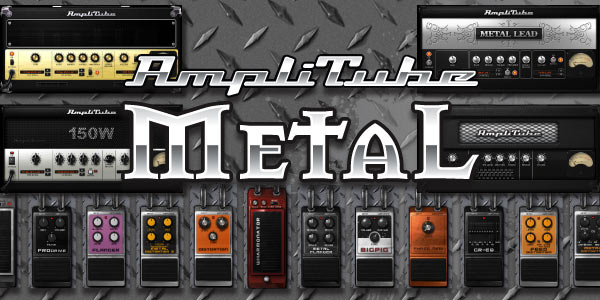
There are five Amp configurations: Vintage Metal Lead (based on the Marshall MP100), Metal Lead V (based on a Peavey 5150 100W), T and W (based on Randall Warhead), Metal clean. The separate management of Pre, Equalizer and Amp allows you to create a good number of new combinations. The Pedal Section (Stomp) (Fig.2) offers seven (sic!) friends of distortion: Big Pig, Overdrive and Distortion (yellow and orange ... do a little you ...), Metal distortion, Prodrive, Metal distortion 2 and Distortion feed. The range is really wide, from light distortions to real nightmares for the ears. Delay, Flanger, Phaser, Wharmonator, Wha Wha and graphic equalizer complete the picture. The modulation section, therefore, was not particularly extensive, probably in homage to the fact that hundreds of clean or psychedelic tones are not usually provided in the metal genre. The Cab part of Amplitube Metal sees combinations of thirteen speaker models with 6 different microphones. For miking it is possible to determine whether on axis or off axis, far or close and to measure the overall ambience level. Finally, the Rack part offers four usable slots by choosing from nine different effects.

Stomp, Amp and Rack
As mentioned, alongside the typical controls of each head, we have six slots for pedal effects. I am left with the doubt as to why pedals not exactly of a "metal" matrix have not been included but still commonly used, especially in modern rock, where the transition from "cheesey" to super distorted sounds is a classic formula of contrast, chorus and compressor pedals (these two however present in the rack, therefore post-cabinet), octaver and some more. The level of pedals, however, is qualitatively very high. Our favorites are the Metal Distortion and the Phaser. Turning to the cabinet (Fig.3), the controls are really all there: choice of microphone, position, ambient level and above all the type of speaker. The possibilities are practically endless. Finally, the rack unit offers the possibility to “close” the sound before it enters the virtual mixer (or more properly the host we are using) with a good choice of effects, including a reverb with a pleasant metallic tone. As a last note of merit we like to mention the Amplitube "tuner", the best so far met for fluidity and ease of use (Fig.4).


Okay, but how does it sound?
To get a concrete idea of how Amplitube Metal really sounds, let's obviously start by listening to the presets, which are supposed to offer an overview of the potential of multi-effects. For listening we use a Variax 300, also to be able to fiddle a bit with the selector and see the results with different tones offered by the guitar. A first impression on the fly on the overall sound of the Amplitube Metal is its presence ("in your face" as the Anglo-Saxons would say), sometimes a bit rough when compared with the perennially "smooth" tone of Guitar rig and the tendency of the Modenese effect to occupy the sound stage with greater aggressiveness in the mid frequencies. We don't mind the feature, especially when it comes to hard rock, also because there is always time to cut frequencies: the hard part is building them. Let's start from Lead T. in a clean and distorted version, decidedly sour. The clean sounds are very beautiful, with chorus, tremolo or dry. Sour the distorted version with a satisfying number of presets. The lead T allows us to immediately notice how, even in the presence of acidic distortions and a little "mosquito", the control remains in our hands, even, for example, with a guitar definitely not suitable for palm mute like the Variax. Moving on to Lead V we find a good series of sounds dedicated to modern hard rock, passing from distortions to Nickelback o Linking Park, neo punk to the Blink 182, Metallica institutional metal or grunge. In short, strong and substantially balanced distortions in the sound spectrum with often a little extra "kick" on the bass. Here too, a positive feature immediately catches the eye and is the excellent response on the "mutes", an important test bench. In this case the control is total: it is very easy to generate artificial harmonics and “chunks” with a completely acceptable level of transition noise even with very extreme distortion settings. It is therefore very easy to work with riffs on the fifth and sixth (and seventh) string. The Lead W offers a good selection of presets with an exaggerated consideration of the extreme frequencies (particularly the bass), certainly not appreciated by the writer. Finally, the Vintage Lead takes us on a journey into sonority Marshall, often with nice results, especially in stereo presets. And, as always when it comes to Marshall… take it or leave it. The distortion response on picking and legato is very satisfying, in particular very clean on the latter and on the tapping of our custom 09 tailpiece. Going into the details of the rest of the presets is really difficult, especially if you consider the high number present and the varied and eventual nature. However, it should be known that IK Multimedia has included many high-profile sounds, even in the “soft” sector where the cleans at Metallica are the masters (also to avoid an unpleasant riot of hairs under the Modena offices). Most of the genres (if not all) attributable to Metal are in fact represented. In general, however, the choice of presets does not really leave room for unsatisfied desires, given that the history of Metal and Rock in general is widely represented (Fig.5).

Amplitube Metal and virtual guitars
We wanted to test Amplitube Metal also in a virtual context, applying it to two of the most used libraries and virtual instruments dedicated to the guitar. The first test was carried out with the innovative Russian plugin MusicLab RealStrat, interesting reproduction in the form of a plug-in of the Stratocaster. It should be noted that the virtual instrument in question is not famous for its "big" voice and its detractors have repeatedly highlighted the difficulty in obtaining credible sound mixes under distortion. The result obtained with Amplitube Metal was very respectable, even with a little surprise. Particularly mellow and rich in harmonics the sound with the Lead T, the RealStrat sounds good and is credible even with the Lead W e Lead v. The combination with the Vintage Lead and in Clean T mode is a little less successful, in the opinion of the writer. Also in this case the general feeling of distortion control is felt as the great merit of the Modenese plugin. We then used an all-Italian product, the Pettinhouse Direct Guitar, produced and created by the Sardinian Andrea Pettinao, who has many admirers around the world. It also offers, by its nature, a richer sound than RealStrat even if it does not enjoy all the "gadgets" of the Russian plug-in. The result with the Clean T is better than the previous test, very good also on Lead T and Vintage Lead. The best result is perhaps the Lead V, as the richer mid-bass tone of the Pettinhouse partially attenuates the somewhat acidic character of the Amp. Thus, the effect with the Lead W, natively led to enhance the extremes, benefited by contrast from the “flat” character of the RealStrat sound.
Conclusions
Offering a 360-degree overview of a product like Amplitube Metal is a practically impossible undertaking, both for the complexity of the product itself and for the inevitable incidence of personal background in evaluations. The variety of timbres present and of “usable” presets makes it an instrument of sure usefulness in the most diverse contexts, which are not limited to the Metal scene, but which in general are also attributable to the most recent pop / rock. In particular, we were positively impressed by the attention paid by programmers and sound designers in accompanying possible rock techniques, guaranteeing cleanliness in the execution. Too often in the past we have witnessed distortions with an exhilarating timbre but with practically no control, a true homage to noise, therefore, in fact, of poor usability. In this sense Amplitube manages to express a very convincing compendium between control and thrust, especially if we consider the overall sound sharp, aggressive and very "in the face". Distortion control and the wide choice of sounds are definitely positive. CPU consumption a bit high in our tests
Metal guitars: effects or samples?
Working with a multi-effect like Amplitube Metal actively raises the question of whether it is possible to obtain with it sounds similar to those provided, already sampled, for example, in libraries such as Monzter Guitars of Precisionsounds or Get Distorted by Alex Pfeiffer and whether this offers any convenience. It must be said that the libraries in question have a wide practicality of use, as they are "load and play" in all respects. To obtain similar sounds, Ampitube Metal is certainly the right effect, but the starting material is very relevant, that is to say the execution. If you are a guitarist and do not think about modifying your guitar parts or the overall tempo of the song too much, then using a real guitar part played with Amplitube is a preferential way, if only for the infinite possibilities of controlling the distortion with chunks, harmonics, slides and the whole repertoire of amenity for guitarists. Obviously it is assumed that you have good picking technique and control. If this is not the case - and flexibility assumes a certain importance for you -, the samples mentioned above are the ready-to-eat food par excellence, with no time and tonality limits, but with all the limitations inherent in sampling.
Price: € 199,99
More Info: IK Multimedia Amplitube Metal
Antonio Campeglia
Ah, the Metal! Always the true phoenix of the rock scene, given up for dead countless times and surprisingly reborn from his ashes, ready to illuminate, without age discrimination, the music scene of the second millennium. IK Multimedia finally releases, we could say after an anxious wait from the public, Amplitube Metal, a spin off by now tested virtual processor for guitar, this time however specifically dedicated to the "hard guys". The high hipe has found justification in the fact that the attention not only of pop, rock and metal guitarists, but also of electronic musicians and composers of soundtracks converge on the product. For all those who want to get an idea of what we mean by using metal guitars in soundtracks, just refer to the blockbuster "300", a skilful mixture of ethnic, metal and ambient.
The software: installation and protection
Installation is easy, setup takes a relatively short time and the application runs for ten days, after which mandatory registration will be required. The type of protection is of the “call & response” type: a code based on the system ID is generated which, once provided via the web to the IKM guys, will allow you to obtain a new code to fully enjoy the program's features. Overall, this is a system that did not offer particular difficulties for the realization of our test.
Structure
Amplitube Metal retains the typical structure of the series. The software allows separate management of Amp, Pedals, Cabinet and Rack, as well as tuner (very functional) and noise gate. Metal comes out with an interesting number of presets, also considered the limitation of the genre, divided by macro: amp, heavy, extreme, heavy, rough and soft (Fig.1).
The sections
There are five Amp configurations: Vintage Metal Lead (based on the Marshall MP100), Metal Lead V (based on a Peavey 5150 100W), T and W (based on Randall Warhead), Metal clean. The separate management of Pre, Equalizer and Amp allows you to create a good number of new combinations. The Pedal Section (Stomp) (Fig.2) offers seven (sic!) friends of distortion: Big Pig, Overdrive and Distortion (yellow and orange ... do a little you ...), Metal distortion, Prodrive, Metal distortion 2 and Distortion feed. The range is really wide, from light distortions to real nightmares for the ears. Delay, Flanger, Phaser, Wharmonator, Wha Wha and graphic equalizer complete the picture. The modulation section, therefore, was not particularly extensive, probably in homage to the fact that hundreds of clean or psychedelic tones are not usually provided in the metal genre. The Cab part of Amplitube Metal sees combinations of thirteen speaker models with 6 different microphones. For miking it is possible to determine whether on axis or off axis, far or close and to measure the overall ambience level. Finally, the Rack part offers four usable slots by choosing from nine different effects.
Stomp, Amp and Rack
As mentioned, alongside the typical controls of each head, we have six slots for pedal effects. I am left with the doubt as to why pedals not exactly of a "metal" matrix have not been included but still commonly used, especially in modern rock, where the transition from "cheesey" to super distorted sounds is a classic formula of contrast, chorus and compressor pedals (these two however present in the rack, therefore post-cabinet), octaver and some more. The level of pedals, however, is qualitatively very high. Our favorites are the Metal Distortion and the Phaser. Turning to the cabinet (Fig.3), the controls are really all there: choice of microphone, position, ambient level and above all the type of speaker. The possibilities are practically endless. Finally, the rack unit offers the possibility to “close” the sound before it enters the virtual mixer (or more properly the host we are using) with a good choice of effects, including a reverb with a pleasant metallic tone. As a last note of merit we like to mention the Amplitube "tuner", the best so far met for fluidity and ease of use (Fig.4).
Okay, but how does it sound?
To get a concrete idea of how Amplitube Metal really sounds, let's obviously start by listening to the presets, which are supposed to offer an overview of the potential of the multi-effects. For listening we use a Variax 300, also to be able to fiddle around a bit with the selector and see the results with different tones offered by the guitar. A first impression of the overall sound of the Amplitube Metal is its presence (“in your face” as the Anglo-Saxons would say), at times a little rough when compared with the perpetually “smooth” tone of Guitar Rig and the tendency of the Modena effect to occupy the soundstage with greater aggression in the mid frequencies. We don't mind this feature, especially when it comes to hard rock, also because there's always time to cut frequencies: the difficult thing is building them. Let's start with the Lead T in a clean and distorted version, decidedly harsh. The clean sounds, with chorus, tremolo or dry, are very nice. Acid distorted version with a satisfying number of presets. The lead T immediately allows us to notice how, even in the presence of acid and slightly “mosquito-like” distortions, control remains in our hands, even, for example, with a guitar that is definitely not suited to palm muting like the Variax. Moving on to Lead V we find a good series of sounds dedicated to hard rock of modern origin, ranging from distortions à la Nickelback or Linking Park, neo punk à la Blink 182, institutional metal à la Metallica or grunge. In short, distortions pushed and substantially balanced in the sound spectrum with often a little extra “kick” in the lows. Here too, a positive feature immediately catches the eye and is the excellent response on the “mutes”, an important test bench. In this case, control is total: it's very easy to generate artificial harmonics and chunks with a completely acceptable level of transition noise even with decidedly extreme distortion settings. It is therefore very easy to work on riffs on the fifth and sixth (and seventh) strings. The Lead W offers a good selection of presets with an exaggerated consideration of the extreme frequencies (especially the bass), certainly not appreciated by the writer. Finally, the Vintage Lead takes us on a journey through Marshall sound, often with pleasant results, especially in the stereo presets. And, as always when it comes to Marshall… take it or leave it. The distortion response on picking and legato is very satisfying, especially very clean on the latter and on the tapping of our custom 09 tailpiece. Going into detail about the rest of the presets is really difficult, especially considering the high number present and their varied and eventual nature. However, it should be known that IK Multimedia has included many top-notch sounds, even in the “soft” sector where Metallica-style cleans reign supreme (also to avoid an unpleasant riot of long-haired people outside the Modena offices). Most (if not all) genres that can be traced back to Metal are actually represented. In general, however, the choice of presets leaves no room for unsatisfied desires, given that the history of Metal and Rock in general is widely represented (Fig.5).
Amplitube Metal and virtual guitars
We wanted to test Amplitube Metal also in a virtual context, applying it to two of the most used libraries and virtual instruments dedicated to the guitar. The first test was carried out with the innovative Russian plugin MusicLab RealStrat, interesting reproduction in the form of a plug-in of the Stratocaster. It should be noted that the virtual instrument in question is not famous for its "big" voice and its detractors have repeatedly highlighted the difficulty in obtaining credible sound mixes under distortion. The result obtained with Amplitube Metal was very respectable, even with a little surprise. Particularly mellow and rich in harmonics the sound with the Lead T, the RealStrat sounds good and is credible even with the Lead W e Lead v. The combination with the Vintage Lead and in Clean T mode is a little less successful, in the opinion of the writer. Also in this case the general feeling of distortion control is felt as the great merit of the Modenese plugin. We then used an all-Italian product, the Pettinhouse Direct Guitar, produced and created by the Sardinian Andrea Pettinao, who has many admirers around the world. It also offers, by its nature, a richer sound than RealStrat even if it does not enjoy all the "gadgets" of the Russian plug-in. The result with the Clean T is better than the previous test, very good also on Lead T and Vintage Lead. The best result is perhaps the Lead V, as the richer mid-bass tone of the Pettinhouse partially attenuates the somewhat acidic character of the Amp. Thus, the effect with the Lead W, natively led to enhance the extremes, benefited by contrast from the “flat” character of the RealStrat sound.
Conclusions
Offering a 360-degree overview of a product like Amplitube Metal is a practically impossible undertaking, both for the complexity of the product itself and for the inevitable incidence of personal background in evaluations. The variety of timbres present and of “usable” presets makes it an instrument of sure usefulness in the most diverse contexts, which are not limited to the Metal scene, but which in general are also attributable to the most recent pop / rock. In particular, we were positively impressed by the attention paid by programmers and sound designers in accompanying possible rock techniques, guaranteeing cleanliness in the execution. Too often in the past we have witnessed distortions with an exhilarating timbre but with practically no control, a true homage to noise, therefore, in fact, of poor usability. In this sense Amplitube manages to express a very convincing compendium between control and thrust, especially if we consider the overall sound sharp, aggressive and very "in the face". Distortion control and the wide choice of sounds are definitely positive. CPU consumption a bit high in our tests
Metal guitars: effects or samples?
Working with a multi-effect like Amplitube Metal actively raises the question of whether it is possible to obtain with it sounds similar to those provided, already sampled, for example, in libraries such as Monzter Guitars of Precisionsounds or Get Distorted by Alex Pfeiffer and whether this offers any convenience. It must be said that the libraries in question have a wide practicality of use, as they are "load and play" in all respects. To obtain similar sounds, Ampitube Metal is certainly the right effect, but the starting material is very relevant, that is to say the execution. If you are a guitarist and do not think about modifying your guitar parts or the overall tempo of the song too much, then using a real guitar part played with Amplitube is a preferential way, if only for the infinite possibilities of controlling the distortion with chunks, harmonics, slides and the whole repertoire of amenity for guitarists. Obviously it is assumed that you have good picking technique and control. If this is not the case - and flexibility assumes a certain importance for you -, the samples mentioned above are the ready-to-eat food par excellence, with no time and tonality limits, but with all the limitations inherent in sampling.
Price: € 199,99
More Info: IK Multimedia Amplitube Metal
 Ah, the Metal! Always the true phoenix of the rock scene, given up for dead countless times and surprisingly reborn from his ashes, ready to illuminate, without age discrimination, the music scene of the second millennium. IK Multimedia finally releases, we could say after an anxious wait from the public, Amplitube Metal, a spin off by now tested virtual processor for guitar, this time however specifically dedicated to the "hard guys". The high hipe has found justification in the fact that the attention not only of pop, rock and metal guitarists, but also of electronic musicians and composers of soundtracks converge on the product. For all those who want to get an idea of what we mean by using metal guitars in soundtracks, just refer to the blockbuster "300", a skilful mixture of ethnic, metal and ambient.
The software: installation and protection
Installation is easy, setup takes a relatively short time and the application runs for ten days, after which mandatory registration will be required. The type of protection is of the “call & response” type: a code based on the system ID is generated which, once provided via the web to the IKM guys, will allow you to obtain a new code to fully enjoy the program's features. Overall, this is a system that did not offer particular difficulties for the realization of our test.
Structure
Amplitube Metal retains the typical structure of the series. The software allows separate management of Amp, Pedals, Cabinet and Rack, as well as tuner (very functional) and noise gate. Metal comes out with an interesting number of presets, also considered the limitation of the genre, divided by macro: amp, heavy, extreme, heavy, rough and soft (Fig.1).
The sections
There are five Amp configurations: Vintage Metal Lead (based on the Marshall MP100), Metal Lead V (based on a Peavey 5150 100W), T and W (based on the Randall Warhead), Metal clean. The separate management of Pre, EQ and Amp allows you to create a good number of new combinations. The pedal section (Stomp) (Fig.2) offers seven (sic!) friends of distortion: Big Pig, Overdrive and Distortion (yellow and orange ... do a little you ...), Metal distortion, Prodrive, Metal distortion 2 and Distortion feed. The range is really wide, from light distortions to real nightmares for the ears. Delay, Flanger, Phaser, Wharmonator, Wha Wha and graphic equalizer complete the picture. The modulation section, therefore, was not particularly extensive, probably in homage to the fact that hundreds of clean or psychedelic tones are not usually provided in the metal genre. The Cab part of Amplitube Metal sees combinations of thirteen speaker models with 6 different microphones. For miking it is possible to determine whether on axis or off axis, far or close and to measure the overall ambience level. Finally, the Rack part offers four usable slots by choosing from nine different effects.
Stomp, Amp and Rack
As mentioned, alongside the typical controls of each head, we have six slots for pedal effects. I am left with the doubt as to why pedals not exactly of a "metal" matrix have not been included but still commonly used, especially in modern rock, where the transition from "cheesey" to super distorted sounds is a classic formula of contrast, chorus and compressor pedals (these two however present in the rack, therefore post-cabinet), octaver and some more. The level of pedals, however, is qualitatively very high. Our favorites are the Metal Distortion and the Phaser. Turning to the cabinet (Fig.3), the controls are really all there: choice of microphone, position, ambient level and above all the type of speaker. The possibilities are practically endless. Finally, the rack unit offers the possibility to “close” the sound before it enters the virtual mixer (or more properly the host we are using) with a good choice of effects, including a reverb with a pleasant metallic tone. As a last note of merit we like to mention the Amplitube "tuner", the best so far met for fluidity and ease of use (Fig.4).
Okay, but how does it sound?
To get a concrete idea of how Amplitube Metal really sounds, let's obviously start by listening to the presets, which are supposed to offer an overview of the potential of the multi-effects. For listening we use a Variax 300, also to be able to fiddle around a bit with the selector and see the results with different tones offered by the guitar. A first impression of the overall sound of the Amplitube Metal is its presence (“in your face” as the Anglo-Saxons would say), at times a little rough when compared with the perpetually “smooth” tone of Guitar Rig and the tendency of the Modena effect to occupy the soundstage with greater aggression in the mid frequencies. We don't mind this feature, especially when it comes to hard rock, also because there's always time to cut frequencies: the difficult thing is building them. Let's start with the Lead T in a clean and distorted version, decidedly harsh. The clean sounds, with chorus, tremolo or dry, are very nice. Acid distorted version with a satisfying number of presets. The lead T immediately allows us to notice how, even in the presence of acid and slightly “mosquito-like” distortions, control remains in our hands, even, for example, with a guitar that is definitely not suited to palm muting like the Variax. Moving on to Lead V we find a good series of sounds dedicated to hard rock of modern origin, ranging from distortions à la Nickelback or Linking Park, neo punk à la Blink 182, institutional metal à la Metallica or grunge. In short, distortions pushed and substantially balanced in the sound spectrum with often a little extra “kick” in the lows. Here too, a positive feature immediately catches the eye and is the excellent response on the “mutes”, an important test bench. In this case, control is total: it's very easy to generate artificial harmonics and chunks with a completely acceptable level of transition noise even with decidedly extreme distortion settings. It is therefore very easy to work on riffs on the fifth and sixth (and seventh) strings. The Lead W offers a good selection of presets with an exaggerated consideration of the extreme frequencies (especially the bass), certainly not appreciated by the writer. Finally, the Vintage Lead takes us on a journey through Marshall sound, often with pleasant results, especially in the stereo presets. And, as always when it comes to Marshall… take it or leave it. The distortion response on picking and legato is very satisfying, especially very clean on the latter and on the tapping of our custom 09 tailpiece. Going into detail about the rest of the presets is really difficult, especially considering the high number present and their varied and eventual nature. However, it should be known that IK Multimedia has included many top-notch sounds, even in the “soft” sector where Metallica-style cleans reign supreme (also to avoid an unpleasant riot of long-haired people outside the Modena offices). Most (if not all) genres that can be traced back to Metal are actually represented. In general, however, the choice of presets leaves no room for unsatisfied desires, given that the history of Metal and Rock in general is widely represented (Fig.5).
Amplitube Metal and virtual guitars
We wanted to test Amplitube Metal also in a virtual context, applying it to two of the most used libraries and virtual instruments dedicated to the guitar. The first test was carried out with the innovative Russian plugin MusicLab RealStrat, interesting reproduction in the form of a plug-in of the Stratocaster. It should be noted that the virtual instrument in question is not famous for its "big" voice and its detractors have repeatedly highlighted the difficulty in obtaining credible sound mixes under distortion. The result obtained with Amplitube Metal was very respectable, even with a little surprise. Particularly mellow and rich in harmonics the sound with the Lead T, the RealStrat sounds good and is credible even with the Lead W and Lead V. The combination with the Vintage Lead and in Clean T mode was a little less successful, in the writer's opinion. Even in this case, the general feeling of distortion control is felt as the great strength of the Modena-based plugin. We then used an all-Italian product, the Pettinhouse Direct Guitar, produced and crafted by Sardinian Andrea Pettinao, who has many admirers around the world. It also offers, by its nature, a richer sound than the RealStrat even if it doesn't have all the "gadgets" of the Russian plug-in. The result with the Clean T is better than the previous test, very good also with the Lead T and Vintage Lead. The best result is perhaps achieved by the Lead V, as the richer tone in the mid-low range of the Pettinhouse partially attenuates the at times slightly acidic character of the Amp. Thus, the effect with the Lead W, natively inclined to enhance the extremes, benefited by contrast from the "flat" character of the RealStrat sound.
Conclusions
Offering a 360-degree overview of a product like Amplitube Metal is a practically impossible undertaking, both for the complexity of the product itself and for the inevitable incidence of personal background in evaluations. The variety of timbres present and of “usable” presets makes it an instrument of sure usefulness in the most diverse contexts, which are not limited to the Metal scene, but which in general are also attributable to the most recent pop / rock. In particular, we were positively impressed by the attention paid by programmers and sound designers in accompanying possible rock techniques, guaranteeing cleanliness in the execution. Too often in the past we have witnessed distortions with an exhilarating timbre but with practically no control, a true homage to noise, therefore, in fact, of poor usability. In this sense Amplitube manages to express a very convincing compendium between control and thrust, especially if we consider the overall sound sharp, aggressive and very "in the face". Distortion control and the wide choice of sounds are definitely positive. CPU consumption a bit high in our tests
Metal guitars: effects or samples?
Working with a multi-effect like Amplitube Metal actively raises the question of whether it is possible to obtain with it sounds similar to those provided, already sampled, for example, in libraries such as Monzter Guitars Precisionsounds' Get Distorted by Alex Pfeiffer, and whether it offers any convenience. It must be said that the libraries in question are highly practical, as they are "load and play" in every respect. To obtain similar sounds, Ampitube Metal is certainly the right effect, but the starting material, namely the performance, is very important. If you're a guitarist and don't plan on modifying your guitar parts or the overall tempo of the song too much, then using a real guitar part effected with Amplitube is a preferable route, if only for the infinite possibilities for controlling the distortion with chunks, harmonics, slides, and the whole repertoire of guitaristic amenities. Obviously, it's assumed that you have good technique and picking control. If this isn't the case—and flexibility is a certain importance to you—the samples mentioned above are the perfect ready-made food, without tempo or tonal limits, but with all the limitations inherent in sampling.
Price: € 199,99
More Info: IK Multimedia Amplitube Metal
Ah, the Metal! Always the true phoenix of the rock scene, given up for dead countless times and surprisingly reborn from his ashes, ready to illuminate, without age discrimination, the music scene of the second millennium. IK Multimedia finally releases, we could say after an anxious wait from the public, Amplitube Metal, a spin off by now tested virtual processor for guitar, this time however specifically dedicated to the "hard guys". The high hipe has found justification in the fact that the attention not only of pop, rock and metal guitarists, but also of electronic musicians and composers of soundtracks converge on the product. For all those who want to get an idea of what we mean by using metal guitars in soundtracks, just refer to the blockbuster "300", a skilful mixture of ethnic, metal and ambient.
The software: installation and protection
Installation is easy, setup takes a relatively short time and the application runs for ten days, after which mandatory registration will be required. The type of protection is of the “call & response” type: a code based on the system ID is generated which, once provided via the web to the IKM guys, will allow you to obtain a new code to fully enjoy the program's features. Overall, this is a system that did not offer particular difficulties for the realization of our test.
Structure
Amplitube Metal retains the typical structure of the series. The software allows separate management of Amp, Pedals, Cabinet and Rack, as well as tuner (very functional) and noise gate. Metal comes out with an interesting number of presets, also considered the limitation of the genre, divided by macro: amp, heavy, extreme, heavy, rough and soft (Fig.1).
The sections
There are five Amp configurations: Vintage Metal Lead (based on the Marshall MP100), Metal Lead V (based on a Peavey 5150 100W), T and W (based on Randall Warhead), Metal clean. The separate management of Pre, Equalizer and Amp allows you to create a good number of new combinations. The Pedal Section (Stomp) (Fig.2) offers seven (sic!) friends of distortion: Big Pig, Overdrive and Distortion (yellow and orange ... do a little you ...), Metal distortion, Prodrive, Metal distortion 2 and Distortion feed. The range is really wide, from light distortions to real nightmares for the ears. Delay, Flanger, Phaser, Wharmonator, Wha Wha and graphic equalizer complete the picture. The modulation section, therefore, was not particularly extensive, probably in homage to the fact that hundreds of clean or psychedelic tones are not usually provided in the metal genre. The Cab part of Amplitube Metal sees combinations of thirteen speaker models with 6 different microphones. For miking it is possible to determine whether on axis or off axis, far or close and to measure the overall ambience level. Finally, the Rack part offers four usable slots by choosing from nine different effects.
Stomp, Amp and Rack
As mentioned, alongside the typical controls of each head, we have six slots for pedal effects. I am left with the doubt as to why pedals not exactly of a "metal" matrix have not been included but still commonly used, especially in modern rock, where the transition from "cheesey" to super distorted sounds is a classic formula of contrast, chorus and compressor pedals (these two however present in the rack, therefore post-cabinet), octaver and some more. The level of pedals, however, is qualitatively very high. Our favorites are the Metal Distortion and the Phaser. Turning to the cabinet (Fig.3), the controls are really all there: choice of microphone, position, ambient level and above all the type of speaker. The possibilities are practically endless. Finally, the rack unit offers the possibility to “close” the sound before it enters the virtual mixer (or more properly the host we are using) with a good choice of effects, including a reverb with a pleasant metallic tone. As a last note of merit we like to mention the Amplitube "tuner", the best so far met for fluidity and ease of use (Fig.4).
Okay, but how does it sound?
To get a concrete idea of how Amplitube Metal really sounds, let's obviously start by listening to the presets, which are supposed to offer an overview of the potential of the multi-effects. For listening we use a Variax 300, also to be able to fiddle around a bit with the selector and see the results with different tones offered by the guitar. A first impression of the overall sound of the Amplitube Metal is its presence (“in your face” as the Anglo-Saxons would say), at times a little rough when compared with the perpetually “smooth” tone of Guitar Rig and the tendency of the Modena effect to occupy the soundstage with greater aggression in the mid frequencies. We don't mind this feature, especially when it comes to hard rock, also because there's always time to cut frequencies: the difficult thing is building them. Let's start with the Lead T in a clean and distorted version, decidedly harsh. The clean sounds, with chorus, tremolo or dry, are very nice. Acid distorted version with a satisfying number of presets. The lead T immediately allows us to notice how, even in the presence of acid and slightly “mosquito-like” distortions, control remains in our hands, even, for example, with a guitar that is definitely not suited to palm muting like the Variax. Moving on to Lead V we find a good series of sounds dedicated to hard rock of modern origin, ranging from distortions à la Nickelback or Linking Park, neo punk à la Blink 182, institutional metal à la Metallica or grunge. In short, distortions pushed and substantially balanced in the sound spectrum with often a little extra “kick” in the lows. Here too, a positive feature immediately catches the eye and is the excellent response on the “mutes”, an important test bench. In this case, control is total: it's very easy to generate artificial harmonics and chunks with a completely acceptable level of transition noise even with decidedly extreme distortion settings. It is therefore very easy to work on riffs on the fifth and sixth (and seventh) strings. The Lead W offers a good selection of presets with an exaggerated consideration of the extreme frequencies (especially the bass), certainly not appreciated by the writer. Finally, the Vintage Lead takes us on a journey through Marshall sound, often with pleasant results, especially in the stereo presets. And, as always when it comes to Marshall… take it or leave it. The distortion response on picking and legato is very satisfying, especially very clean on the latter and on the tapping of our custom 09 tailpiece. Going into detail about the rest of the presets is really difficult, especially considering the high number present and their varied and eventual nature. However, it should be known that IK Multimedia has included many top-notch sounds, even in the “soft” sector where Metallica-style cleans reign supreme (also to avoid an unpleasant riot of long-haired people outside the Modena offices). Most (if not all) genres that can be traced back to Metal are actually represented. In general, however, the choice of presets leaves no room for unsatisfied desires, given that the history of Metal and Rock in general is widely represented (Fig.5).
Amplitube Metal and virtual guitars
We wanted to test Amplitube Metal also in a virtual context, applying it to two of the most used libraries and virtual instruments dedicated to the guitar. The first test was carried out with the innovative Russian plugin MusicLab RealStrat, interesting reproduction in the form of a plug-in of the Stratocaster. It should be noted that the virtual instrument in question is not famous for its "big" voice and its detractors have repeatedly highlighted the difficulty in obtaining credible sound mixes under distortion. The result obtained with Amplitube Metal was very respectable, even with a little surprise. Particularly mellow and rich in harmonics the sound with the Lead T, the RealStrat sounds good and is credible even with the Lead W e Lead v. The combination with the Vintage Lead and in Clean T mode is a little less successful, in the opinion of the writer. Also in this case the general feeling of distortion control is felt as the great merit of the Modenese plugin. We then used an all-Italian product, the Pettinhouse Direct Guitar, produced and created by the Sardinian Andrea Pettinao, who has many admirers around the world. It also offers, by its nature, a richer sound than RealStrat even if it does not enjoy all the "gadgets" of the Russian plug-in. The result with the Clean T is better than the previous test, very good also on Lead T and Vintage Lead. The best result is perhaps the Lead V, as the richer mid-bass tone of the Pettinhouse partially attenuates the somewhat acidic character of the Amp. Thus, the effect with the Lead W, natively led to enhance the extremes, benefited by contrast from the “flat” character of the RealStrat sound.
Conclusions
Offering a 360-degree overview of a product like Amplitube Metal is a practically impossible undertaking, both for the complexity of the product itself and for the inevitable incidence of personal background in evaluations. The variety of timbres present and of “usable” presets makes it an instrument of sure usefulness in the most diverse contexts, which are not limited to the Metal scene, but which in general are also attributable to the most recent pop / rock. In particular, we were positively impressed by the attention paid by programmers and sound designers in accompanying possible rock techniques, guaranteeing cleanliness in the execution. Too often in the past we have witnessed distortions with an exhilarating timbre but with practically no control, a true homage to noise, therefore, in fact, of poor usability. In this sense Amplitube manages to express a very convincing compendium between control and thrust, especially if we consider the overall sound sharp, aggressive and very "in the face". Distortion control and the wide choice of sounds are definitely positive. CPU consumption a bit high in our tests
Metal guitars: effects or samples?
Working with a multi-effect like Amplitube Metal actively raises the question of whether it is possible to obtain with it sounds similar to those provided, already sampled, for example, in libraries such as Monzter Guitars of Precisionsounds or Get Distorted by Alex Pfeiffer and whether this offers any convenience. It must be said that the libraries in question have a wide practicality of use, as they are "load and play" in all respects. To obtain similar sounds, Ampitube Metal is certainly the right effect, but the starting material is very relevant, that is to say the execution. If you are a guitarist and do not think about modifying your guitar parts or the overall tempo of the song too much, then using a real guitar part played with Amplitube is a preferential way, if only for the infinite possibilities of controlling the distortion with chunks, harmonics, slides and the whole repertoire of amenity for guitarists. Obviously it is assumed that you have good picking technique and control. If this is not the case - and flexibility assumes a certain importance for you -, the samples mentioned above are the ready-to-eat food par excellence, with no time and tonality limits, but with all the limitations inherent in sampling.
Price: € 199,99
More Info: IK Multimedia Amplitube Metal
Ah, the Metal! Always the true phoenix of the rock scene, given up for dead countless times and surprisingly reborn from his ashes, ready to illuminate, without age discrimination, the music scene of the second millennium. IK Multimedia finally releases, we could say after an anxious wait from the public, Amplitube Metal, a spin off by now tested virtual processor for guitar, this time however specifically dedicated to the "hard guys". The high hipe has found justification in the fact that the attention not only of pop, rock and metal guitarists, but also of electronic musicians and composers of soundtracks converge on the product. For all those who want to get an idea of what we mean by using metal guitars in soundtracks, just refer to the blockbuster "300", a skilful mixture of ethnic, metal and ambient.
The software: installation and protection
Installation is easy, setup takes a relatively short time and the application runs for ten days, after which mandatory registration will be required. The type of protection is of the “call & response” type: a code based on the system ID is generated which, once provided via the web to the IKM guys, will allow you to obtain a new code to fully enjoy the program's features. Overall, this is a system that did not offer particular difficulties for the realization of our test.
Structure
Amplitube Metal retains the typical structure of the series. The software allows separate management of Amp, Pedals, Cabinet and Rack, as well as tuner (very functional) and noise gate. Metal comes out with an interesting number of presets, also considered the limitation of the genre, divided by macro: amp, heavy, extreme, heavy, rough and soft (Fig.1).
The sections
There are five Amp configurations: Vintage Metal Lead (based on the Marshall MP100), Metal Lead V (based on a Peavey 5150 100W), T and W (based on Randall Warhead), Metal clean. The separate management of Pre, Equalizer and Amp allows you to create a good number of new combinations. The Pedal Section (Stomp) (Fig.2) offers seven (sic!) friends of distortion: Big Pig, Overdrive and Distortion (yellow and orange ... do a little you ...), Metal distortion, Prodrive, Metal distortion 2 and Distortion feed. The range is really wide, from light distortions to real nightmares for the ears. Delay, Flanger, Phaser, Wharmonator, Wha Wha and graphic equalizer complete the picture. The modulation section, therefore, was not particularly extensive, probably in homage to the fact that hundreds of clean or psychedelic tones are not usually provided in the metal genre. The Cab part of Amplitube Metal sees combinations of thirteen speaker models with 6 different microphones. For miking it is possible to determine whether on axis or off axis, far or close and to measure the overall ambience level. Finally, the Rack part offers four usable slots by choosing from nine different effects.
Stomp, Amp and Rack
As mentioned, alongside the typical controls of each head, we have six slots for pedal effects. I am left with the doubt as to why pedals not exactly of a "metal" matrix have not been included but still commonly used, especially in modern rock, where the transition from "cheesey" to super distorted sounds is a classic formula of contrast, chorus and compressor pedals (these two however present in the rack, therefore post-cabinet), octaver and some more. The level of pedals, however, is qualitatively very high. Our favorites are the Metal Distortion and the Phaser. Turning to the cabinet (Fig.3), the controls are really all there: choice of microphone, position, ambient level and above all the type of speaker. The possibilities are practically endless. Finally, the rack unit offers the possibility to “close” the sound before it enters the virtual mixer (or more properly the host we are using) with a good choice of effects, including a reverb with a pleasant metallic tone. As a last note of merit we like to mention the Amplitube "tuner", the best so far met for fluidity and ease of use (Fig.4).
Okay, but how does it sound?
To get a concrete idea of how Amplitube Metal really sounds, let's obviously start by listening to the presets, which are supposed to offer an overview of the potential of the multi-effects. For listening we use a Variax 300, also to be able to fiddle around a bit with the selector and see the results with different tones offered by the guitar. A first impression of the overall sound of the Amplitube Metal is its presence (“in your face” as the Anglo-Saxons would say), at times a little rough when compared with the perpetually “smooth” tone of Guitar Rig and the tendency of the Modena effect to occupy the soundstage with greater aggression in the mid frequencies. We don't mind this feature, especially when it comes to hard rock, also because there's always time to cut frequencies: the difficult thing is building them. Let's start with the Lead T in a clean and distorted version, decidedly harsh. The clean sounds, with chorus, tremolo or dry, are very nice. Acid distorted version with a satisfying number of presets. The lead T immediately allows us to notice how, even in the presence of acid and slightly “mosquito-like” distortions, control remains in our hands, even, for example, with a guitar that is definitely not suited to palm muting like the Variax. Moving on to Lead V we find a good series of sounds dedicated to hard rock of modern origin, ranging from distortions à la Nickelback or Linking Park, neo punk à la Blink 182, institutional metal à la Metallica or grunge. In short, distortions pushed and substantially balanced in the sound spectrum with often a little extra “kick” in the lows. Here too, a positive feature immediately catches the eye and is the excellent response on the “mutes”, an important test bench. In this case, control is total: it's very easy to generate artificial harmonics and chunks with a completely acceptable level of transition noise even with decidedly extreme distortion settings. It is therefore very easy to work on riffs on the fifth and sixth (and seventh) strings. The Lead W offers a good selection of presets with an exaggerated consideration of the extreme frequencies (especially the bass), certainly not appreciated by the writer. Finally, the Vintage Lead takes us on a journey through Marshall sound, often with pleasant results, especially in the stereo presets. And, as always when it comes to Marshall… take it or leave it. The distortion response on picking and legato is very satisfying, especially very clean on the latter and on the tapping of our custom 09 tailpiece. Going into detail about the rest of the presets is really difficult, especially considering the high number present and their varied and eventual nature. However, it should be known that IK Multimedia has included many top-notch sounds, even in the “soft” sector where Metallica-style cleans reign supreme (also to avoid an unpleasant riot of long-haired people outside the Modena offices). Most (if not all) genres that can be traced back to Metal are actually represented. In general, however, the choice of presets leaves no room for unsatisfied desires, given that the history of Metal and Rock in general is widely represented (Fig.5).
Amplitube Metal and virtual guitars
We wanted to test Amplitube Metal also in a virtual context, applying it to two of the most used libraries and virtual instruments dedicated to the guitar. The first test was carried out with the innovative Russian plugin MusicLab RealStrat, interesting reproduction in the form of a plug-in of the Stratocaster. It should be noted that the virtual instrument in question is not famous for its "big" voice and its detractors have repeatedly highlighted the difficulty in obtaining credible sound mixes under distortion. The result obtained with Amplitube Metal was very respectable, even with a little surprise. Particularly mellow and rich in harmonics the sound with the Lead T, the RealStrat sounds good and is credible even with the Lead W e Lead v. The combination with the Vintage Lead and in Clean T mode is a little less successful, in the opinion of the writer. Also in this case the general feeling of distortion control is felt as the great merit of the Modenese plugin. We then used an all-Italian product, the Pettinhouse Direct Guitar, produced and created by the Sardinian Andrea Pettinao, who has many admirers around the world. It also offers, by its nature, a richer sound than RealStrat even if it does not enjoy all the "gadgets" of the Russian plug-in. The result with the Clean T is better than the previous test, very good also on Lead T and Vintage Lead. The best result is perhaps the Lead V, as the richer mid-bass tone of the Pettinhouse partially attenuates the somewhat acidic character of the Amp. Thus, the effect with the Lead W, natively led to enhance the extremes, benefited by contrast from the “flat” character of the RealStrat sound.
Conclusions
Offering a 360-degree overview of a product like Amplitube Metal is a practically impossible undertaking, both for the complexity of the product itself and for the inevitable incidence of personal background in evaluations. The variety of timbres present and of “usable” presets makes it an instrument of sure usefulness in the most diverse contexts, which are not limited to the Metal scene, but which in general are also attributable to the most recent pop / rock. In particular, we were positively impressed by the attention paid by programmers and sound designers in accompanying possible rock techniques, guaranteeing cleanliness in the execution. Too often in the past we have witnessed distortions with an exhilarating timbre but with practically no control, a true homage to noise, therefore, in fact, of poor usability. In this sense Amplitube manages to express a very convincing compendium between control and thrust, especially if we consider the overall sound sharp, aggressive and very "in the face". Distortion control and the wide choice of sounds are definitely positive. CPU consumption a bit high in our tests
Metal guitars: effects or samples?
Working with a multi-effect like Amplitube Metal actively raises the question of whether it is possible to obtain with it sounds similar to those provided, already sampled, for example, in libraries such as Monzter Guitars of Precisionsounds or Get Distorted by Alex Pfeiffer and whether this offers any convenience. It must be said that the libraries in question have a wide practicality of use, as they are "load and play" in all respects. To obtain similar sounds, Ampitube Metal is certainly the right effect, but the starting material is very relevant, that is to say the execution. If you are a guitarist and do not think about modifying your guitar parts or the overall tempo of the song too much, then using a real guitar part played with Amplitube is a preferential way, if only for the infinite possibilities of controlling the distortion with chunks, harmonics, slides and the whole repertoire of amenity for guitarists. Obviously it is assumed that you have good picking technique and control. If this is not the case - and flexibility assumes a certain importance for you -, the samples mentioned above are the ready-to-eat food par excellence, with no time and tonality limits, but with all the limitations inherent in sampling.
Price: € 199,99
More Info: IK Multimedia Amplitube Metal
Ah, the Metal! Always the true phoenix of the rock scene, given up for dead countless times and surprisingly reborn from his ashes, ready to illuminate, without age discrimination, the music scene of the second millennium. IK Multimedia finally releases, we could say after an anxious wait from the public, Amplitube Metal, a spin off by now tested virtual processor for guitar, this time however specifically dedicated to the "hard guys". The high hipe has found justification in the fact that the attention not only of pop, rock and metal guitarists, but also of electronic musicians and composers of soundtracks converge on the product. For all those who want to get an idea of what we mean by using metal guitars in soundtracks, just refer to the blockbuster "300", a skilful mixture of ethnic, metal and ambient.
The software: installation and protection
Installation is easy, setup takes a relatively short time and the application runs for ten days, after which mandatory registration will be required. The type of protection is of the “call & response” type: a code based on the system ID is generated which, once provided via the web to the IKM guys, will allow you to obtain a new code to fully enjoy the program's features. Overall, this is a system that did not offer particular difficulties for the realization of our test.
Structure
Amplitube Metal retains the typical structure of the series. The software allows separate management of Amp, Pedals, Cabinet and Rack, as well as tuner (very functional) and noise gate. Metal comes out with an interesting number of presets, also considered the limitation of the genre, divided by macro: amp, heavy, extreme, heavy, rough and soft (Fig.1).
The sections
There are five Amp configurations: Vintage Metal Lead (based on the Marshall MP100), Metal Lead V (based on a Peavey 5150 100W), T and W (based on Randall Warhead), Metal clean. The separate management of Pre, Equalizer and Amp allows you to create a good number of new combinations. The Pedal Section (Stomp) (Fig.2) offers seven (sic!) friends of distortion: Big Pig, Overdrive and Distortion (yellow and orange ... do a little you ...), Metal distortion, Prodrive, Metal distortion 2 and Distortion feed. The range is really wide, from light distortions to real nightmares for the ears. Delay, Flanger, Phaser, Wharmonator, Wha Wha and graphic equalizer complete the picture. The modulation section, therefore, was not particularly extensive, probably in homage to the fact that hundreds of clean or psychedelic tones are not usually provided in the metal genre. The Cab part of Amplitube Metal sees combinations of thirteen speaker models with 6 different microphones. For miking it is possible to determine whether on axis or off axis, far or close and to measure the overall ambience level. Finally, the Rack part offers four usable slots by choosing from nine different effects.
Stomp, Amp and Rack
As mentioned, alongside the typical controls of each head, we have six slots for pedal effects. I am left with the doubt as to why pedals not exactly of a "metal" matrix have not been included but still commonly used, especially in modern rock, where the transition from "cheesey" to super distorted sounds is a classic formula of contrast, chorus and compressor pedals (these two however present in the rack, therefore post-cabinet), octaver and some more. The level of pedals, however, is qualitatively very high. Our favorites are the Metal Distortion and the Phaser. Turning to the cabinet (Fig.3), the controls are really all there: choice of microphone, position, ambient level and above all the type of speaker. The possibilities are practically endless. Finally, the rack unit offers the possibility to “close” the sound before it enters the virtual mixer (or more properly the host we are using) with a good choice of effects, including a reverb with a pleasant metallic tone. As a last note of merit we like to mention the Amplitube "tuner", the best so far met for fluidity and ease of use (Fig.4).
Okay, but how does it sound?
To get a concrete idea of how Amplitube Metal really sounds, let's obviously start by listening to the presets, which are supposed to offer an overview of the potential of the multi-effects. For listening we use a Variax 300, also to be able to fiddle around a bit with the selector and see the results with different tones offered by the guitar. A first impression of the overall sound of the Amplitube Metal is its presence (“in your face” as the Anglo-Saxons would say), at times a little rough when compared with the perpetually “smooth” tone of Guitar Rig and the tendency of the Modena effect to occupy the soundstage with greater aggression in the mid frequencies. We don't mind this feature, especially when it comes to hard rock, also because there's always time to cut frequencies: the difficult thing is building them. Let's start with the Lead T in a clean and distorted version, decidedly harsh. The clean sounds, with chorus, tremolo or dry, are very nice. Acid distorted version with a satisfying number of presets. The lead T immediately allows us to notice how, even in the presence of acid and slightly “mosquito-like” distortions, control remains in our hands, even, for example, with a guitar that is definitely not suited to palm muting like the Variax. Moving on to Lead V we find a good series of sounds dedicated to hard rock of modern origin, ranging from distortions à la Nickelback or Linking Park, neo punk à la Blink 182, institutional metal à la Metallica or grunge. In short, distortions pushed and substantially balanced in the sound spectrum with often a little extra “kick” in the lows. Here too, a positive feature immediately catches the eye and is the excellent response on the “mutes”, an important test bench. In this case, control is total: it's very easy to generate artificial harmonics and chunks with a completely acceptable level of transition noise even with decidedly extreme distortion settings. It is therefore very easy to work on riffs on the fifth and sixth (and seventh) strings. The Lead W offers a good selection of presets with an exaggerated consideration of the extreme frequencies (especially the bass), certainly not appreciated by the writer. Finally, the Vintage Lead takes us on a journey through Marshall sound, often with pleasant results, especially in the stereo presets. And, as always when it comes to Marshall… take it or leave it. The distortion response on picking and legato is very satisfying, especially very clean on the latter and on the tapping of our custom 09 tailpiece. Going into detail about the rest of the presets is really difficult, especially considering the high number present and their varied and eventual nature. However, it should be known that IK Multimedia has included many top-notch sounds, even in the “soft” sector where Metallica-style cleans reign supreme (also to avoid an unpleasant riot of long-haired people outside the Modena offices). Most (if not all) genres that can be traced back to Metal are actually represented. In general, however, the choice of presets leaves no room for unsatisfied desires, given that the history of Metal and Rock in general is widely represented (Fig.5).
Amplitube Metal and virtual guitars
We wanted to test Amplitube Metal also in a virtual context, applying it to two of the most used libraries and virtual instruments dedicated to the guitar. The first test was carried out with the innovative Russian plugin MusicLab RealStrat, interesting reproduction in the form of a plug-in of the Stratocaster. It should be noted that the virtual instrument in question is not famous for its "big" voice and its detractors have repeatedly highlighted the difficulty in obtaining credible sound mixes under distortion. The result obtained with Amplitube Metal was very respectable, even with a little surprise. Particularly mellow and rich in harmonics the sound with the Lead T, the RealStrat sounds good and is credible even with the Lead W e Lead v. The combination with the Vintage Lead and in Clean T mode is a little less successful, in the opinion of the writer. Also in this case the general feeling of distortion control is felt as the great merit of the Modenese plugin. We then used an all-Italian product, the Pettinhouse Direct Guitar, produced and created by the Sardinian Andrea Pettinao, who has many admirers around the world. It also offers, by its nature, a richer sound than RealStrat even if it does not enjoy all the "gadgets" of the Russian plug-in. The result with the Clean T is better than the previous test, very good also on Lead T and Vintage Lead. The best result is perhaps the Lead V, as the richer mid-bass tone of the Pettinhouse partially attenuates the somewhat acidic character of the Amp. Thus, the effect with the Lead W, natively led to enhance the extremes, benefited by contrast from the “flat” character of the RealStrat sound.
Conclusions
Offering a 360-degree overview of a product like Amplitube Metal is a practically impossible undertaking, both for the complexity of the product itself and for the inevitable incidence of personal background in evaluations. The variety of timbres present and of “usable” presets makes it an instrument of sure usefulness in the most diverse contexts, which are not limited to the Metal scene, but which in general are also attributable to the most recent pop / rock. In particular, we were positively impressed by the attention paid by programmers and sound designers in accompanying possible rock techniques, guaranteeing cleanliness in the execution. Too often in the past we have witnessed distortions with an exhilarating timbre but with practically no control, a true homage to noise, therefore, in fact, of poor usability. In this sense Amplitube manages to express a very convincing compendium between control and thrust, especially if we consider the overall sound sharp, aggressive and very "in the face". Distortion control and the wide choice of sounds are definitely positive. CPU consumption a bit high in our tests
Metal guitars: effects or samples?
Working with a multi-effect like Amplitube Metal actively raises the question of whether it is possible to obtain with it sounds similar to those provided, already sampled, for example, in libraries such as Monzter Guitars of Precisionsounds or Get Distorted by Alex Pfeiffer and whether this offers any convenience. It must be said that the libraries in question have a wide practicality of use, as they are "load and play" in all respects. To obtain similar sounds, Ampitube Metal is certainly the right effect, but the starting material is very relevant, that is to say the execution. If you are a guitarist and do not think about modifying your guitar parts or the overall tempo of the song too much, then using a real guitar part played with Amplitube is a preferential way, if only for the infinite possibilities of controlling the distortion with chunks, harmonics, slides and the whole repertoire of amenity for guitarists. Obviously it is assumed that you have good picking technique and control. If this is not the case - and flexibility assumes a certain importance for you -, the samples mentioned above are the ready-to-eat food par excellence, with no time and tonality limits, but with all the limitations inherent in sampling.
Price: € 199,99
More Info: IK Multimedia Amplitube Metal


