

We leave the Doepfer Galaxy behind to reach another planet of the modular constellation; ironically, however, this journey takes an unexpected turn, we get lost miserably in a black hole; we are projected into another time, the distant 1980, in a cold Russia, closed in its grip of ice and divided from the rest of the world. The first impulse is to find the right path, to resume the set goal, but my innate curiosity pushes me to want to take a look at what is happening on planet Earth in this particular historical period. It is time to take courage, take off helmets and respirators, put on some heavy vintage clothes and mix with the locals; one of my trusted collaborators and I are preparing to visit and investigate musical scenes across the border.

The brand
The Polivoks (Fig. 1) is a duophonic analog synthesizer made in the USSR during the early 80s. By duophonic we mean the possibility of playing two notes simultaneously by assigning one of the two voices available in the machine to each note. This synthesizer was designed by a team, led by Vladimir Kuzmin both at Ural Vector Company created by Formant Radio Plant. Also known by the names of "Polyvoks" or "Polyvox" it is generally translated into Polivoks. This instrument, like many others of the period, was conceived to offer Soviet musicians the same timbres and colors that other foreign musicians could already use. It should be no wonder that, at that time, many foreign products were not allowed for import into the Socialist Republic. By the same admission of its designer, the Polivoks was conceived as an alternative to the Minimoog aiming at a similar structure both in the audio path and in the control signals. Compared to the Minimoog there are many substantial differences: the presence of two oscillators (against the three of the Minimoog), a two-mode filter (Lowpass and Highpass), a dedicated LFO and duophony. Another important thing is that the Polivoks ushered in the era of synthesizers in Soviet land. Before then, in fact, the only "experimental" electronic instrument available seems to have been the Theremin. It is estimated about 30.000 units produced in total by the Formanta factories.
.gif)
How it looks
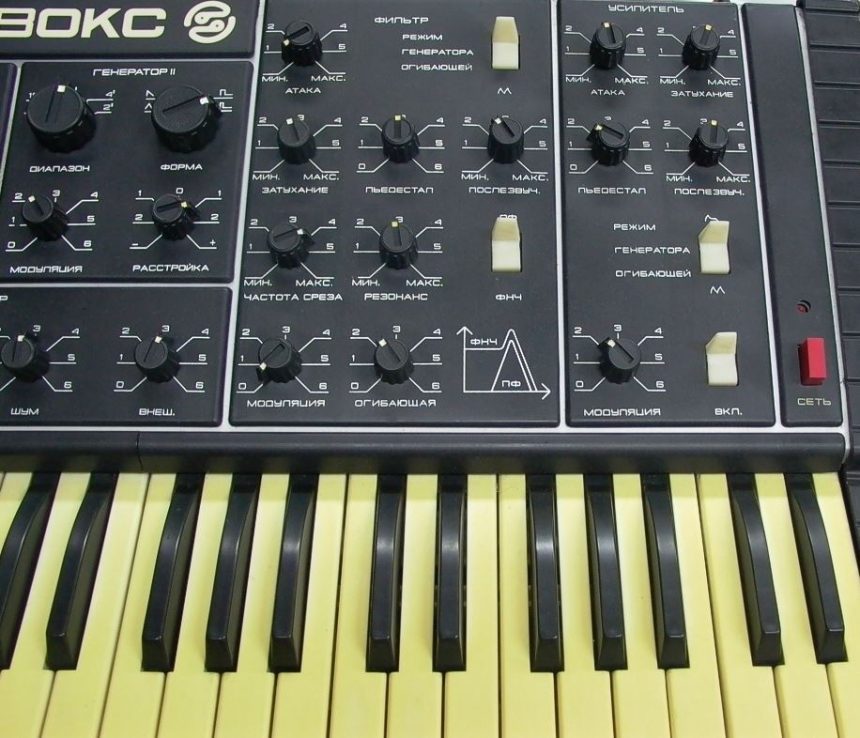
At first glance the instrument looks like a small travel suitcase (Fig.2), of those that emigrants used to go to work abroad. Once we open the aluminum container, coated with a black paint, we find ourselves in front of a really strange unit for the machines of the time. The entire chassis of the instrument, as well as the knobs and switches, are made of plastic and resemble, sardonically, the clothespins with which we usually hang clothes (Fig.3). The keyboard has 49 keys (Fa-Mi) and feels very fragile to the touch. I have never before touched such light keys that I am seriously afraid of breaking them. Note the absence of physical modulators such as pitch wheel and modulation wheel. The control panel is entirely in Cyrillic, but fortunately there are excellent translations on the web. The machine is equipped with two oscillators with waveforms selectable between Triangle, Sawtooth, Square and two types of Pulse, both are tunable in the range of 5 octaves, another knob also allows us a more precise tuning of these. There is a Noise Generator, an LFO with various waveforms (including a Sample & Hold) and two ADSR envelopes, one for the filter and one for the amplification. A peculiarity of these envelopes consists in being able to select the “auto trigger” mode, each with independent “rates”. What happens, once the switch is moved to that position, is that the envelope restarts automatically once the last stage is reached. The panel has a total of 31 knobs and 6 switches. On the back of the machine there are two 1/4 "input jacks and two 5-pole DIN inputs (MIDI style, standard at the time in the Soviet Union) probably used to control the filter and audio in (Fig.4).
.gif)
.gif)
.gif)
The filter
I find it very important to say a few words in favor of the filter on the Polivoks as I consider it one of the most particular among the many I have ever listened to. Let's start by describing its basic features: it provides a 2-pole 12db Lowpass and a Highpass. Strangely, the translations of the panel available on the net refer to a Bandpass, but the ear does not betray and what you can hear is the typical cut of a Highpass. The filter has a warm tone which gradually becomes very aggressive. In the tests I was able to carry out, I noticed a peculiarity that makes the sound of this synthesizer scratchy and violent: as the Resonance is increased, the sound becomes increasingly bad and harsh. The auto-oscillation of the filter is unlike any that I've had the pleasure of hearing so far. The influence of oscillators on the centering of the filter becomes more and more evident as one approaches the self-oscillation threshold (Fig.5). The result is a sound that, my word, you will hear it right inside your gums. It vaguely resembles the violence achievable by mixing the resonances of the two filters on the Korg MS-20, with that very characteristic midrange tip. Equally strangely, if you reset the oscillator volumes and use Noise as a sound source, the filter will self-oscillate more clearly, generating the typical sine wave. Unlike many analogs, which use a combination of capacitors with varying resistances, the heart of the filter is simply a couple of low-power op-amps. Taking a look at the schematic it would seem, at first glance, a classic variable state filter (SVF) but with one substantial difference: the total absence of capacitors. The voltage modulations are applied to a pin of the integrated, to increase or reduce the "gain band" of the operational. In this way it acts as a time variable RC element (Resistance + Capacitor). Making a clone, therefore, becomes extremely simple and cheap (Fig.6).

.gif)
.gif) How it sounds
How it sounds
As mentioned above, the Polivoks has a truly unique character linked above all to how the filter was designed and built. Fortunately, oscillators aren't joking about character either. They sound very “buzzy”, a bit like those of the Andromeda A6, and in pairs they manage to give that sound texture so adored by vintage fans. Once the locations of the various components have been memorized, it becomes very simple to program it from the panel without using the translation. The single LFO manages to provide interesting modulations especially when the random waveform is selected (which sounds like a Sample & Hold to the ear). The effect obtained by applying the aforementioned waveform as filter modulation is beautiful. Combine this with the automatic retrigger of the envelopes and you will get unique tones. The bass sounds are always present and full-bodied, but different from the classic sounds we know of the Moog and the classic Roland TB303, but no less fascinating. Equally interesting are the leads: it is possible to obtain scratchy sounds by making good use of the modes available in the filter. The geeks will find intriguing the possibility of programming pads and drones with very positive results, obtaining complex and never musically useless timbres. Equally intriguing is the possibility of being able to process external audio signals through the instrument's filter. Imagine how good drumloops could sound through the rude Lowpass of the Polivoks (Fig.7), or how your own voice would be processed and sculpted by the instrument's scratchy filters. Don't be scared you sound purists, at times these alchemies have led to the creation of the "sound" that made a piece a great success. Who doesn't remember Cher's processed voice singing "Believe" or the deliberately fake brasses of Van Hallen's "Jump"? As a lover of vintage I can only look, with my mind's eye, at the situation that presents itself to me, catapulted into cold Russia isolated from the world; it must have been a great godsend for Soviet musicians to have a synthesizer on which to experiment with new sounds on a par with their overseas colleagues. Exploring every single knob, every octave jump, all the nuances and possible modulations looking for the right combination for our creativity, are sensations that remain unchanged over time and that, fortunately, we can still try on our skin today. Nowadays such a synth would be considered limited, too expensive compared to what it offers and difficult to maintain. Yet many similar instruments continue to present a certain market attractiveness despite not being produced for years. From Polivoks onwards, for the synthesizer sector in the Soviet homeland, it was all an uphill road. Returning to the present it must be considered that, inexplicably, today these names have almost ended up in oblivion and only a small niche of enthusiasts manages to combine the Polivoks, with other glories of the time such as Moog, Roland, Korg products and so on. . Returning to our discussion, it must be said that, despite the obvious limitations of a vintage car, the results that can be obtained are very satisfactory. I dare not imagine a version with more polyphony, so as to be able to create completely different pad sounds from those we have been used to for years on records of all kinds. Maybe we would notice a less warm and enveloping sound than a Jupiter 8 or the famous G7 Preset of analog strings from the Roland MKS70, less scratchy than an OB8, but I assure you that the machine has such a sound paste that it would make many of the most famous synths eat the dust. Unfortunately, on this instrument we only have two polyphony voices available which, once activated, make the sound much less aggressive and full-bodied. Even if the machine is overflowing with rotary controls, the lack of controllers, already standard for the time, is felt, especially for the “pitch bend”, I really can't understand either the technical or the commercial reason for such a choice. Wandering around the net, looking for information, I accidentally came across a curious software version of this gem. We at CM2 have explored this small satellite, in search of a new lifeblood for the analog star of the East.
Polivoks Station VSTi
From the site (http://vst.smtp.ru/Polyvoks.htm) you can download a freeware VST emulation of Polivoks (Fig.8) created through SynthEdit. My curiosity is captured by the words of the author who, on the product page, declares a degree of emulation equal to 96% of the original sound. There are also additions such as polyphony, a stereo delay, a phaser and additional waveforms. Do not delay and download the small file to put under stress. The interface is very similar to that of the real Polivoks, with the addition of new sections dedicated to the new features previously listed. The program is equipped with a library of 35 presets (Fig.9). I try a few right away and I am sadly noted that it is practically identical to any sound obtainable by assembling the standard SynthEdit modules. I don't let myself be defeated by the first impression and I try to program some new timbre starting from the “init” patch, using two sawtooth waveforms and modulating the filter. No way. Unfortunately this product, although graphically well presented, has very little to do with the original machine. If then we must consider that the added functions far exceed the "emulated" ones we can say that of the Polivoks, here, we have only the name. This is, in my opinion, the demonstration that the emulation of a synthesizer of the past cannot be obtained simply by reconstructing the path of the audio signal. We need a great study of the behavior of the machine, of the imperfections in the oscillators, of the response of the filter and of all those particularities that a vintage instrument has and even in these cases an emulation is unable to obtain the thrust and headroom of the original. . I feel, however, to give the author the credit for having made this synth known to those who were completely strangers to it. Thanks to this small niche of enthusiasts, nowadays we can find authentic gems that, otherwise, would end up in the limbo of lost instruments.
.gif)
Conclusions
Let's go back to the spaceship (Fig.10). While my collaborator friend Luca Capozzi is intent on preparing audio demos with Polivoks samples, both hardware and software version, I reflect on this new experience and on these two products so similar, in terms of type of audio path, but so different. in their nature. I don't want to open a chapter in my logbook "is it better to use hardware or software?", It would not make sense, but I reflect on how some interesting tools such as the Polivoks are still completely unknown to most users. Such a phenomenon was certainly justifiable a few years ago, the telematic highways had not yet been opened and information on specific products such as a synthesizer was difficult to find, unless you had a winter residence in the former USSR. Today, however, thanks to an ever-growing community of enthusiasts, we have the opportunity to rediscover old jewels whether they are quasars of rare power, such as the few EMS Synth 100s available in the world, or small and shiny comets as the destination object of the our journey. The first pilot calls me it's time to leave, L. Capozzi he has just finished preparing his demos while he sends them electronically to the editorial office, I am preparing to trace a new route for the next journey in the vast galaxy of analog instruments. What will wait for us? Will we resume the lost modular road, or will we continue this journey into the past in search of new synths? Follow us and you will know.
.gif)
Thanks to Mr. Luke Capozzi for having contributed to the writing of the article.
Antonio Campeglia