

From an early age I have always had a passion for recording. When I was a kid my father gave me a Philips K7 cassette tape recorder, with which I recorded songs from the radio speaker.
I always tried not to make noise so as not to affect the quality of the recording. Everything took place mainly at night, when the RAI was broadcasting a program where I could listen to Alberto Radius. Then it was the turn of a recorder a coil of Grundig, always recovered by some family friend, a notable leap in quality.
From that point on, even though I did a thousand other jobs, I have always been interested in everything that revolves around the world of audio recording and reproduction. So over time I have accumulated some equipment that I use in my "home studio". The latest purchase, during the lockdown, was a pair of microphones Lewitt LCT 040 Match, which I wanted to use for acoustic guitar recordings.
Actually I had miscalculated because, due to a recent operation on my left hand, my skills as a guitarist are (fortunately only temporarily) compromised. In the meantime, I helped some friends for online lessons, and in my mind I was accumulating data for the writing of this article. Many students of the music school have asked how they can best record their performances, of course with a small economic investment, to be able to monitor the progress of their training and, perhaps, share their favorite songs with friends.
Hence the idea of comparing microphones suitable for guitar recording, which could be purchased with a fairly low investment, we are talking about microphones whose cost ranges from hundred ai two hundred euros per couple. These are small or medium diaphragm condenser microphones. Then I thought about adding another microphone, which I had at home for some time. But we'll talk about this at the end.
The "competitors" of this comparison are: Samson C02 (about 100 euros per couple, price "on the road"), Lewitt LCT 040 (about 180 euros per couple, price "on the road"), SE electronics X1A (about 200 euros per couple, price "on the road"). Let's start with the first couple.
Samson C02
The Samson pair comes in a foam-padded plastic box, they come complete with wind filters and a pair of shock mounts for mounting on the temples, with a rubber suspension that insulates quite effectively. The microphones are very well made, with an aluminum body which gives a nice impression of solidity. Each microphone, which has the classic pencil shape (but it would be better to say felt pen), weighs about 170g. There is neither the PAD to attenuate the signal, nor the possibility of inserting a high pass filter. The connector is the classic XLR and need power 48 V phantom.
These are the characteristics declared by the American manufacturer:
Frequency response

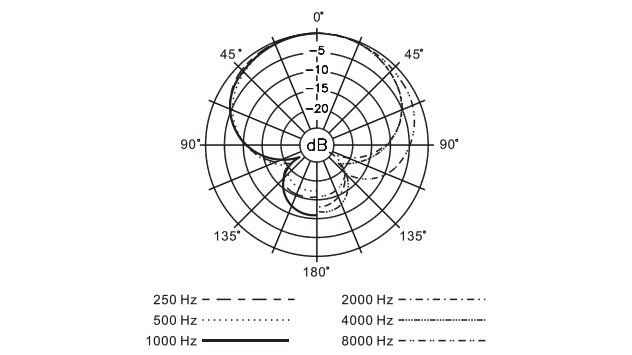
As you can see from the graph, the frequency response is quite linear, in a range of +/- 5 dB with an accentuation of the frequencies from 5000 Hz onwards, a feature that we will also find in the listening phase.
Polar characteristic
The polar feature is cardioid, with a fairly pronounced rejection of posterior signals. These are the technical characteristics declared by the manufacturer:
Type Condenser Polar pattern Cardioid
Frequency response 40 20.000 Hz
Sensitivity -40 dBV / pa (10 mv / pa)
Rated impedance 200 Ohm
Equivalent noise level 22 dB (A weighted IEC / DIN 651)
SPL max 134dB (THD≤0.5% 1000Hz)
Dynamic range 112 dB
Power supply 48 V Current consumption 3,5 mA
Dimensions 20 x 150 mm
Weight 170 g
The frequency response is extended, the sensitivity quite high (which allows you not to exaggerate the gain, especially if you have a cheap sound card) and the very low power consumption, which is useful if you use battery-powered recorders. For the recording of the guitar the manufacturer suggests a distance from 15 a 60 cm from the instrument.
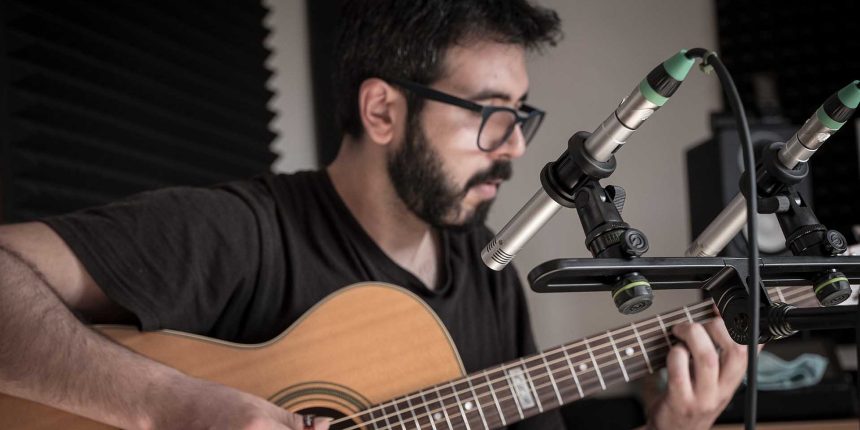
During the recording rehearsals we kept about 30 cm, placing one microphone at the bridge and the other at the twelfth fret on the neck. The result obtained, in relation to the cost of the couple, is very interesting. They are a bit “pimp”, brilliant in the high frequencies and very fast in the response. Very easy to put them in a mix and still require little work to make them "sound" good.
In my opinion they are ideal if you do not have the opportunity to spend more, however they are all-rounders that it is always good to have in the toolbox, because they are good for both guitar and piano miking, they can be used as drum overhead with good results and finally as ambient microphones. In short, one hundred euros very well spent.
Lewitt LCT 040
The second pair in comparison is from the Austrian Lewitt, a company born ten years ago, but which is imposing its products in an important way. They are quite cheap, high quality, versatile microphones and the technologies introduced are very interesting. The microphones are individually packaged in foam-padded cardboard boxes, each microphone is equipped with a windscreen, a support to fix it to the rod and a padded pouch to hold everything. The support is made with a resin that is very consistent to the touch and of moderate weight. Each microphone weighs around 44g, which is almost a quarter of the Samsons, but despite this they provide a good impression of solidity. The advantage of having a lightweight microphone is that mounting a pair on a stereo bar still results in an assembly that doesn't put too much strain on the mounting rod.

The frequency response graph shows, also in this case, an increasing response on the highs, with an increase of about 5 dB dai 5000 ai 12000 Hz. The strange thing, when listening, is that this increase is not as perceptible as in the case of the Samsons. There is always some certainty brilliance, but in the overall performance the sound is more homogeneous in the frequency range. The polar characteristic, always cardioid, compared to the Samsons is narrower with an even greater rejection to the rear signals.
These are the declared technical characteristics of the house:

Type Condenser Polar pattern Cardioid Transducer diameter 17mm
Frequency response 50 20000 Hz
Sensitivity 18,8 mv / pa (-34,5 dBV / pa)
Rated impedance 203 Ohm Rated load impedance 1000 Ohm Equivalent
Noise level 20db(A) SPL max 135dB SPL
Dynamic range 115dB Power supply 48V
Current consumption 7,2 mA
Dimensions 24 x 83 mm
Weight 44 g
From which it is clear that the sensitivity is higher than the Samsons, and that it also allows for less noise. The current consumption is double compared to the Samsons, but still quite negligible for use "in the field". The manufacturer recommends this pair of microphones for the guitar recording or how overhead for the battery. The transient response seems a bit slower than the Samsons, but still very fast. Overall, the resulting sound is more balanced, always very easy to insert into the mix and requires very small equalization interventions. Compared to the Samsons they are "a step forward" for the quality of the nuances and harmonics they manage to capture.
SE Electronics X1A
- X1A they do not have the pencil shape of the other two and the weight is also considerable. Also in this case the package is made of cardboard and padded with expanded foam. Only the support for the rod is supplied, solid but not very rigid. A metal shock mount is available separately, very well built and solid, but which increases the cost not a little. We made our tests with the standard supports supplied.
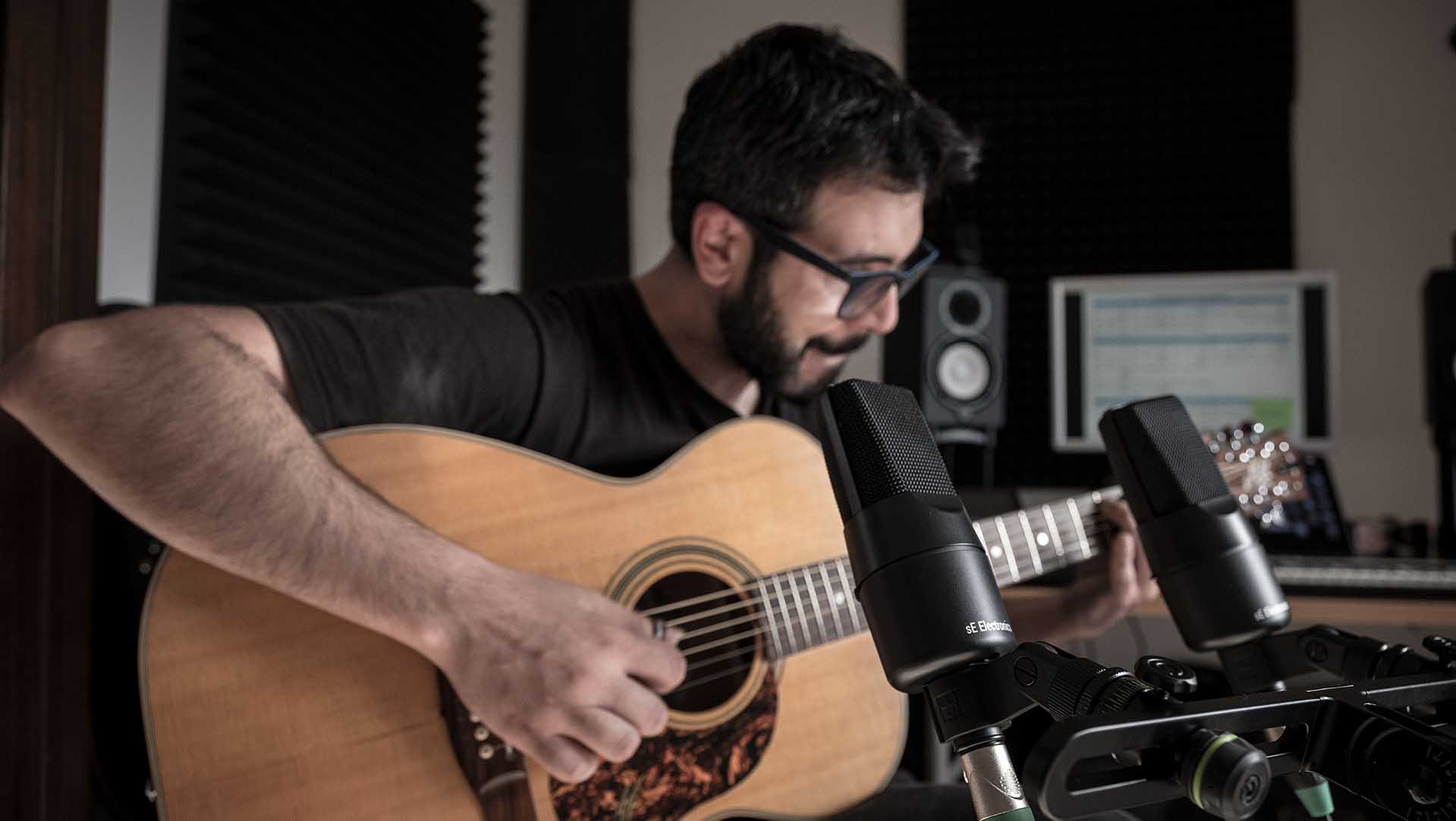
On the body they are present two switches, the former attenuates the signal of 20 dB, the second activates a high pass filter a 100 Hz. Each microphone weighs just under 400g. Although sE refers to them as large diaphragm microphones, the capsule has a diameter of 16 mm, therefore equivalent to that of the Lewittts. That is why they have been included in this comparison. The manufacturer also recommends them for acoustic instruments, for vocals, as overhead, for the microphone of amplifier cabinets etc. In short, real all-rounders.
The declared frequency response is very linear, +/- 2 dB da 50 a 20.000 Hz and the polar figure, always cardioid, has a slightly lower rejection than the two previous microphones, especially at low frequencies, probably linked to the different conformation of the body.
These are the declared technical characteristics:
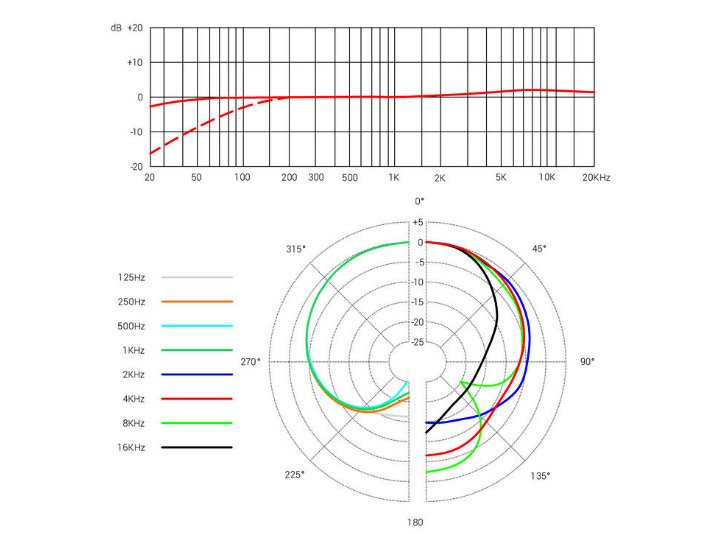
Type Condenser Polar pattern Cardioid Transducer diameter 16 mm
Frequency response 20 - 20000 Hz
Sensitivity 20 mv / pa (-34 dBV / pa) Rated impedance 50 Ohm Rated load
impedance 1000 Ohm Equivalent noise level 16 db (A)
SPL max 130dB SPL (150 with PAD)
Dynamic range 114dB (134 with PAD)
Power supply 48 V Current consumption 4 mA Dimensions 58 x 169 mm
Weight 390 g
In this case the noise is even lower, compared to the other two and the sensitivity slightly higher. During the listening phase, there is a greater presence of the low range (the shots were performed with the high pass filter excluded), of the slightly slower transients, a generally more “amalgamated” sound, without particular prevalence. Again, it's easy to get sound into the mix, without worrying too much about equalizers or other plug-ins.
Special guest
The fourth guest of our comparison is a bit particular, it is not a narrow diaphragm microphone, it is not a condenser microphone, it is a marked "Chinese" Marantz - specifically the model MPM3500r, and it's a active ribbon microphone.
It is in my arsenal because, some time ago, I took it by taking advantage of a super discount, paying for it approximately EUR 90. I had no idea how to use it, but a ribbon microphone can always help. It is an active ribbon microphone and therefore requires 48 V phantom power. Comes in a nice aluminum case, padded with foam, comes with a full metal shock mount and a resin pop filter , really well built. In short, only the accessories would cost more than the ninety euros spent on the purchase. The case includes some rubber bands and spare rubber seals. The accompanying frequency response graph, very approximate, shows a rather tortuous trend, with variations of 8 dB among the 50 and of 10.000 Hz. Despite the hump in the mid range, the resulting sound is very rich in mid frequencies and a bit waning in the highs. It is also very fast and articulate, and rich in harmonics. You have to work a little to make it "sound" good, but the result is not bad at all, always in relation to the cost. Being a ribbon microphone the polar figure it is at 8, so the rear signal has no rejection.
These are the declared characteristics:
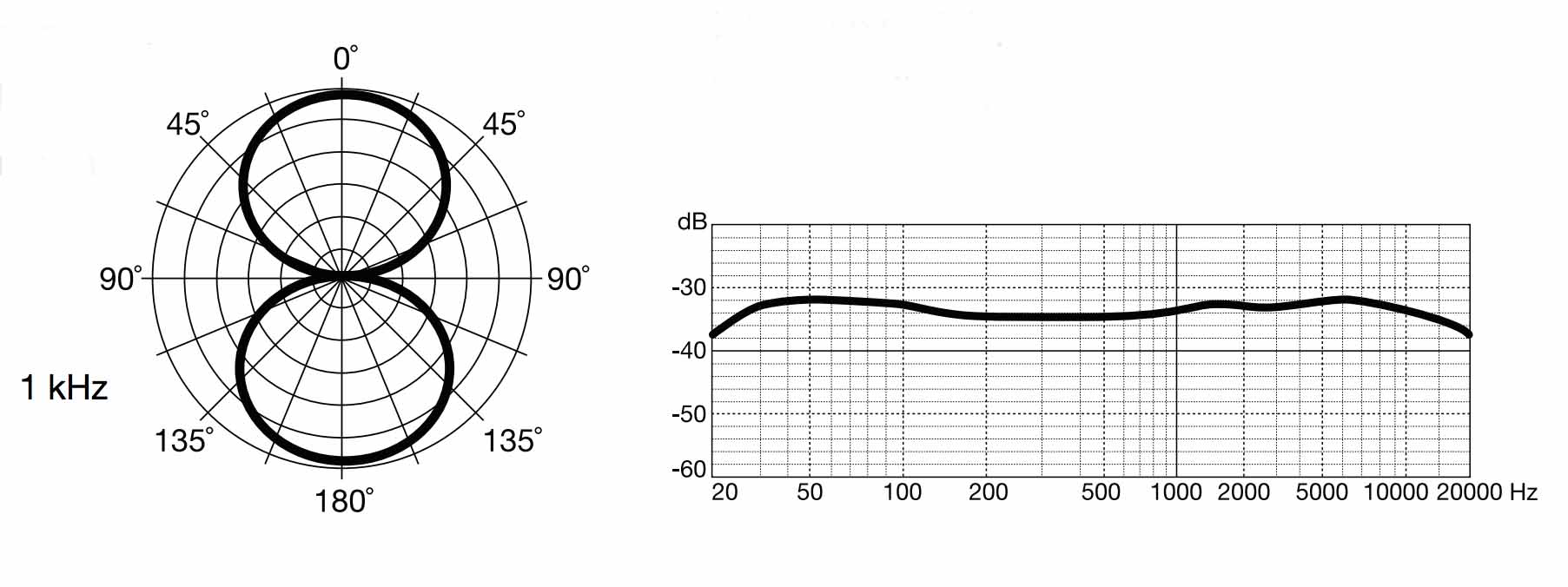
Type Ribbon Polar pattern Figure eight
Frequency response 20 - 20000 Hz
Sensitivity 20 mv / pa (-34 dBV / pa)
Rated impedance 200 Ohm Rated load impedance 1000 Ohm Equivalent
Noise level 15 db (A)
SPL max 135dB Power supply 48V Current consumption 3mA
Dimensions 58 x 205 mm
Weight 490 g
The absorbed current is negligible, the dimensions are quite important, with the support and the pop filter it reaches almost 900 g in total.
Recording and listening test
As mentioned, due to the operation I was not yet able to play in an acceptable way, and I asked for help from my teacher, the Master Giovanni Feliciello, who came to my rescue.
In his home studio we have set up a set to record, with a pair of microphones at a time (except for the tape one which is single), his personal arrangement of "Lady Madonna" by the Beatles, lasting about sixty seconds. We mounted the microphones on a stereo bar, placing them each time about 30 cm from the instrument, with one microphone at the bridge and the other near the twelfth fret. The guitar used is one guard EBG808TE. All recordings were made with a sound card MOTU 624 e Cubase 10.5.2, trying to keep levels similar between takes. These are the results (the files uploaded to Soundcloud are in wav format, 24 bit/48 KHz):
Samson C02
soundcloud.com/davidevisca/samson-c02
Lewitt LCT 040
soundcloud.com/davidevisca/lewitt-lct040
sE_Electronics X1A
soundcloud.com/davidevisca/se-x1a
Marantz MPM3500r
soundcloud.com/davidevisca/marantz-mpm3500-g
Conclusions
It is not easy to draw conclusions, there are neither losers nor winners, each microphone has its own peculiarities and provides, always based on the purchase price, results ranging from good to excellent. Of course the microphone is not the only actor in the chain, but the preamps of the sound card, the converters, the environment also come into play. Our test does not want to provide a universal result, nor does it want to have an absolute scientific value. Everyone can (and should) experiment on their own with the combinations that provide the best results. And - I repeat - we must not forget the economic range of the microphones under test.
David Visca