

Somewhere I must have read that Robert Taylor started his passion for building acoustic guitars when he came across a Ranger XII of the very Italian Eko. little: In the homeland of the modern folk guitar, the one who would become one of the world's leading producers of fine acoustic guitars was not struck by the wonderful dreadnoughts of the Martin or Gibson house, but was fascinated by the features of an inexpensive "spaghetti-western "Produced in Italy.
This circumstance - for the writer - confirms a long-held theory, namely that the folk guitars produced by Eko, and specifically the models of the "Ranger" series, represented something fascinating, something that crossed the boundaries of economic imitations of production. beyond the Alps.
 In the years of the commercial boom of the "Eko Ranger", therefore, Bob taylor (Fig.1) begins his adventure in the world of acoustic lutherie, between very clear ideas and financial difficulties.
But America is still the homeland where ideas, projects, banks and lenders have been able to create planetary giants… at least until a few last years.
And so, towards the middle of the years '70, young Bob finds the necessary funds and gives life to his formidable creature.
Taylor Quality Guitars
What has always impressed me - and paradoxically perplexed - about Taylor production is that mix of lutherie tradition and “inhuman” constructive cleanliness.
With Taylor, the traditional American acoustic guitar abandons the folk instrument - minimal and Spartan - becoming something extremely refined and luxurious. The concept of "high quality" becomes manic and inaugurates the trend of acoustic-boutique, where the value of the project as well as the realization of any detail is entrusted to robotic machinery of absolute precision. Finding some manufacturing flaw in a Taylor is a difficult task, its construction to the test of "superhuman" hands ensures standards beyond any conventional lutherie creation.
In short, tradition becomes hi-tech with such excellent results as to force the main competitors to adapt. Far from the glories of the fifties (Martin) and the sixties (Gibson), the world's leading manufacturers of acoustic guitars take lessons from Robert Taylor and follow - in some ways - footsteps and strategies. Furthermore, after Taylor, a myriad of small producers and luthiers of “de luxe” acoustic instruments flourished, the clear rye of a market by now shrewd and receptive to creations of superior quality.
Robert Taylor was therefore a pioneer in this area. Obsessed with the concept of "top quality”, He used it in every area of his production: from design to the choice of essences, come on painting methods to the plants of preamp, from cases to brochures and catalogs of his home. Even the latter, from simple advertising brochures, become true editorial masterpieces. Ditto for the website which beats any manufacturer in the sector for photographic quality and completeness of information.
In short, our Bob created his factory of prestigious musical instruments in the seventies and immediately declared his intentions by giving it the name of "Taylor Quality Guitars".
Taylorseries
Speaking of clear ideas, let's briefly mention the acoustic instruments in the catalog. Limiting ourselves to the production of solid wood, we have only three "body shapes”In seven different combinations of essences.
The identification of a model, therefore, is based on a numerical prefix (from 3 to 9) which identifies the mix of woods used and a suffix (10, 12 or 14) which identifies the shape of the instrument.
For the woods we have in order of increasing value:
• Series 3 Sapele (back and sides) - Sikta Spruce (soundboard);
• Series 4 Ovangkol - Sikta Spruce;
• Series 5 Mahogany - Engelmann Spruce or Cedar;
• 6 Maple Series - Sikta Spruce;
• Series 7 Indian Rosewood - Engelmann Spruce;
• Series 8 Indian Rosewood - Sikta Spruce;
• Series 9 Indian Rosewood - Sikta Spruce.
Obviously, as we climb the “series” - and obviously the purchase prices - we will have more selected tops and inlays of greater value and complexity.
Finally the three body shapes:
• Series 10 Dreadnought;
• 12 Grand Concert Series;
• Series 14 Grand Auditorium.
Any additional abbreviations "C"Ed"E"Indicate - respectively - the presence of the cutaway (Cutaways) and electrification (Electric).
The 814 "ce"
We are dealing with an “8” series (therefore Indian rosewood back and sides and spruce top) in “14” configuration (Grand Auditorium).
As mentioned, the acronym "CE" (Cutway / Electric) indicates the presence of the cutaway in the "Venetian" style and the electrification system.
The instrument under test represents the "core" of Taylor production. According to the company's own statement, the 8 Series represents the “flaship” of the entire production and its greatest commercial success. The mix of essences used in the 814, in fact, constitutes a real standard for prestigious acoustics.
The instrument is supplied in the classic Brown Tolex Taylor case, a true masterpiece of aesthetics, solidity and protection of the instrument. Entirely made of wood, this case is beautifully finished with as many as five strong brass (or otherwise brass-plated metal) latches and a finely coated internal padding that houses the guitar with very low tolerances. Apart from the moderate weight (but often the quality weighs), we are faced with a serious case with a careful finish: a balance of sobriety, refinement and marble consistency.
Once the lid of the trunk is lifted, it is difficult to refrain from: “ohhhh!….”. The 814ce is truly beautiful and also immediately communicates a feeling of great balance between luxury and simplicity.
A first glance reveals a gorgeous spruce top with straight, thin and very compact grain. It is not possible to appreciate knots or other minor irregularities. In short: a highly selected harmonic plan.
By picking up the instrument we get a feeling of awe, certainly not like a guitar to be brutalized on the shoulder while we hitchhike around the world or accompany friends during a bonfire on the beach. The varnish is impeccably laid and the transparent appears very thin and worked in such a way as to make the instrument absolutely "hi gloss". The material used for the finish appears ultra-light, resinous and extremely elastic.
We turn and turn the guitar but we can't find an inaccuracy, a smudge, an uncertainty in the realization. In short: Perfect wood joints, textbook neck anchorage, impeccable binding, abalone inlays on the soundhole and fingerboard without the slightest tolerance, perfect fret laying.
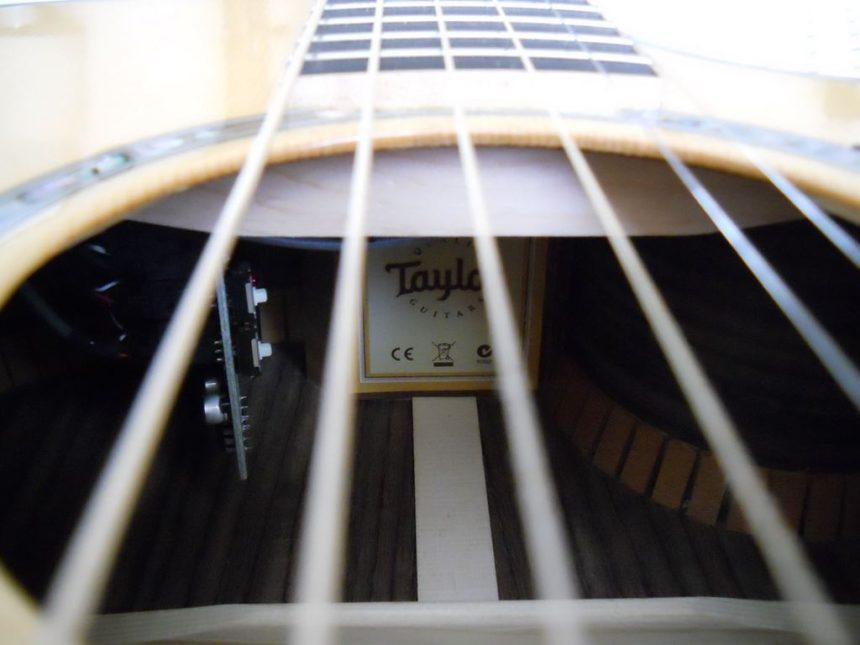
But what really leaves you disconcerted is peeking into the inside of the case… The constructive cleanliness is such that it is impossible to appreciate traces of glue even between the cracks in the counter-bands. The chains are perfect, with flawless sharp edges. The inside of this instrument is almost mirror polished and - attention - we are talking about raw woods ... bare and raw.
The weight of the instrument is also perfect (about 2,250 kg including electrical system): We are holding a very light guitar which, despite the woods used and the thicknesses used, seems to be made of balsa. While seated, our right quadriceps give thanks.
A few words about geometries. This "Grand Auditorium" has perfect shapes. Sinuous, precise and balanced in the curves, it highlights coherent proportions and a great aesthetic sense.
Following the navigation "on sight" we scrutinize the finest binding in flamed maple to the case and to the keyboard in amber finish which, moving away from the plastics to which the prevalent production has accustomed us, contribute greatly to the general feeling of high class.
And the class is confirmed by the very first tactile approach. The glossy finish of the case is counterbalanced by the mahogany neck with satin varnish that communicates a sense of natural comfort and smoothness to the touch, almost touching a raw but perfectly smooth wood. Needless to say: record-breaking action and very high precision mechanics. Turning the latter is a pleasure for the softness and homogeneity of the kinematics.
The sound proof
The purpose of a “Grand Auditorium Size” is to provide an instrument that combines the characteristics of sharpness, separation and speed of the notes typical of finger-style guitars, with the “big volume” of a Drenaught.
The intention is therefore that of a "Jumbo OM" (pass the neologism) that can combine the tastes of fingerpickers with that of strummers.
If we add to this stylistic combination the considerable volume of the instrument, the presence of the cutaway and that of the electrification, we can easily guess that the "814ce" is aimed at the professional musician who can move in any context: Arpeggios, rhythmic, solos, electrified executions in live contexts e unplugged sessions in the studio in front of a shooting microphone.
The instrument we tested impressed us with its tonal qualities. We have found in this Taylor all the characteristics of a high quality instrument: excellent overall volume, an “easy” dynamic that does not require excessive playing effort, but above all a remarkable balance between the different strings that never gives way to dough. The total "separation" between the strings and their balance allow any note, taken in any part of the neck, to continue its spatial journey independently, independently enhancing its voice in the context of complex but always clear harmonic inlays. Particularly appreciable characteristic - this - in the execution of arpeggios, where the use of different dynamics of the right hand returns three-dimensional images to the execution. This guitar is a harp.
The separation of voicings is further enhanced by an electronic tuner-proof pitch of the instrument, on any string and at any point on the neck. The intonation of this 814 enhances and validates the different tensions between intervals and chords and does so in a casual and natural way. After spending some time playing it, switching to an inferior instrument becomes easily frustrating.
And the defects?
At this point, however, we must try to find some defects ...
What can I say… Does the cold construction of a perfect folk guitar by luthiers-robots reverberate in the sound too? …Maybe…
Even in this top of the range we perceived what is a common vein in the production of Taylor acoustics, that is the exaltation of a certain crystallinity in all frequency ranges. A propensity for clear registers, with a backward midrange devoid of any nasality as well as basses which, although generous in depth, retain a certain brilliance.
This “814ce” is a classy lady, with a refined and icy beauty.
Taylor Expression System
Here things get complicated.
Since the late 90's Taylor has abandoned the amplification systems of the Fishman. Despite the high quality of the latter, it was perhaps too easy to adopt them: A Taylor could not rely on a traditional piezo system, albeit of excellent quality. A proprietary system was therefore needed, appropriate to the class of its instruments.
Il Taylor Eexpression Ssystem (TES. in theme), was the result of a study conducted by Taylor and lasted several years. The design of the related preamplifier was instead entrusted to the guru of "hi end" audio systems Rupert Neve.
The idea of the project is to amplify an acoustic guitar with a minimally invasive system, we would say almost invisible, which does not diminish the "acoustic" value of the instruments with widespread mutilation of the woods to house the hardware. The system relies on transducers positioned in strategic points of the harmonic plane to reproduce the widest timbral spectrum in a natural way. 
In this Expression System, the pick-up is therefore entrusted to a mix of sensors in contact with the soundboard, mixed with a single coil pick up “embedded” under the fingerboard in the block at the end of the neck. In short, at least in intention, this TES is to the acoustic piano as piezo-electric systems are to a Fender piano ...
The shooting system is supported by a very low noise preamplifier, equipped only with "bass","Treble"and "Volume".
This "electrical minimalism" is reflected in the advice on how to use the house where it is suggested to place everything "flat" and use the controls to obtain small environmental corrections.
Ultimately: Minimum aesthetic impact on the lutherie and functional minimalism of "one shot-one-kill". We are light years away from the prevailing philosophy that often and willingly resorts to preamp systems equipped with graphic equalizer, notch filter, piezo / mic mixer, electronic tuner and other utilities.
But how does this TES sound?
Personally it makes me despair ... a love-hate.
Undoubtedly, a system of contact sensors is capable of transforming every minimum dynamic nuance of the instrument into a useful electrical signal. But if it is true that the TES differs from piezo-electric timbres, it is also true that we are very far from the sound of studio microphones that this architecture claims to be inspired by.
This system, in our opinion, exasperates the mid-high frequencies and does so by returning subtle and intubated sounds that certainly do not do justice to the remarkable acoustic voice of the instrument.
But it's hard to digest the fact that Taylor did something wrong. It is all the more so due to the fact that Robert Taylor sponsors his TES as one of the major revolutions in the field of electrification of the modern acoustic guitar.
At the state of our test it was not possible to go much further ... several guitarists report that the TES acquires tonal quality if properly filtered by DI box or as a studio preamp. The only observations we can make in our test context are that this system requires (we repeat: It needs!) A balanced cable and that the reproduced audio quality is more than proportional to the amplification system (mixer and speakers) used: cheap audio systems, the results were often embarrassing and, given the class of the instrument, below any other good level piezo-electric system.
The TES at a glance:
PRO
• Immediate use;
• Non-invasiveness (much coveted by non-electrified acoustics purists);
• No permeability to the Larsen effect;
• Absolute silence of the preamplifier;
• Quality of components and wiring.
VS
• Thin and ducted tone, difficult to equalize with the traditional controls of a common PA system
Conclusions
This 814 is a remarkable instrument, perfectly crafted and characterized by an amazing intonation.
From the timbral point of view, it enhances a certain crystallinity which is abundantly compensated by the considerable volume that gives it depth and solidity of projection.
The essences used, the constructive cleanliness and the quality of the project endow it with remarkable dynamic abilities and the excellent emphasis of the harmonics restore a natural and always euphonic reverberation to the listening.
Separate considerations must be made for the proprietary TES amplification system which, while marrying the philosophy of absolute quality of the Taylor house, manages to express its best qualities only when related to professional and high quality audio systems.
In addition to the “Grand Auditoriun” format, the “8” series is available in Dreadnought, Gran Conert, 12-string and, from this year, “Grand Symphony” versions. Also since 2012, the “Grand Auditorium” and the “Gran Concert” are available in the version with nylon strings.
Finally, the sore point of the price which, for both the natural and sunburst versions, is around 3.000,00 Euros in the price list, except for special discounts offered by retailers.
Ultimately a great tool with only one small patriotic regret… ah! … If the catalog of Eko's glorious folk still existed!
USEFUL NEWS
Producer: Taylor
Model: Taylor 814ce
Website: www.taylorguitars.com
Distributor: www.backline.it
Price: About 3000/3200 euros
At the next TEST