



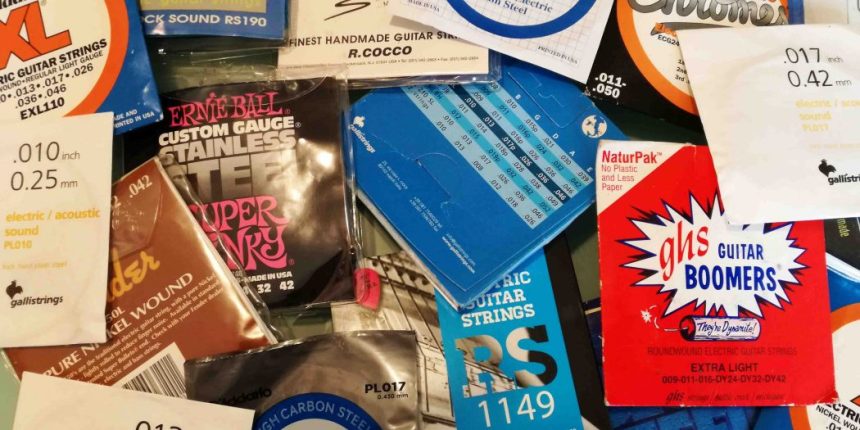
In this article, we will delve into the knowledge of electric guitar strings. As you all know, primum movens for the generation of sound it is the vibration (oscillation) of the string.
Premise, the strings used in electric guitars must have a fundamental characteristic: they must be made with materials (ferromagnetic) capable, when in oscillation, of inducing a variation in the magnetic field generated by Pickup.
For those wishing to deepen the Pickup topic can consult two of my previous articles, published on Age of Audio.
Before starting to analyze the characteristics of the strings, I would like to mention that for vary the pitch of the sound generated by a vibrating string we can basically act on three parameters:
Rope tension, or how much more or less strongly it is put in traction. In the case of the guitar, the pull / tension is varied by adjusting the "tuning keys". Great traction (very tight rope) => higher note, low traction(tight rope) => lower note.
Llength. In fact, plucking strings that are equally tight but different lunghezza we will get different sounds. Short ropes => high-pitched sound, long ropes => low sound.
Mass or thickness/caliber of the rope. Thin rope => high-pitched sound, double rope => low sound.
To make all this immediately visible, just look at the thickness and length of the different strings in a piano between the low and high notes, or notice the differences between the strings of a double bass and a violin. We have already said about the keys for adjusting the tuning / tension.
Let's return to the ropes and their characteristics.
The material used for the construction of thesoul of electric guitar strings is thesteel (ferrous alloy composed mainly of iron and carbon, the latter in a percentage not exceeding 2,06 %). The section of the steel core may be cylindrical o hexagonal . According to some manufacturers, ropes with a hexagonal core allow for better adhesion of the outer coating.
The steel core is then covered with windings generally made of nickel o steel and rarely anything else.
In relation to the winding profile we can distinguish the strings into three types:
Round Wounds (rough), Half Round Wound (half rough), flat wound (smooth).
Roundwood
Il coating presents circular section. They usually have a brighter, sharper tone.


Half round wound:
Il coating presents section semicircular, with the rounded part facing inwards. It offers less resistance to touch and generally produces a less open sound.


flat wound:
Il coating presents section completely smooth. Good touch sensation, low pick resistance and a sound tending to darker tones.


In relation to the construction materials used forwinding we can then further distinguish the strings from each other. Some examples:
Pure Nickel: completely in nickel, they generally have more sound hot e balanced design:
Nickel plated: In nickel-plated steel, have a bright and balanced sound
Stainless steel: in steel stainless, have a brighter and sharper sound.
Chrome: plated chrome, preferred by those who play jazz.
Gold: in , used by those allergic to Nickel.
Another fundamental characteristic is the diameter /thickness/caliber/ gauge of the ropes.
This is indicated in inches. The set of strings with their gauge and their ratios is commonly referred to as "scaling". When it is regular, it is often sufficient to indicate the values of the two E (high and low) to identify it. Eg. 0.010-0.046 or 0.09-0.042 etc.
Below is a brief table with some "classic scalings":

Lo string thickness affects some features:
Voltage: the thicker they are, the greater the tension and therefore the harder the string will be to the touch
Volume: the greater the string, the greater the pertubation of the magnetic field, the greater the volume.
Tone: Thicker strings produce lower sounds and vice versa.
Furthermore, larger gauge strings generally present more sustain, un more ready attack, major definition; on the other hand they are more rigid (harder to play), they do not facilitate bending e they increase the tension on the neck / headstock / body of the instrument ...
The thinnest strings they are generally easier to play, More soft to the touch and allow better bending but they lack some of the characteristics we find in thicker strings.
As often happens in acoustics/electroacoustic you have to make choices and accept compromises because some parameters are in contrast with others and everything cannot be achieved. This consideration is generally valid for many situations that arise in life, but this is another matter and so let's get back to the ropes!
To work, the string must be mounted on the guitar and here another fundamental parameter comes into play: Instrument tuning fork.
diapason o guitar scale: expressed in inches or millimeters, it represents the length of the vibrating string and goes from the nut to the bridge saddle.


The two best known reference scales are that of Fender Stratocaster Long Staircase- with a tuning fork of 25.50 ″ (647,70 mm) and that of the gibson les paul Short scale- with a tuning fork of 24.75 (628,65 mm).
Beyond these two standards we also find other lengths used in different guitars.
The length of the scale affects the tension of the strings, the sound and the feeling with the fingerboard. Let's analyze the reason for these effects:
The tension of the strings, with the same diameter, will be influenced by the length of the tuning fork, that is, the longer the scale, the tighter the string will be (short scale => lower voltage, long scale => higher voltage). A guitar with a long scale and tighter strings will generally present a more present and faster sound in the attack, a “better” low frequency emission and a good sustain.
Furthermore, for the sake of completeness of information, it should be mentioned that with the same string scaling, there could be different tensions between one brand and another depending on the type of harmonic steel and related alloys used.
Below, just as a testimony to the variability and personalization of the choice, I report some examples di scaling used by famous artistsi.
Concluding this brief overview of ours, we can say: knowing the ropes and our needs is essential to try to orient yourself and make an informed decision. What is certain is that there is no universal choice but everyone, depending on the instrument used, the genre played, the feeling they want to have to the touch and the tone they prefer, will make their conscious choice.
When you read, however, always remember the guitar on which the strings were mounted (tuning forks and characteristics). Also keep in mind that the strings are important but the final sound of an instrument is in any case the result of a mix of more or less determining factors wood, pickups, constructive choices, strings, adjustment, amplification, touch of the player, etc ...
Stevie Ray Vaughan .013 (.013 - .052)
Jimi Hendrix .009 - .038 or .010 - .038
Jimmy Page .008 or .009
Jeff Beck .011 - .049 or .009 - .052
Eddie Van Halen .009 - .040
Buddy Guy .010
BB King .010
Slash .011 - .048
Mark Knopfler .009
Eric Clapton .010 - .046
David Gilmour .010 - .048
Zakk Wylde .010
Steve Vai .009 or .010
Joe Satriani .009
Joe Bonamassa .011 - .052
Brian May .009 - .034
Eric Johnson .010 - .046
Frank Zappa .009 - .042
Lenny Kravitz .010 - .052
John Frusciante .010
Good choice and good music to all
Useful Information
Magnetic Pickups for Electric Guitar Part I
Magnetic Pickups for Electric Guitar Part II
References
Cicape
Musical instruments
Agreement.it
Helmuth Lemme: Electric Guitar Sound Secrets and Technology
Dave Hunter - The Guitar Pickup Handbook: The Start of Your Sound
Wikipedia
Musicoff
Jeff PerrinMusic


