

Honestly, I did not expect it, even if perhaps I unconsciously wanted it ... so I finally have proof that they read our thoughts and interpret our desires very well ...
Well yes, I had the original Wavestation taken just out then (obviously) expanded to the EX version. For the time it was science fiction stuff, hundreds of samples, but above all the possibility of overlapping them and creating your own wavesequences (a series of wave form/samples reproduced one after the other). The icing on the cake was the possibility of playing simultaneously in a performance (in a mix between layer and split) up to 8 patch (each consisting of 1-2 or 4 oscillators / wavesequences) and double the effects send.

After calculations made, however, unfortunately when playing a performance consisting of 8 patches with 4 oscillators, the 32-note polyphony was exhausted by pressing a single key (even the calculation power was put to the test starting to lagging on the notes played ...) even if no one was he would never have dreamed of doing it: the point is that in any case a single patch made up of 4 sounds was of an unprecedented power for the time! In short, the successful Korg response to the very famous and also very innovative Roland D-50.
Hardware, material quality
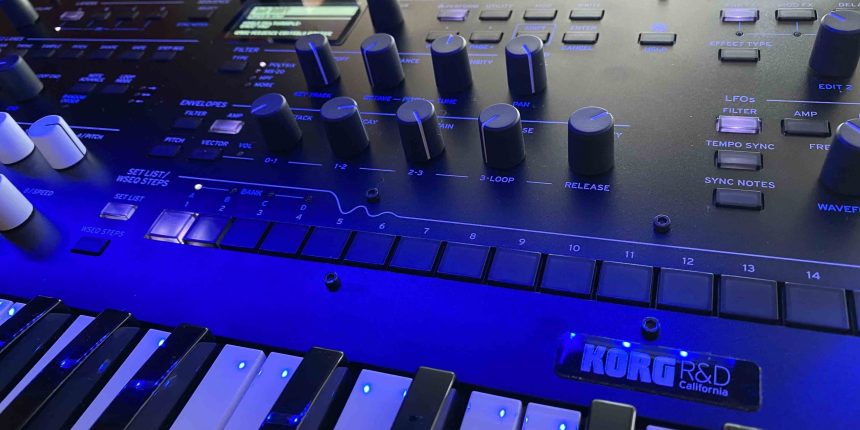
The new synth is well assembled, the materials chosen are perfectly in line with the price range of the instrument and, to contain costs, instead of using dedicated chips, Korg has chosen to use a Raspberry Pi as a central computing unit. The controls and buttons are of good quality and respond very well to the touch, the top panel is metallic, the keyboard is a standard 3 octave format but without aftertouch and a bit light (clearly it won't happen to play Brahms and if it happens just use a external keyboard), the OLED display small but well readable (now they use them everywhere given the very affordable price) but I - wanting to stay on a standard size display - I would have put another 2 to manage the various parameters. Power is supplied by an external power supply.

Considering the price of the synth, however, there would be a miracle to be screamed at… he makes up for all the small shortcomings due to cost containment.
Arrangement of knobs
The controls are arranged in a fairly intelligent and ergonomic way, divided by section; there are 2 wheels, one for the pitch and the other for a modulation source (we will see later that the modulation section is very powerful but really very powerful) there is the inevitable Joystick that in the original machine was designed to control the mix of the 4 oscillators (ABCD) but here it also acts as a modulation source.

There is no shortage of double functions assigned to the various controls, a cross and delight of all serial (and evening ...) snipers, I admit that I also need a fairly continuous use so as not to forget all the possible combinations of SHIFT + Rotate or ENTER + Rotate ...
Sound engine / Differences with the Wavestation
I will not go to analyze in a surgical and scientific way the differences with the original Wavestation, just know that the Wavestation for each performance could load 8 patches each consisting of 1, 2 or 4 oscillators / wavesequence; the Wavestate instead focuses on a Performance made up of 1 to 4 layers / programs / oscillators / wavesequence. This is the only "limit" compared to the ancestor (along with the lack of aftertouch).
For the rest, the new model is a winner on all fronts, starting from memory management: the original had a limited number of performances (50 ram1 + 50 ram2) and storable patches (35 ram1 + 35 ram2) also limited the number of user wavesequence (32 ram1 +32 ram2). In practice, if you went to modify one of the patches or wavesequences, all performances that used that patch / wavesequence were also affected (which also happens in the modern Fantom, except that the latter can store thousands of user patches and therefore the problem can be easily bypassed). In Wavestate, on the other hand, each performance is independent (you can really store thousands of them), the 4 layers / programs - which can also be used on different midi input channels - are freely editable without having to worry about influencing other performances, they have independent effects ( apart from the reverb which is inserted on the global audio path of the performance) and it is however possible to save a layer as a program so that it can be used in other performances. Same thing goes for the wavesequences, they are freely modifiable and memorable for future use as starting points or in other performances. All this in favor of our creativity that will no longer be limited by the little memory available as in the original Wavestation.

Very importantly, in the new synth there is a filter with variable resonance derived from virtual analog (in the original it was not resonant, so goodbye to the classic analog sweeps with open / close high resonance filter). There are even various types of them, some derived from Korg analog synt emulations of the past: "Bypass, 2-pole LPF, 2-pole HPF, 2-pole BPF, 2-pole Band Reject, 4-pole LPF, 4-pole HPF, 4-pole BPF, 4-pole Band Reject, Multi Filter, MS-20 LPF, MS-20 HPF, Polysix"
The Wave Sequence chapter alone would need an entire article. As I said earlier, a Performance is made up of 4 layers or if we want to call them sound-programs. The important thing is to understand that they are from 1 to 4 and are independent, like 4 different synths (apart from the reverb which is global). Each layer can be used as a normal oscillator that reads a sample by drawing (therefore not Virtual Analog) from the internal library or set as Wavesequence (so it will read up to a maximum of 64 samples in sequence).
Each wavesequence it is not only composed of only a series of waveforms but of multiple parallel traces (calls BORROW, literally lane in English) where each contains information for playing the wavesequence. We will then have the LANE where there are the steps containing the waveforms to be reproduced, the crossfade times and the loop points (to name the most important). The LANE containing the timing for the execution of the steps. The lane for the pitch to be assigned to each step and even a LANE that acts as a step sequencer to modulate a whole series of destination parameters.

If we think that each LANE can have different loop points and different probability percentages on the execution of the step, we begin to glimpse only the tip of the iceberg of the evolutionary polyrhythms that can be generated ... without even bothering the available arpeggiator!
Remarkable is the availability of samples, divided by categories and origin (original Wavestation - Plugin GURU and Wavestate). Only by using these samples and without using wavesequences you can really come up with sounds interesting; the samples (several hundred) are truly a constant source of inspiration. Of course, let's not expect the multisamples that could be present in the workstations, but that would not be the ideal use of this synthesizer anyway.
The assortment is very vast, starting with acoustic sounds and then moving on to synthetic ones: the very particular and expressive samples of the Plugin Guru are worthy of note.
They complete the specifications of the synth section well 4 LFOs (addressed to filter, volume, pan e pitch), complete with everything and synchronizable to time BPM of the performance. Three envelopes for amplitude, filter and pitch respectively; The joystick can be moved manually or programmed to follow 4 second points in the envelope to be programmed.
The effects section is complete and well sounding: for each of the 4 layers they are available PRE effects, modulation and delay. In the end, on the total mix of the 4 layers there is reverb. It would have been very useful to have the ability for each layer to bypass the reverb stage or, better yet, a send to determine how much reverb to apply to the layer.
Bench quality
There are tons of sounds divided into various categories, which is great for facilitating the creation of sounds using the technique of "look for a sound similar to what you want to make and then modify it until it becomes what you wanted". This could be a bit complicated given the very complex structure of the Wavestate. Sometimes it is necessary to literally disassemble, deconstruct the sound to understand its behavior from what it is generated. Excellent the possibility of memorizing the various “components” of the performance in independent objects to be able to use them in other performances. The programs that make up the 4 layers of the performance and the wave sequences can be stored.
To facilitate the organization of all saved elements and sounds, a librarian is available immediately.
Ease of use
With the Wavestate you go through 3 phases: as soon as it is switched on it creates a good dose of confusion, the panel controls are many but the parameters available are really many, inevitably to go and modify some parameters you need to enter the various menus.
The second phase begins from the menus when you perceive that despite being a synth with almost infinite potential, the Korg programmers have managed to harness everything in a fairly logical way with panel shortcuts that allow you to quickly reach the chosen menu.
Once you understand what and how much you have in front of you, the third phase begins, the one where you need to use all your imagination to be able to put all the pieces together. It is a multifaceted synth that can be used and exploited at various levels: you choose a preset and you start generating ever-changing evolving melodies. Need a lead prog or a pad? Just use a single layer with the right sample and voilà the Wavestate becomes a simple VA where you can set for example layer n.1 with a saw, set it in mono mode and split it with the unison function set to 2 - a touch of portamento and delay and that's it. For a nice pad just use one of the countless waveforms or start from the usual saw and use a nice 6-voice detune to simulate a supersaw with a single layer. Do you want to start creating from scratch using all the possibilities given by the synth? Good luck… boredom will never take over.
Ultimately a synth that can give its best using it at various levels of complexity.
What I like
- The ability to edit performance layers and wave sequences without affecting other performances.
- The sound of the reverb, one of the best ever heard on a synth: even with long decay times it is never unnatural or flat.
- The collection of samples really well done.
What I do not like
- The display. In 2020 I would have liked a more generous display that could show multiple parameters at the same time without having to change pages.
- The lack of keyboard aftertouch.
- The lack of possibility to dose the reverb on the single layers
I thank the Musical House Cav. Quinto Fabio (SA), for giving me the opportunity to use the Korg Wavestate, for as long as I needed in the various tests carried out.
Useful Information
Producer: Korg
Distributor: AlgamEko
Model: Wavestate
Advised price: € 650,00