

Universal Audio continues to represent a point of arrival for many companies in the field of products for the recording studio and not.
Over the years, many companies have tried to emulate the contents and in the last period practically all the major companies in the field of audio interfaces are starting to give the possibility to manage proprietary plugins (see Antelope Audio or Apogee) or form partnerships with various developers (Focusrite), but the UAD offering is still difficult to achieve, at least as far as plugins are concerned.
The Scotts Valley, California-based company recently introduced a new line of professional-grade audio interfaces renamed Apollo X which replaces the previous Apollo. We therefore have four new models: Apollo x6, Apollo x8, Apollo x8p e Apollo x16 all based on connectivity Thunderbolt 3 with new redesigned preamps over the previous ones and new internal Hexa Core processors equipped with 6 processors SHARC extension for proprietary plugin processing.
For this test we will consider the new one Apollo X8, seeking a comparison with the Focusrite Red 8Pre, close rival in the sector and already tested by Age of Audio in the past.
First impressions
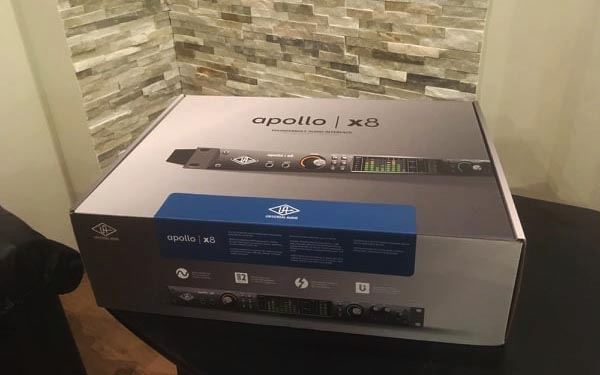
Let's start with the card unboxing. In the package, apart from the interface, we essentially find only the power supply (external, as per UAD tradition, inconvenient, but definitely safer, unlike other companies that provide it within the interface itself).
Front panel
The board is of very solid construction, aesthetically very beautiful, although personally I preferred the black color of the previous one. On the front panel we find a large central display which, in addition to allowing us to view the meter of the various input or output channels, allows us to see what type of input has been selected (Microphone, Line or HI-Z), the frequency of selected sampling (the adopted one lights up).
All left of the display we have (almost invisible to the eye) an integrated Talkback microphone, manageable through the card management software. Very useful choice for those who use the card on the desk, less for those who intend to mount it sideways to the rack. Following we have two entrances Hi-Z for instruments, a potentiometer equipped with a colored LED to adjust the gain of the preamps, which changes color depending on the function used, i.e. off at the minimum value, green for normal use, orange when we use the mode UNISON, that is the internal emulation of historical and amber Pre amplifiers when, using the Unison mode, you act on a second Gain parameter if provided by the plugin.

Always to the left of the display, we have 6 buttons. The first, Input, to select the desired input, then a Low-Cut filter fixed at 75hz with a decay of 12db per octave, the button to activate the power Phantom, pad attenuation of -20db, phase and button link to link two channels.
On the right of the display we have the possibility to change the display of the meter bar, the ALT button that allows us to switch between two pairs of monitors (possibility that is missing in Focusrite Red) and then the button FCN to enter the board setup pages. Following is the volume potentiometer, also with a color variation depending on the chosen function and finally two headphone outputs with relative potentiometer.
Back panel
Sul back panel we have, in addition to the power socket, 2 ADAT inputs and 2 outputs with optical connector, two Thunderbolt 3 \ USB-C ports, BNC connectors for World Clock 1 input \ output S \ PDIF and then 8 Line Out configurable at -10dBV or + 4dBu. It is also possible, via software, to change the output headroom of the card going from + 20dBu to + 24dBu to work with analog mixers or tape machines that require higher signal levels. In addition, the card also provides the possibility of listening in 7.1 surround through these 8 outputs.

Following we have the exit main monitor L / R. Then we have 8 Line Inputs, also these with variable headroom between +20 and + 24dB in addition to the 4 preamps (they become 8 in the X8p) which can provide a maximum of 65dB of gain.
We do not find any connection cable to the PC. When it comes to connectivity Thunderbolt 3 (the connector is the same as the new USB-C ports), we could not "recycle" the connection cable of the Apollo Twin or Focusrite Red in our possession, both with Thunderbolt 2 connectivity.
This forced us to purchase an adapter Apple Thunderbolt 2 USB-C, for the modest sum of € 49,90. From Universal Audio, they justify the lack of a USB-C cable or at least an adapter, with the fact that at this moment the number of PCs with Thunderbolt 2 connectivity is exactly equivalent to the new PCs with Thunderbolt 3 \ USB-C connections so they preferred leave "the choice" to the user on how to interface the card to the PC. Fairly acceptable choice even if, thinking about the price of this card and the older sisters, an effort could have been made.
Not present in the box, but "standard" for all new UAD users by registering their interface, the historical package Realtime Analog Classic (perhaps a little too historical by now ...) which includes the emulations of Teletronix La-2a, 1176, UA 610-B and others. However, it should be noted that the American company provides, in a fairly systematic manner during the year, promotions for those who buy new interfaces, thus being able to access paid plugins with various types of discounts.

Test
Installing the card on my PC and later on a iMac i7 2014 with operating system High Sierra, it was as simple as ever. Having already installed the driver for the Apollo Twin and the Satellite, I didn't have to do anything at all, just plug the card into the PC. It must be said that this is a great convenience for those who use different UAD products, so the console is the same for all interfaces and has the classic UAD layout that has been in vogue for some years.

At the top we have the input section with the gain starting from 10db and not from 0 (which is also present in the old models and we honestly never understood why). Below we have the UNISON panel from where you can choose the eventual emulation of historical preamps to be associated with the channel and then the classic input section with the standard parameters.
Let's now analyze the latency values of the card provided by Logic Pro X 10.4.6 both as output and as roundtrip values, in parentheses. In the first table we have the values of the UAD, in the second the values of the Red 8Pre in our possession.
Note: the values of the Focusrite differ from the test we carried out two years ago, as a heavy firmware update was carried out.
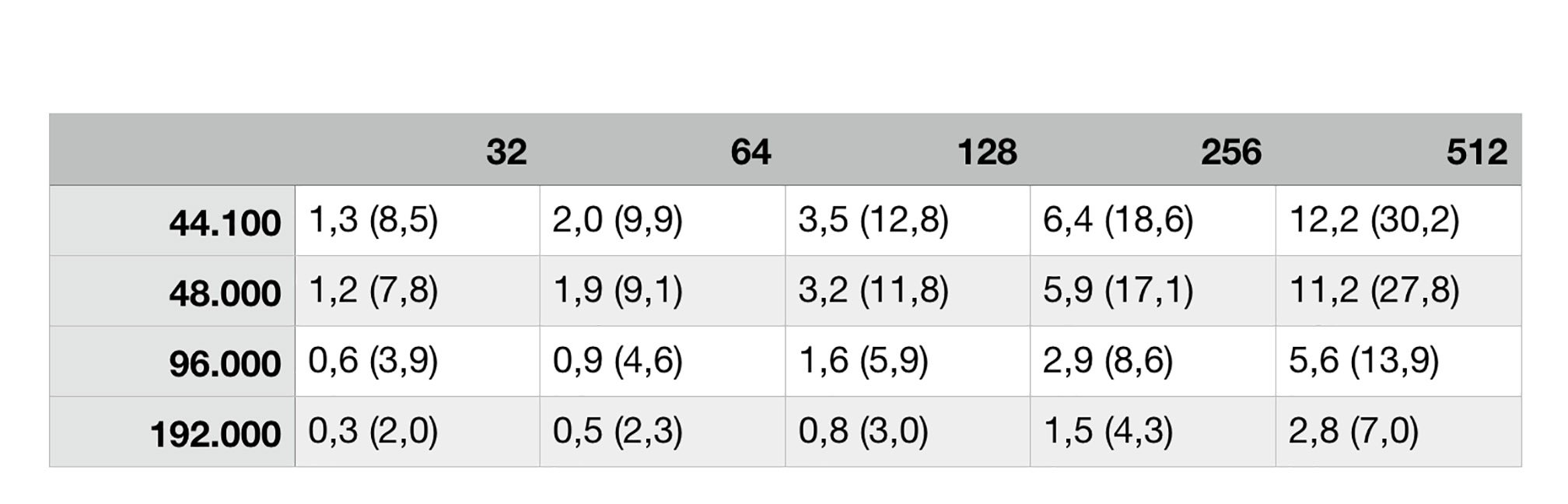

As we can see, the output values are practically identical and surprising how low they are. 0,3ms of latency a 192khz with 32 samples of buffer size they are a truly exceptional value. The question is different with regard to the roundtrip values which, compared to the Focusrite, are significantly higher both by reading the value on the Logic general page and by performing a ping test on inputs and outputs. We also went through the manual and UAD gives an Analog Round-Trip Latency value of 1.1ms a 96khz. This is probably a potential value, reachable with future drivers.
However, we can say that i UAD driver I'm definitely very stable, both by also enduring sample rate changes without restarting DAW or control software and by connecting the x8 in cascade with the Red 8Pre (we also tried this), creating an aggregate between the two cards and trying to use them as a "single interface" on the Reference DAW.
The only detail, really marginal, is that while the Focusrite changes sampling frequency without any noise whatsoever, on the UAD we hear an internal “tick” at each change made.
GUITAR AUDIO TEST
In the audio test we carried out a passive splitter was used to compare the sound of the two cards by miking a Larrivee acoustic guitar with a microphone DPA 4090, miking an electric guitar amplifier Fender Deville with a Sennheiser MD441. The impression in both cases, always analyzing one's own personal taste, is that there is very little difference between the two cards. Focusrite probably seems to be a bit more veiled in the frequencies medium-high, while UAD always stands out on those medium-low, but we are talking about sensations rather than evidence.
AUDIO TEST ACOUSTIC BATTERY
For the battery test we used a stereo pair of DPA 4090 to shoot a set of Pearl drums. The sensation that comes out in this case is almost identical in the medium-high frequencies, we can see it from the hi-hat that there is a lot of similarity between the two recordings, while listening to the snare drum, the focusrite recording gives us slightly more belly .
TEST Male and female voice
Both singers are professionals with great expressive and interpretative skills. The takes were made with the following microphones AKG 414 e Neumann U 87 available at our studio.
The new PRE of the Apollo, compared to the previous ones, are really up to one professional registration. The processed timbre did not need any external outboard for greater control over the microphone output signal.

Color is very balanced, perhaps the Focusrite Pre's remain a little more versatile, but let's talk about tastes. The question of the modality is different UNISON or the possibility of emulating historical preamplifiers in the tracking phase. In this case, the comparison between the two interfaces is obviously not relevant, because it is one thing to take advantage of the UNISON mode directly from the UAD console panel, it is another thing to use the plugin on a track recorded on your DAW. So speaking only and exclusively of the UAD, the difference is not so appreciable with the (standard) emulation of the UAD 610-B, the approach is different when using the channel strip API o Neve.
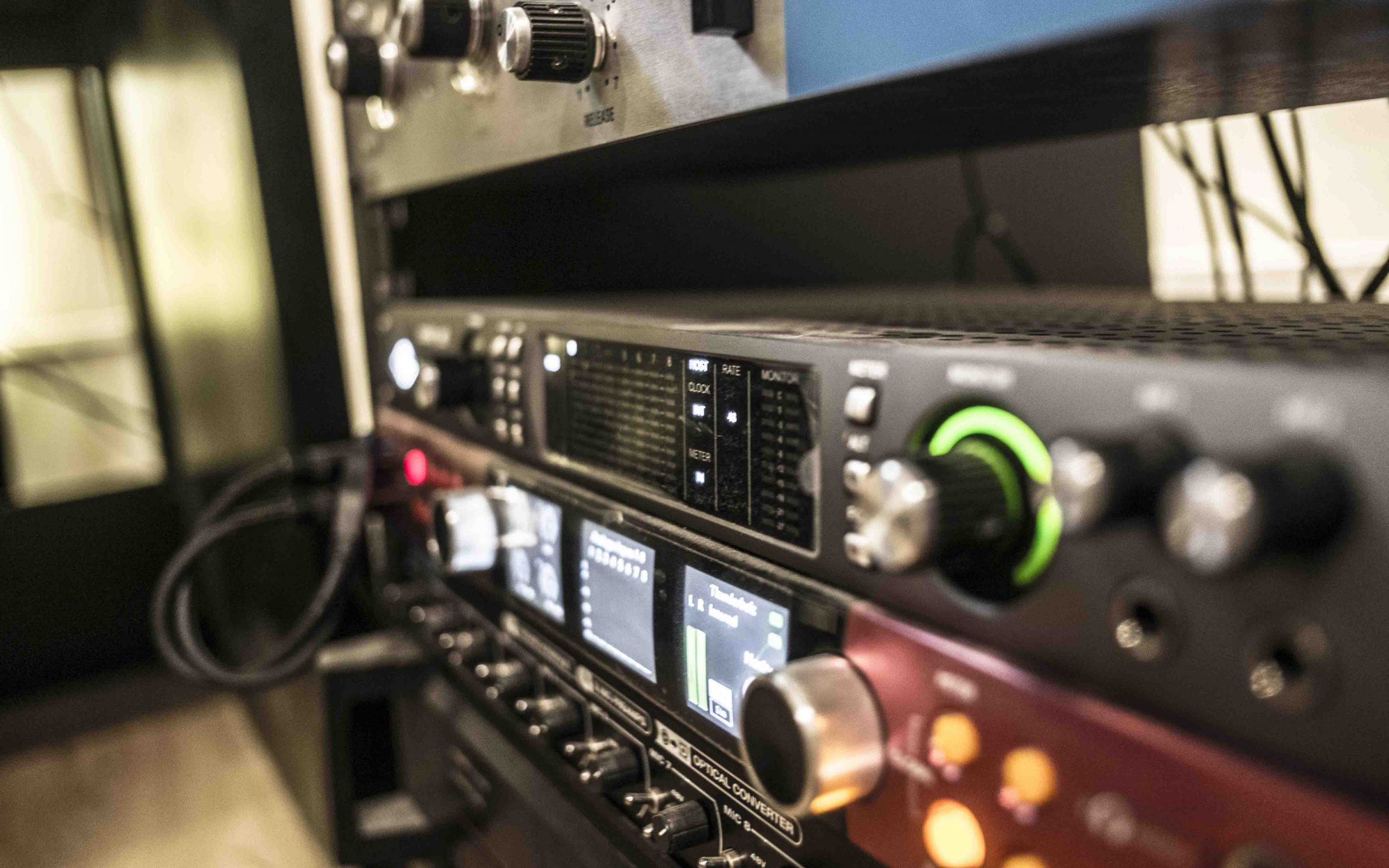
Let's say that such a solution allows you to easily bypass the purchase of cheap preamps, often necessary, even on expensive interfaces, to give your recordings some life. In this case, we begin to notice a real difference already with the use of the modules 500 Heritage Audio 73jr present in our studio, but we are talking about about 900 euros per module ... ..
So the suggestion for those who buy such a card and want to use PREs for a certain color, is to buy medium-high range products, take PRE or mediocre channels, it doesn't make sense. At that point, better a UAD emulation that can be placed on all the preamps available on the card, which among other things, with the new internal DSP, can easily manage them at the same time, without overloading the processors too much.
TEST OF
Another interesting test concerned the DI section, in this specific case we even have 2 inputs "Hi-z" that work separately, same situation that we find among other things on Focusrite. We tested the Hi-z inputs of both with the previously used Larrivee acoustic guitar, also in this case the result for both is highly professional, we leave the choice to you readers. What we can see, however, is that, unlike the classic DI inputs of cheap cards that tend to pump the mid-highs, on both, as far as possible, the sound manages to embrace the entire frequency range without exaggerating the high component too much.
Conclusions
We are faced with a classic UAD product which however winks at the future. Compared to other rival cards (also considering the versions 8p e 16x), connectivity is always lower. Let's take Antelope or Focusrite itself for example, making it quite complicated to use it for a hybrid analog / digital setup.
The American company's intention to focus on the less traditional studio is therefore clear, without analog banks from dozens of canals and cascades of outboard to be paid with thirty-year mortgages.
The decidedly more linear sound of this new version of the UAD preamps and the huge amount of features present, DSP, talkback, etc. make it attractive for professional situations, especially for those who want to build a modern studio "in the box”With a minimum of hardware machines and with the right use of UAD plugins which, when properly used, guarantee an all-in-one product of the highest quality at very low prices.
The only flaw is the total absence of Thunderbolt 3 cables or adapters. I understand the dilemma of what to put in the package, but spending from € 2700 to € 3500 for such a card and having to add at least another 50 of cables, is a bit angry.
USEFUL INFORMATION
Producer: Universal Audio
Distributor: Eco Music Group
Model: Universal Audio Apollo X8
Advised price: €2.800
Audio Demo made at Trees Music Studio in Cava de'Tirreni
DPA Stereo UAD battery - Apollo x8
Focusrite DPA Stereo Battery - Red 8 Pre
Acoustic Guitar Arpeggio Dpa - UAD Apollo x8
Acoustic Guitar Arpeggio Dpa - Focusrite Red 8 Pre
Acoustic Guitar DI - UAD Apollo x8
DI-Focusrite Red 8Pre Acoustic Guitar
Acoustic Guitar Dpa - UAD Apollo x8
Dpa Acoustic Guitar - Focusrite Red 8Pre
Electric Guitar MD441 CLEAN - UAD Apollo x8
Electric Guitar MD441 CLEAN Focusrite Red 8Pre
Electric Guitar MD441 Power - UAD Apollo x8
Electric Guitar MD441 Power - Focusrite Red 8Pre
Guitarist Stefano Turin
Acoustic guitar Larrivee
Microphone DPA 4090
Guitarist Stefano Turin
Electric guitar Gibson Les Paul Standard
Guitar Amplifier - Fender Deville
Microphone Sennheiser MD441U
Drummer John Fasano
Battery - Pearl Masters Studio Birch Shell
Dishes - Ufip Rough Series
Microphones DPA 4090 Stereo Set
Good music to all
Vincenzo Siani