

The sound designer is a particular creative category: his work is not seen, but you can hear it and this is the important thing.
He realizes what E. Satiand he defined "Furnishing music" or a music that thwarts the noises of the outside world that brazenly insinuate themselves into the work. Mainly armed with microphone and computer plays the task of creating sounds or sound effects to be placed within a musical production or to participate in a performance as an artist.
A sound designer combines different skills: first of all must be well versed in sound science, hardware and software technology, have a knowledge of the historical evolution of sound and a good knowledge of music theory.
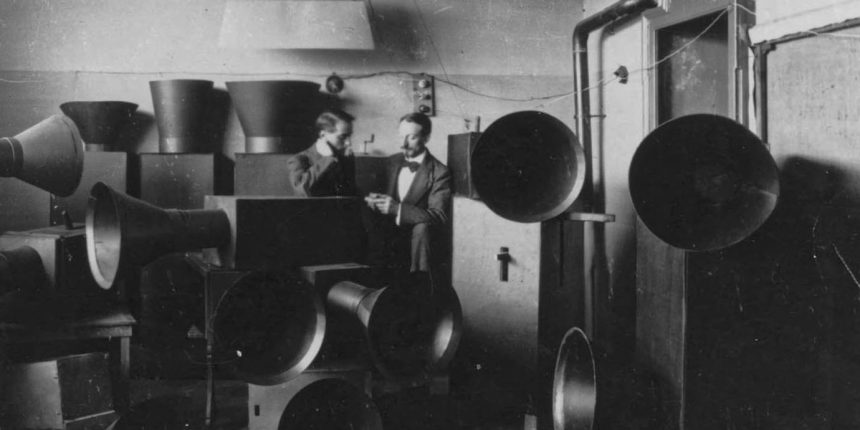
Historically we can say that the first sound designers were the futurists, in particular Louis Russolo who conceived the noise-intonation machine, an instrument formed by a wooden parallelepiped with a cardboard loudspeaker in the front. By pressing buttons and levers, the player starts the machinery and controls its dynamics.

Inside the instrument are metal plates, gears and metal strings that were vibrated. The tensions of the strings were modified by the player who, gliding on the string, generated notes. According to the noise generated, the instruments were classified by families: crackers, bubblers, rumblers, buzzers, pops, hissers, rubbers and howlers; each of which in turn included the registers of: soprano, alto, tenor and bass.
Coming quickly to the present day, it is certainly one of the best known designers Brian Eno, which among countless creations has composed the jingle that millions of people hear every time they start Windows.
We can distinguish three types of industries where the sound designer can find employment, namely: Broadcast, which contains in itself movies, television e podcasting; multimedia industry including communication, web, telephony and video games; finally the music industry which includes live performances, programming of musical instruments, creation of sound libraries and creation of new musical instruments.

The broadcast industry
The most prolific sector for a job sound designer is represented by the broadcast industry. In Italy, compared to the Anglo-Saxon countries, there is a fairly limited knowledge in relation to this profession and essentially the work carried out for the images is entrusted to a film editor, a professional technical figure who has his roots in the history of movies Italian. The editor combines the sounds coming from the direct recording and from the work of the noisers (fooley) with those taken from sound libraries.
The great overseas productions have given us a different idea of what it means to create sound for images, just mentioning great designers who have contributed significantly to the success of films such as Ben Burtt for Star Wars, ET; Gary Rydstrom for Jurassik Park; Dane Davis for matrix; Ethan Van Der Ryn for The Lord of the Rings; Walter Scott Murch for Apocalipse Now. If today it is quite easy to create complex sounds as technology allows us to obtain fast processing that also requires little economic investment, this was not true for the great films of the 70s and 80s which required a long preparation and use. also pioneering the technology then present.

An example can be represented by the sound effects used for the saga of Star Wars in which the sound of lightsabers was created by combining the sound emitted by an old movie projector with that of an interference produced by a television; to then obtain the change in pitch of the swords. Ben Burtt directed the sound to a loudspeaker by recording it with a moving microphone in order to generate theDoppler effect to simulate a moving sound source. In conclusion, we can say that it is essential, to become a good sound designer, to learn how to handle the various techniques and technologies, acquiring a good historical culture of sound for images and above all doing a lot of practice, perhaps trying to resonate film scenes of various genres: horror, action, animation, dramatic, thriller, comedy.
The important thing is that the work feels!