



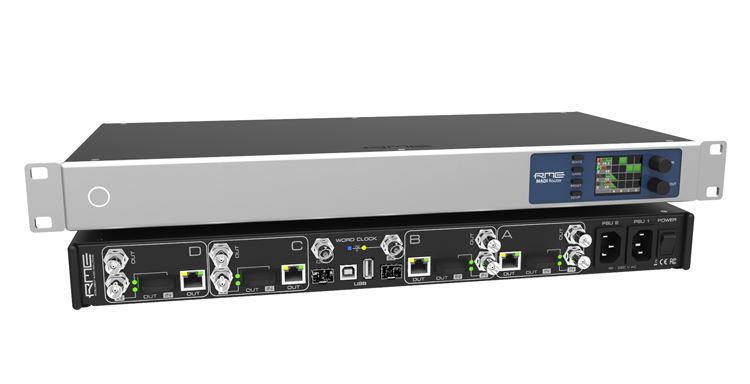
RME presented its renewed Premium Line at NAMM 2013 with a wide range of products of the highest level for multichannel digital transmission and conversion.
The protocol MADI (English acronym for Mmultichannel Aaudio Digital Interface) was defined worldwide by the AES and allows you to manage up 64 channels a 24 bit at a frequency of 48kHz or alternatively, 32 channels a 24 bit and 96 kHz.
Among the first brands to develop products with the support of MADI technology, RME has always tried to maintain high standards for this open protocol, making products stable and efficient. The ADI-642, ADI-6432 and ADI-648 converters were among the first MADI compatible devices. Subsequently, the MADI Bridge and the MADI Converter, further contributed to consolidating RME's reputation as one of the world's leading developers for this protocol.
This year RME updates the MADI digital converters of its Premium Line, introducing five new products with a renewed design: MADI Routers, ADAT Router, AES3 Routers, ADAT Converter e AES3 Converter.
One of the main innovations that all five products have onboard is the new connector RJ45, which allows you to use standard Ethernet network cables for data transmission. Until now, data transmission according to the MADI standard was done exclusively via a single coaxial cable with connectors BNC or on optical fiber. Now with traditional network cables you can have cables up to 100m, it is for the first time possible the audio transmission between two devices through a single cable and, not insignificant detail, it is possible to count on considerable cost cutting for cabling.
Madi Router

Il MADI Routers features four groups with three different MADI I / O each and is used as a patch bay and format converter, making it absolutely essential for anyone working with the MADI protocol. Aside from the perfect quality in signal distribution, the MADI Router allows, compared to the award-winning MADI Bridge, to create output signals with combinations of audio channels from the different MADI inputs.
ADAT Router

The ADAT Router is based on the design of the ADI-648, with MADI channels transferred in both directions through eight ADAT optical inputs and eight outputs. There are also MADI connectors for optical, coaxial and MADI Twisted Pair connections. All audio channels can be freely assigned between MADI and ADAT.
AES3 Routers

AES3 Routers instead it follows in the footsteps of the two previous models ADI-642 and ADI-6432, taking the best of the two devices. With multiple AES3-MADI conversion capabilities and the usual optical, coaxial and MADI Twisted Pair connection, the AES3 Router integrates four 25-pin D-sub ports, for a total of 32 channels of audio input and output. These are 'send-only' or 'receive-only' ports which can therefore guarantee 64 channels of audio outgoing or incoming. All three routers include a TFT display to simplify operations and view status, dual power supplies and USB ports for saving presets and updating firmware.
ADAT Converter

The ADAT Converter born as a natural extension for one of the three routers, receiving power from the Router's MADI Twisted Pair connection. Hence, it requires no additional power supplies. The new ADAT Converter converts the signals of up to eight ADAT inputs into MADI TP, and sends the signals from its MADI inputs to the eight ADAT outputs.
AES3 Converter

The new AES3 Converterit was born as a natural extension for one of the three routers. It can be configured to convert the MADI signal to send and receive 32 audio channels or, if necessary, send or receive 64 audio channels.
See you next news.


