


LinPlug updates CRONOX to version 3, an exceptional sampling-based synthesizer, with infinite tonal possibilities capable of creating sounds ranging from deep bass to cutting leads. Thanks to its 5.1 surround mixing capability we could define Cronox as the ideal synth for film-makers.
Overview:
Chronox (Fig 1), perhaps the name comes from "cronos", time, and as we all know time is infinite, just like this synth: the sounds it offers are almost inexhaustible, thanks above all to the fact that it is essentially a sample-player as its four generators can exploit the samples as sound sources.

The structure would seem complex but in reality it is enough to navigate between the editing pages to see what it offers and how: the outputs of the four generators converge in the two filters, which converge in parallel in two effect processors and then end up in further four effects connected in series. On the first page of the interface we find the classic panel of "Quick editing", that is the fundamental parameters on which to be able to act on the fly during a performance: the pan and volumes of the four generators, the cutoff and resonance of the two filters, the intensities of the six effect processors, the portamento parameters, the polyphony and the commands for load or save presets. From page two the fun begins! (Fig 2)

Generators one and two can operate in four different modes: in "oscillator" mode we have classic analog-like waveform oscillators, selectable between sega, triangular e court, complete with PWM (pulse-width modulation, which in Cronox acts on all three waveforms by varying the so-called duty cycle, pulse width) and relative modulation. The nice thing is that it is possible to do a real mixing between one shape and the next, and not simply select one or the other. Furthermore, generators one and three support frequency or amplitude modulation using generator two or four as modulating. Second mode: Time Sampler. In this way, algorithms are applied to the samples loaded as the sound source pitch shifting or time stretch always maintaining the pitch but clearly acting on the harmonic variants of the sample. Obviously, with this system it is possible to completely distort the content of any sample making it become an unusual and new waveform. Next is the Schrader mode, or wavetable, which simply plays the raw sample. Lastly, and only for the first two generators, there is the Loop Sampler: in this mode it is possible to load up to eight different samples for each generator, set loop points and modes, parameters such as volume and key range, and create bizarre timbral sequences, fascinating intertwining sound bits and anything else that has no different subsonic nature! What has been said so far would be enough to make us believe that Cronox has no limits, but there is more. Let's move on to page four (Fig 3): filters. There are two, selectable between 12 dB or 24 dB on octave, low-pass, band-pass, high-pass, notch, low-pass, band-pass, pass ... oops, oh no ... I'm not crazy, that's right the filter selection wheel that looks like this: you don't switch from one filter to another simply with a click, but you can do a real mix of filter types! For the cutoff and resonance controls there are also some nice XY controls that can be assigned via MIDI in case there was a joystick on our master.

We also find the classic controls of key track, envelope with relative amount, pan, volume and a pre-filtering saturation. Same settings for filters one and two. Let's now jump to the effects page (Fig 4), and here we find the world around which Cronox's sound revolves: six effects processors, each with twelve different algorithms including reverb, delay, chorus, bit crusher, and a type of effect that DJs will really like, the "Gator", or the famous "trance gate".

Each effect has an on / off button and its parameters mostly represented in the form of horizontal sliders. Recall that effects one and two are in parallel and take the output directly from the filters, while effects three through six are connected in series. And finally, the most complex page of Cronox: page six, Modulation (Fig 5).

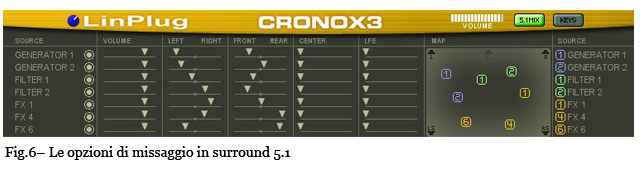
On the top left we have the envelopes for generators one and two, for modulations one and two and for theamplitude. Here they are vertical sliders but with a variation: they can have linear or logarithmic increment scales. Needless to say what they are for, just know that for the ADSR that acts on the volume of the sound it is good to use the logarithmic increment. At the top right is the LFO section, four identical with the possibility of key-sync (oscillation starts when a key is pressed on the keyboard), variable waveform, frequency, symmetry, phase, attack, decay and delay. At the bottom left there is the arpeggiator, thirty-two steps, ten different patterns, synchronized with the host tempo, sensitive to the dynamics and with swing variable. And now comes the fun: the modulation matrix. In this section you can link the different modulation sources (LFOs, envelopes, external controls, etc.) with the destinations, and you can use almost all the parameters of the synth as a destination. By programming this section properly, it is possible to obtain sounds that vary over time (or should I call it “cronos”?) Without ever becoming static and… boring! A big news of Cronox 3 is the possibility of mixing in 5.1 surround (Fig 6). For someone who has six outputs on their sound card, and a VST host capable of 5.1 surround sound, this could be a new source of fun and interesting experimentation. By clicking on the button “5.1” at the bottom right of the interface, a panel opens, instead of the keyboard, which shows the 2D spatial field and the available sound sources that can be distributed in space. Just move each source with the mouse or use the sliders for each parameter. This way, you can also create occlusion effects (using low pass filters), passing effects, rotation effects… really everything you need for the next Matrix soundtrack!
The sound:
With the installation of the plug-in, over 200 Mb of different presets are supplied, including dozens of samples used by the generators in the most varied ways and forms. If I were to write the soundtrack of a horror movie I'm sure Cronox 3 would be enough to create all kinds of sounds useful for the occasion. But if we want to get into a slightly more "musical" discourse, I would dare to define Cronox as "the instrument of climax": surely in a pop music piece I would use it to add that pad or that special effect that every now and then we usually use during the "bridge" of a piece. If I were a DJ maybe I would choose Cronox for those long, deep pads connected in side-chain with a compressor driven by the kick track. If I were George Duke, I would connect it to my “Keytar” (as those shoulder keyboards are called) to have fun with tireless lead sounds. If I were Ice-T, I would surely find my ideal bass in Cronox. I'm sure Jean Michel Jarre would spend a whole day programming the Cronox arpeggiator to compose the new Oxygene. I limited myself to listening to the presets until I found a beautiful pad, then dim the lights in my studio, hold down the sustain pedal and play a G-9 chord and at the same time improvise some "ambient" with the rest of my gear… the thrills! There are other synths similar to Cronox, among which I would mention WusikStation ( wusik.com ), also equipped with great editing possibilities, excellent modulation matrix, and able to use samples as sound sources (Fig 7), but certain Cronox features such as Time Sampler, Loop Sampler, mixable filters and six effects processors are hard to find in other plug-ins. Someone would perhaps name Absynth from Native Instruments. Well, yes, maybe there may be a similarity, but Cronox has the fact that it's easier to program even if not as powerful as that.

Conclusions:
Cronox can be installed without any particular problem, it is compatible with Windows e Macintosh in VST or AU formats, it comes with an excellent library of presets and is surprisingly light on the CPU. The fields of application range from pop music to dance, perhaps it is particularly suitable for ambient genres and electronic music in general, the sound is very crystalline, perhaps too much, but after all we must admit that it has a sound character of its own, difficult to compare. to other similar tools.


