

Currently Plug & Play is used almost exclusively on analog machines, while the situation changes for those that are managed in part or completely by digital devices. In this case, we are faced with a hardware / software duo capable of providing multiple results, as long as you dedicate time and mental energy.
Today I would like to talk about the pedal management software of Positive Grids, Bias Pedal: the intention is to provide a short introduction that gives an idea of what is possible to do with this instrument. A clarification, however, is a must: in my opinion the software deserves an in-depth discussion, not a blurb within a review. Precisely for this reason, here I will only deal with this aspect, while the audio tests are in the articles dedicated to Twin Delays, Modulation e Drive.
What are we talking about?
Let's talk about a software for sound modeling: through this very complete suite, it is possible to create high-quality sounds with almost maniacal care. This is possible, for example, with the Bias Pedal Modulation, the first one I tried and also with the Bias Delay, but not with the Distorsion, which has its matcher at the end of the chain for profiling the sound of an overdrive pedal. .
How is it structured?
First of all you need to configure, in the “Audio settings” section, where the sound enters and exits, starting from the sound card (analog inputs), sampling and which output to use.
After this very fast setting, time two minutes on the clock, you can move on to the juicier part of the program.
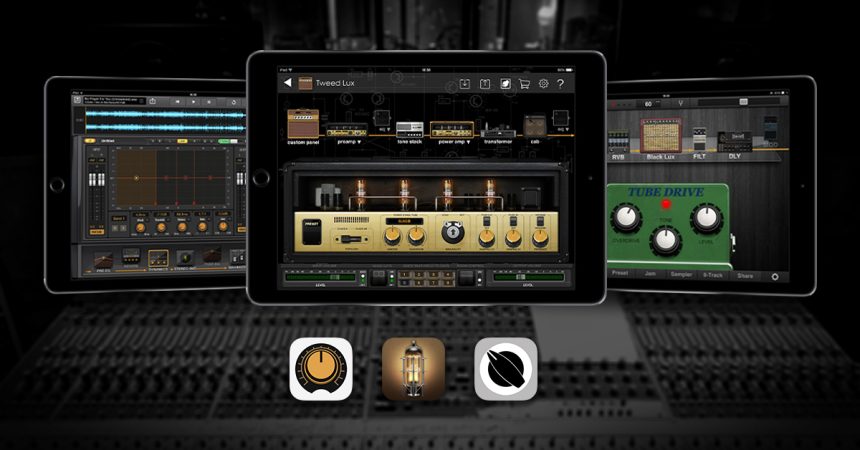
Everything is structured by preset, or it can be managed with a large number of custom models that we can create as we wish. The entire audio chain is handled in a very interesting way and with not too pompous graphics:
Main module -> input equalization -> stage 1 -> stage 2 -> output equalization -> power module
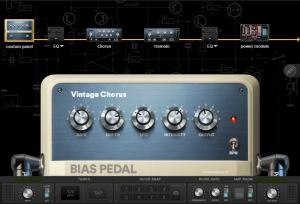
After choosing the preset, in this case the vintage chorus, I can add or not a eq in and out or one or more modulation stages; the tonal possibilities are truly endless, you could spend days looking for a Chorus.
The two modulation stages are quite different, obviously both have the possibility to choose the modulation stage (Phaser, Tremolo, etc.) and the various control commands that allow the setting, from the management of the oscillator wave to the of incoming and outgoing volumes.
To make the idea better, some screens are required; below a vintage chorus, already present in the initial modules for software installation.


What, in my opinion, is the gem for the true "Guitar Nerd" is the management of the power module, which allows you to manage the output compression and internal power to simulate supercharging, which many do both on the pedals of distortion and modulation.

If we also add the possibility of matching, the tone cloud in which to import sounds from other users or made available over time by the company, the possibilities are further expanded.
What does it allow to do?
As mentioned above, it allows you to create your own “pedal” sound, allowing you to manage every point of the audio chain, obviously with due attention and dedicating the right time. I found it very interesting even if at first perhaps a bit difficult to understand, but with truly exceptional results.
Considerations
Pro
- Incredible tonal possibilities
- tone clouds
- Tone matching (For distortions)
Cons
- Familiarize yourself with the suite
- Paradoxically there are too many possibilities (but read the note below!)
Note from the author
I am personally torn to talk about this with , not because the product is of low quality or does not give the yield it promises, but because there are too many options, of which I think I would barely use half.
This speech, however, is only valid for me: my home studio works are "small" and I have no high-profile professional needs, so I don't know to what extent I would sit down to set the sounds, I think it will depend on a need very precise.
But if your goal is to have a "definitive" product, to be purchased only once and reconfigured indefinitely then this is the right instrument, because virtually infinite sounds can be obtained.
the next
Antonio Cangiano