


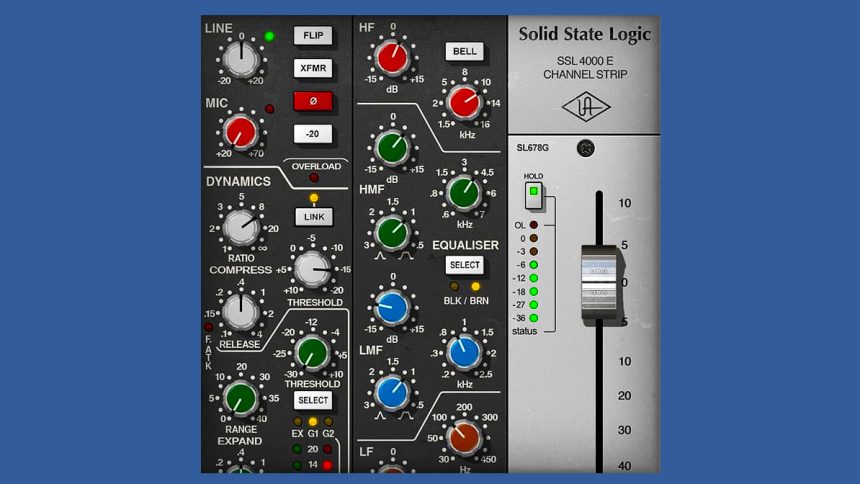
Welcome to this new article dedicated once again to UAD plug-ins. This time around we will deal with Universal Audio's recent upgrade to the SSL 4000 E channel modeling.
This channel of the 4000 console E series has been the subject, over the years, of various emulations, which from time to time have always provided (for the time in which they were programmed) a tool capable of reducing the gap between analog and digital processing.
Same Universal Audio, years ago (I think in 2009 or thereabouts), he proposed a first and useful version of this processor. In the new remodeled version, channel 4000 E becomes a plug-in with Unison technology: the microphone preamp complete with input transformer Jensen.
For those who are not familiar with the UAD system, Universal Audio produces two different types of hardware that allow processing dsp. The lines are called Apollo e Satellite.
The Apollo is a real audio interface with its preamplifiers, line inputs and outputs (available in various formats according to the most disparate needs) and its dedicated signal processors, which allow recording to zero latency, through a work environment called Mix Console, which precedes our DAW in the digital signal path.
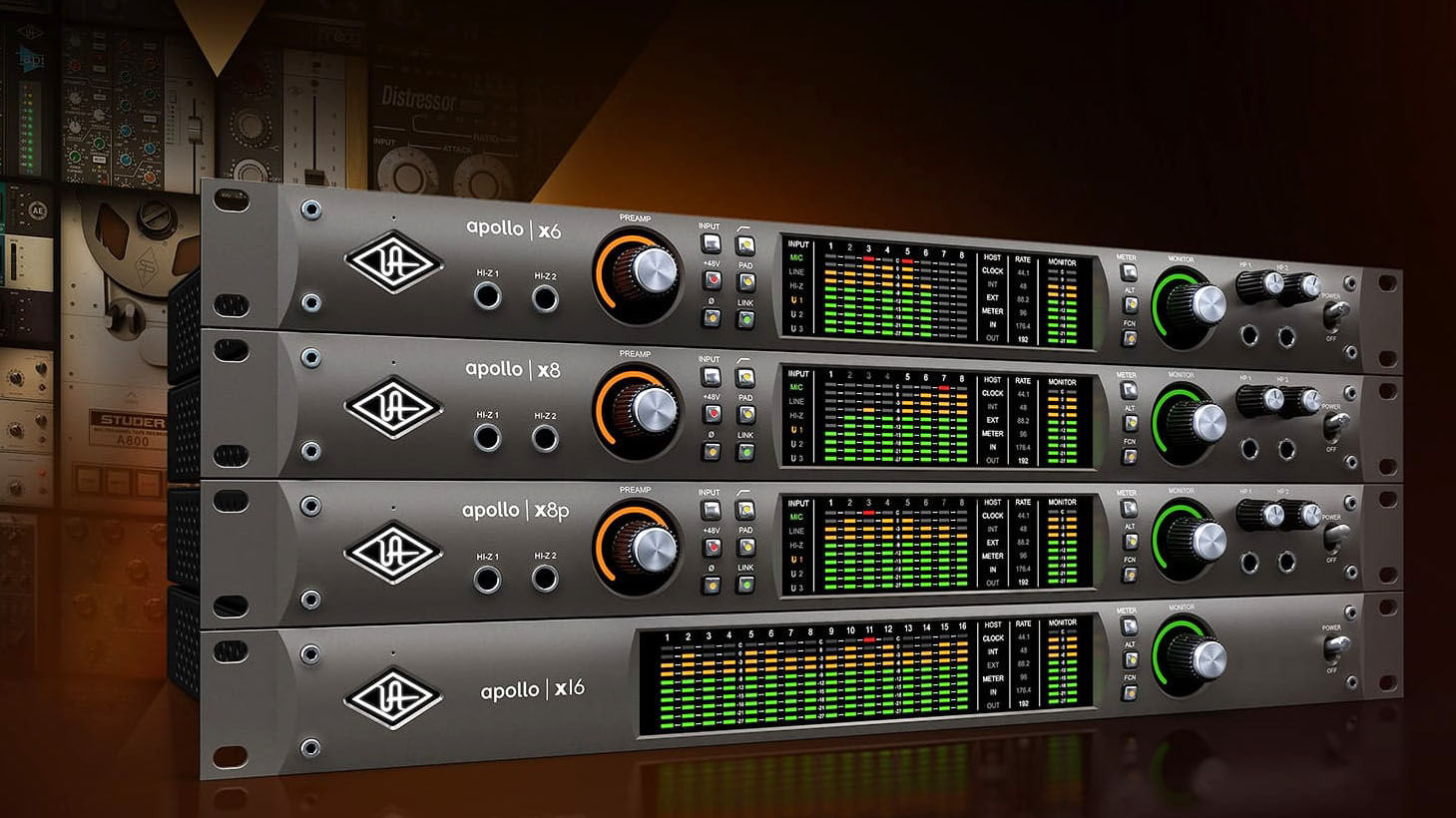
In the series Satellite, on the other hand, the dsp signal processors are always allocated in the hardware, which appears, however, as a small box that has neither inputs nor outputs: through connections thunderbolt, USB3 o firewire we can, from our daw, delegate to these processors the calculation of plug-in owners of UAD. Of course the plug-ins used in this system are the property of Universal Audio and cannot be used on the central processor of our computer. They are therefore sold by a dedicated shop that sees UAD hardware peripherals as real protection dongles.
The channel Solid State Logic 4000 E is therefore a plug-in Unison: what does it mean?
In Universal Audio's terminology, the small circle of Unison plug-ins includes those digital processors that can be software-substituted for Apollo-mounted hardware preamps with zero-latency processing if placed in the “Unison” slot of the UAD mixer.
This category includes all channel strips, emulations Fender and the recent delay of Korg SDD 3000.
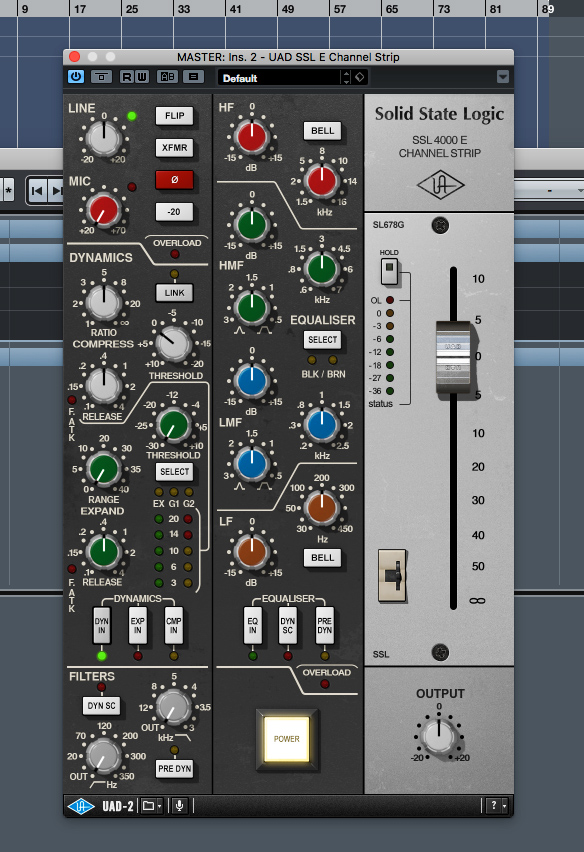
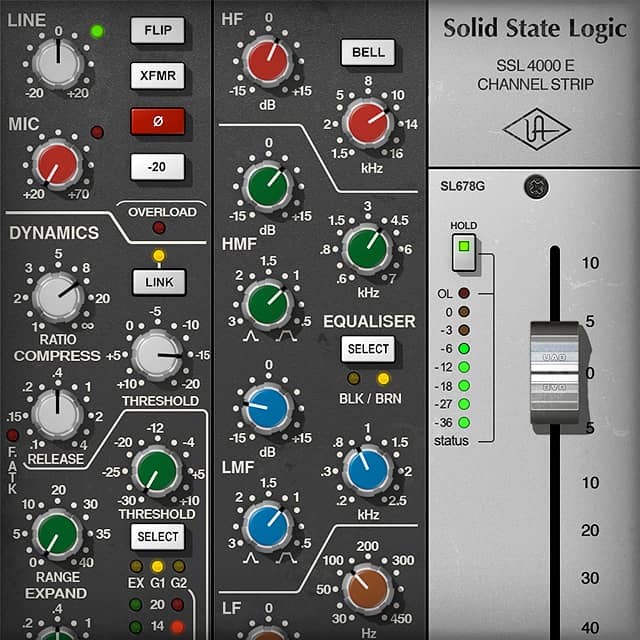
Let's start with the SSL 4000 E Preamplifier, on which we find the button XMFR extension to activate or deactivate the emulation of the Jensen input transformer when the input is activated MIC. The bass bump of the transformer is obvious and incredibly musical but can be bypassed for linearity requirements.
As a second module we find the dynamics; as in the original console, we have a compressor/limiter and a expander/gate independent.
The third module is represented by smart filters and the signal routing buttons.
The fourth module is theequalizer with mode black/brown for more personal tonal control (the brown knobs, for what the manual indicates, distinguish a gentler sound with more extreme settings, while the black ones reveal a more surgical sound.
Last, but not least, module is the channel fader. I would like to emphasize this section because it is a real source of tonal shaping: Raising or lowering the fader drastically affects (at least as much as the preamp) the harmonic distortion of the audio content (which can, subsequently, and in a linear way, be adjusted at the output through the output control, located at the bottom right of the channel).
I would like to specify that all the processors I review are software that I have purchased, so this column of mine stands exactly as "advice for purchases" and not as a description of processors that are submitted to me for promotional purposes.
Surely the fact of recommending one processor over another is not a discriminating factor to deduce my intellectual honesty, but I believe that, to indicate the quality of this plug-in, there is nothing better than to tell the experience that I have. induced to buy it.
I was recording an electric bass, a jazz bass, online and had activated the demo of this plug-in out of curiosity. After spending exactly 15 seconds fiddling with the controls, the bass was ready to be recorded. And it remained flat during mixing, as did all the other basses and vocals I recorded over the next 15 days of the demo duration. It is not that the bass in use was a stellar instrument, I think it also had problems of volume difference between one string and another, but the compressor and the tonal shaping of the pre and fader have shaped the signal perfectly.
The thing that surprised me most was the layering of the harmonic distortion through the forms. Each module has been modeled exactly like the hardware and therefore crossing the whole channel we can, in each section, add different clipping depending on the operation. For example, by generating more power through the preamp, we can clip its output slightly and, by entering the equalizer by adding gain on a band, we can also clip the output of this module exactly as it would be in thehardware. In the end the total saturation comes out of how much we overload each individual module, not like in most other plug-ins where, to simulate a saturation, the channel has the module of drive for last.
This type of processor is suitable for processing any type of signal, from items guitars, acoustic drums. Perhaps I would find myself a little uncomfortable in handling electronic percussion, given the lack of flexibility of the attack (and this is also a limitation of the hardware counterpart) but for the color this emulation is, in my opinion, the highest point that the software has reached.
The only note that saddens me is the gigantic load on the cpu of this processor: 70 % of a dsp for the stereo version (Manley Voxbox 56%, Api vision channel 30%, Neve 88rs 44%) make me understand that 12 processors are not enough for me anymore (sigh!).
Once again thank you Age of Audio and the study The art of the Noises of Marano for giving me the chance to write this article and experiment with new software. We will hear from you very soon with new tips for digital purchases.
John Rome


