

This type of compressor is typically valve as the term MU indicates the voltage gain of the valve (transconductance).
This was the first technology available for the construction of compressors e radio limiters known over the years '30/'40 of the '900.
Construction of a valve
A valve consists of four characteristic elements: a metallic filament which is electrically heated to incandescence to release electrons, a negative pole (cathode), a positive pole (anode), and one or more grids interposed between the two poles that modulate the passage of electrons. These control grids are negatively polarized, to counteract the passage of electrons, therefore an increase in negative voltage on the grid slows down, until it blocks, the passage of electrons between cathode and anode. This blocking can occur quickly, if the geometry of the grid is uniform, or very gradually if its spacing is variable. The valves with variable transconductance are of the latter type since a linear change of the control voltage corresponds to a non-linear variation of the valve gain. The most representative processor of this type is certainly the Fairchild 670 dual mono, stereo compressor with impressive dimensions.

It all begins thanks to Rein Narma, an Estonian engineer who emigrated to America to escape the ravages of World War II. In the 1954 dissatisfied with the audio equipment available up to that moment, he became one of the founders of Gotham Audio Development with the aim of building professional quality audio components. Among the various projects he produced was the first multitrack recording console made directly for Les Paul; in the meantime he had started working on a limiter compressor that followed the idea of sound processing in vogue at the time, that is: a neutral approach avoiding as much as possible sound colorings.
Meanwhile, another character who responds to the name of Sherman Fairchild son of the co - founder of IBM. Sherman, a talented businessman, had two great passions: professional audio and photography and, in 1931, he founded the Fairchild Recording Equipment Company to produce audio and broadcast equipment with which he came to own more than 30 patents ranging from silicon semiconductors to 8mm camera. Narma was persuaded by Fairchild to license his compressor project and be hired as chief engineer at Fairchild Recording Equipment Company, thus creating the Fairchild 660 mono e 670 stereos. The first example of this compressor went to Rudy Van Gelder who used it on the masters of the Blue Note Records, while the third copy was delivered to Mary Ford and Les Paul.
Fairchild 670
The Fairchild 670 is equipped with 20 valves, 11 transformers, 2 inductors, occupies 6 rack units and, in particular, weighs 30Kg. With attack times ranging from 0,2 a 0,8 milliseconds, considered exceptional for the time and, being able to be used in stereo, dual mono or in M / S (Lat / Vert function on the panel) at the beginning its use was reserved to limit the peaks in radio broadcasts and to print the master for the production of vinyls; only later did it spread to the most important recording studios in the world thanks also to Geoff Emerick who from 1966 to Abbey Road Studios he used it extensively in the production of the albums Beatles, especially on the tracks of drums, piano and guitar.

Since the grid voltage required to control the various MU of this compressor is very high, let's talk about 80V, inside there is a push - pull amplifier stage that manages these voltage and current needs.
Control Panel
The control panel is quite simple, it has a switch for use in L - R or M / S mode, a step-by-step potentiometer. 1dB which adjusts the input signal and another adjusts the threshold. The Fairchild 670 has a compression curve that varies according to the input signal, by doing so, we can have ratios ranging from 2:1 a 20:1a very precise adjustment can be made by means of a trim placed inside the machine. Finally a switch a 6 positions allows you to choose as many combinations of attack and release times: the first four positions have a fixed attack and release, while the last two have a fixed attack again, but the release varies according to the input signal.
Curiosity
We conclude with a curiosity about this compressor, given the success it has had over the years, so much so that even today it is considered the "Holy Grail" of record productions, in 2007 it was included in the Technology Hall Of FameMoreover, given its not exactly high circulation, less than a thousand copies have been produced, today on the market an original Fairchild is quoted at figures close to 300.000 euros, not really within everyone's reach. Over the years the market has seen several replicas of both hardware and software alternate and, in 2022 Heritage Audio decided to release a clone of the original project called Herchild produced both in mono version at the cost of 5000 Euro both in stereo version at a doubled price.
Heritage Audio Herchild
The Herchild it is also proposed as an update of the iconic Fairchild because in addition to maintaining the imposing dimensions almost like its predecessor: it occupies 6 rack units, weight 13Kg, is formed from 22 valves e 9 transformers; maintains all the controls as the original but also adds new ones such as the DC Threshold selector that adjusts the hardness or less of the compressor knee intervention and finally, the Herchild also has a sidechain filter adjustable on four frequencies: 50Hz, 100Hz, 200Hz e 350Hz.
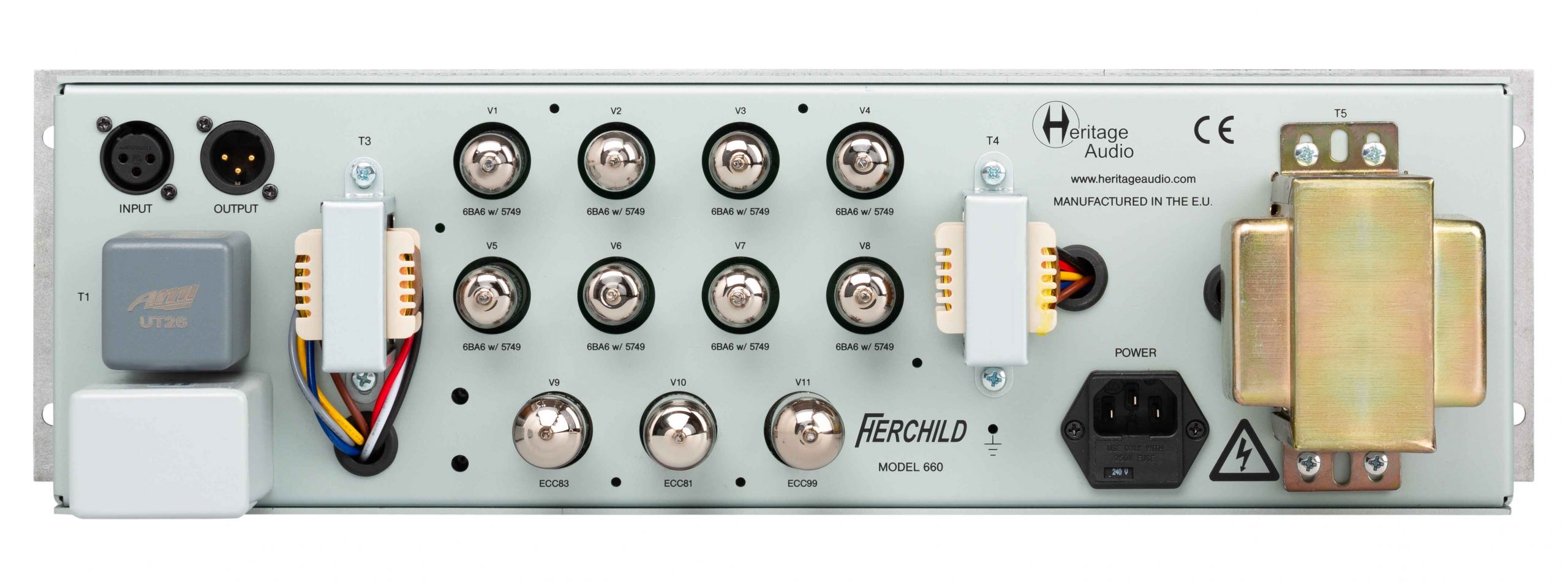
We can define the model proposed by Heritage Audio as an update of the iconic Fairchild to adapt it to a context of mixing e mastering modern trying to maintain that color and that sonic paste that is sought in such a machine.
Paolo Alessandro Andrea Cherubini Barberini