


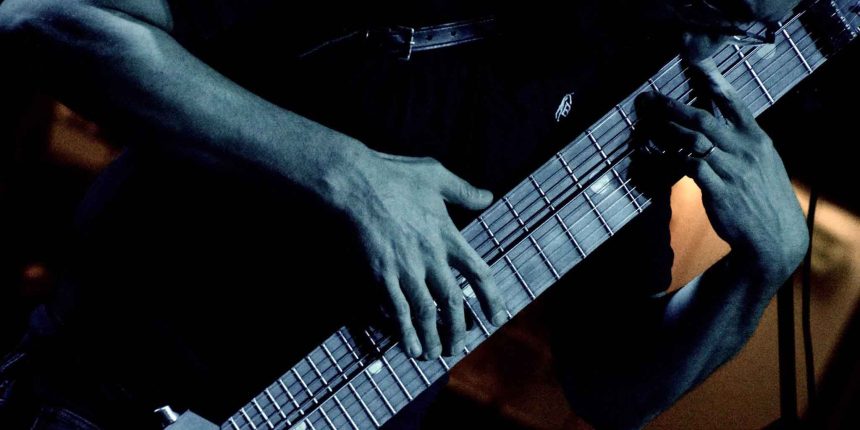
Michele Vitulli is a musician who for years has been increasingly establishing himself as one of the greatest Italian representatives of the Chapman Stick.
And on the occasion of the release of his latest record (for Stick and violin), “Polimeri Epimeri”, we were able to collect some of his considerations.

It must immediately be said that “Polimeri Epimeri” is a record that hides its complexity in the folds of the scores and that is embellished and enhanced in listening by the timbres of Vitulli's Stick, always in perfect balance between technicality and taste.
“This is a work born some time ago - Vitulli says - I composed and recorded (the parts of Stick and the themes for the violin) in a month, in November 2015, practically straight away, parallel to the writing of the story on which it is based. The violin was recorded a few months later, because I struggled a bit to find the right interpreter, and I must say it was worth it, Jacopo Ciani he interpreted the scores very well, recording everything in one day (and it wasn't easy).

The disc is a decidedly minimalist concept-album, starting from the choice of using only two instruments (Chapman Stick and violin), based on a story that is certainly autobiographical, but which may have traits in common with the lives of many other people, almost philosophical in some respects, since it revolves around universal themes, the meaning of life, death, love, solidarity, empathy.

From the musical point of view, I enjoyed working on various tones, but trying to make them converge within the framework of a suite, therefore with recurring elements (starting from the sounds used), trying to compose melodies that were as "singable" as possible in a harmonic framework with various modulations and tempos ranging from canonical 4/4 to odd rhythms and compound tempos.
The best example is that of the title track, "Ephemeral polymers“, Where the first part of the theme plays on three chords which are repeated for a series of bars in 15/8 (in the form of 7 + 8) and the melody at that point is almost a nursery rhyme for children, but thought in 4/4. Then the time stretches into 4/4, the harmony opens and becomes more elaborate passing through various modulations and the melody develops, it remains "cantabile" but in a slightly more complex form. And it is not a rhetorical exercise, because it is part of the moment of the story in which the meaning of the expression "ephemeral polymers" referring to the human race is revealed, and the music tries to render the meaning of that concept.

Similarly, in "Waltz for Mom & Dad"(Obviously dedicated to my parents, both of whom have disappeared), the theme is a dream of the protagonist in which he sees his parents dancing, young and happy, in a village party, and the music follows him without particular harmonic complexities, indeed it is rather simple, a dreamlike and romantic 3/4 at the same time, with a different choice of sounds than the other songs, to underline the atmosphere of the dream.
Another example is the song "Qu'est ce qui ama?“, A passage in 4/4 very simple and melodic, linked to the discovery of the protagonist of love as a "simple thing if you let yourself go", in which the main theme is the Stick and the violin follows its development, the only piece that proceeds without modulations of any kind , where, however, the simplicity of the theme (both musically and in the written text) never yields to banality, at least in my intentions ".
Marco Sica


