


We talked about Queen, then about Toto… Do we forget anyone? Perhaps we forget one of the master bands in the well-known combination of creativity / innovation (it is not so obvious that a creative can also innovate, think about it), capable of combining a great "hit parade" compositional vein with a sound experimentation faced at 360 degrees, again today under the microscope of the experts.

A dizzying band in recordings, live shows, up to the album covers made by the late Storm Thorgerson, each of which deserves a separate article. In short, this summer that saw the return of David Gilmour in Italy, for a series of concerts in Rome, Verona and - after more than forty years- Pompei, it seems right to us, for all the reasons set out, to take into consideration what has been the evolution of instrumentation by Pink Floyd and in particular from the lamented Rick Wright, both for studio recordings and for live performances.
Starting from The Piper at the Gates of a Down, the band's debut album, initially formed by Syd Barrett on vocals and guitar, Roger Waters at the bottom, Richard Wright to keyboards and Nick Mason on drums, dated 1967, was largely by recording using a Farfisa Combo-Compact Organ, in Wright's possession since 1964 and his main instrument, together with trombone and saxophone, which together with the piano, he learned to play at the Gilder School of Music a few years earlier.

In the album Wright himself used in the recordings, totally the result of the inspiration of Syd Barrett who composed all the music and lyrics, even a piano and in the song The Gnomes you may notice the use of a Celesta. The particular atmospheres of this album were also recreated using the classic Plate Reverb Emt 140, customized with thin sheets of metal in tension and the historic Camera-Eco degli Emi Studios Abbey Road of London, built in 1931.
Another technique used to "swell" Barrett's voice, which was actually much more subtle, was theAutomatic Double Tracking, invented in Abbey Road by the sound engineer Ken Townsend and also used a lot in the recordings of Beatles. All this allowed the creation of songs like Astronomy Domine e Interstellar Overdrive, which had a sound literally never heard before.
With A saurceful of secrets, the band's second album and swan song by a now problematic Syd Barrett, who forced others to roll up their hands and put their artistic ideas on the plate in order to continue the adventure, hiring an old school friend, David Gilmour, Wright continued to predominantly use the Farfisa Compact, alternating it with Compact duo, adding in its audio chain a device that will become legendary probably thanks to the English band: the Binson Echorec, a ribbon echo created by the Italian Binson, who, unlike normal ribbon echoes, saw a metal disc, on whose outer circumference a thin metal wire was wound in a spiral.

In the passage Set The Controls For The Heart Of The Sun, Wright processes his Farfisa as well as with the Binson, also with a pedal wah wah. In the album Wright used, together with Farfisa, also a Hammond, L 'M-102, a compact version of the various B3 o C3, a vibraphone and finally, in the song that gives the title to the album, the Mellotron M400 MkII with which it creates fantastic textures, also placing it in layers with the Hammond.
For Ummagumma, a double disc, on the first, containing live recordings, Wright uses only the Farfisa Compact Duo, associated with the usual BinsonEchorec, while on the second disc which sees suites each composed by a member of the band, Wright in his Sisyphus continues to use Hammond M-102, Farfisa Compact Duo, a Piano and the Mellotron. Virtually identical instrumentation used on the colonna sonora More, which came out in early 1969.
We thus arrive at Atom Hearth Mother, the famous album of the "cow" on the cover: Wright's instrumentation remained almost identical, with the addition of a Leslie 145 coupled as usual Hammond M-102 .
On this album, the band used the string and wind orchestra of the Emi, who recorded the long instrumental suite, while in the closing piece Alan's Psychedelic Breakfast, the band provides an instrumental background combined with various sounds recorded here and there by Mason and Waters, via a tape recorder Revox. It is therefore possible to hear dripping taps, dishes washed, as well as commentary from Alan Styles, a roadie from the band preparing his own breakfast. It was the time in 1971 di Meddle, album that saw the band for the first time be able to use a recorder a 16 tracks.
Wright's instrumentation here also remained almost the same, but we cannot fail to recall his work in pieces such as One of these days and Echoes. On the latter, the keyboardist, together with Gilmour, trying to recreate the sound of a Sound, passed the piano sound into a Leslie, thus recreating that submarine sound. Many argue that this song sees the presence of the first synth used by the band, or theEMS VCS3 (at the time owned only by them and ours Franco Battiato, as recently declared by the Sicilian artist himself, then there were the who used it for Highway), but in all likelihood its first use on record was on the album Obscured by Clouds of the following year, which was initially supposed to be the album's soundtrack the Vallèè, but which actually became a real record, despite the group already working on the next Dark Side of the Moon.

Il VCS3, a three oscillator synthesizer, was invented by a man by name Peter Zinovieff and was nicknamed Putney VCS3 because Putney was the town where Zinovieff lived. The first prototype was housed in a small garden toolbox. On this album, Wright also used an electric piano for the first time Fender Rhodes, while drummer Nick Mason experimented with a sort of primitive electronic drums, to recreate percussive sounds. This was also the first period of the live in quadraphony made by the band to demonstrate the enormous experimentation they carried out. All this was possible thanks to a device, theAzimuth Coordinator created by Bernard Speight in the studies of Abbey Road.

Richard Wright via two joysticks present on this device, made the sound rotate through the various speakers positioned in the room. We are therefore al 1973. After spending a year closed in the studio, rehearsing some parts of the record already from the tour of Meddle, Pink Floyd released The Dark Side of The Moon, a landmark in the history of music. Here Wright's instrumentation is significantly enlarged. The most used electric organ in the album was a Hammond RT-3 with two manuals, with Leslie 122, then replaced by the subsequent tour with a C-3. The electric pianos used were Wurlitzer Ep-200 sweetened with a leslie in slow position and a Fender Rhodes Mark I.
One was used as an acoustic piano Steinway. On the synthesizer side, as regards the instrumental piece On the Run, the successor of the VCS3 was used, that is theEms Synthi A (nicknamed Portabella), which also had a primordial sequencer function inside. This part was first experimented with by Gilmour, only to be recorded on disc by Waters. He also made his debut with the London band on minimoog, first used by Rick Wright in the song Any Color you Like. A great deal of work was also done by Mason and the sound engineer, such Alan Parsons, who went around recording clocks (for Time ), making people run into the echo chamber (per On the run) and using sounds of cash registers and coins (Money). In this regard, we recall that Parsons created the intro of Money, making a "long" loop around the tape around various microphone stands, creating a sort of track time on which the band had to play (and on which they immediately lost time by slowing down dramatically at the beginning of the vocals, as Parsons declared years later, who was forced to a sudden fade out of that loop). Additionally, Mason's drum case was processed to remember the heartbeat sound which opens and closes the album. For the next tour, Wright took theRT-3, minimoog and Wurlitzer. There are very nice stories about using the Minimoog live, written on the autobiography of Nick Mason, I, in which it is told of the unpleasant occasions when there were electrical problems on stage and poor Wright's Minimoog (he had a spare), inevitably forgot during the concert, once forcing the poor keyboard player to leave the stage in anger .
Already on the current tour, the band began to try new compositions, which would end up on the album Wish you were here, dated 1975. Here too, the use of electronic instruments was fundamental. The long (and split disc) suite, Shine on you crazy diamond, still remains a must for any self-respecting keyboard player. When you want to recreate that sound on your keyboards, it always seems like something is missing. Something is added or removed every day. As for the starting pad, Wright used a layer consisting of EMS VCS3, Arp Strings Ensemble ed Hammond, skillfully processed with reverb, delay e phaser, combined with a recording of fingers rubbing on glasses filled with water (each with a different amount) recycled from a tape recorded by the band for a record of "sounds" never made.
Personally, I was also able to watch live this performance with glasses, when in 2006 during a concert ofOn an Island Tour in Florence, David Gilmour presented a player of glasses known on the street, who on the intro of "Diamond" played these glasses filled with colored water (Gilmour joked, claiming it was Chianti ...), accompanying Rick Wright in what was his penultimate performance of his life. For the solo part, however, Wright made that sound brass-like with a minimoog. In part 8 of Shine on, Wright also used a Honher Clavinet D6, also used as bass line in Have a cygar.
An anecdote regarding the recordings of Shine on is linked to the person who inspired the song, namely Syd Barret. One day, while the band was in the mixing phase, a very special character came into the studio, completely bald, overweight, without eyebrows, with a shopping bag in hand. No one recognized him for quite a while, thinking he was a studio orderly, until Gilmour recognized him and invited him to listen to the song. Barrett he listened to the song, calling it "already heard" and then disappeared after lunch. He spent much of his time brushing his teeth with a toothbrush, also asking to be able to record the guitar. In some cases, Wright used to register in multitrack both EMS and Minimoog, trying to create a polyphony, obviously not recreatable by simply playing these keyboards, which they were monophonic.
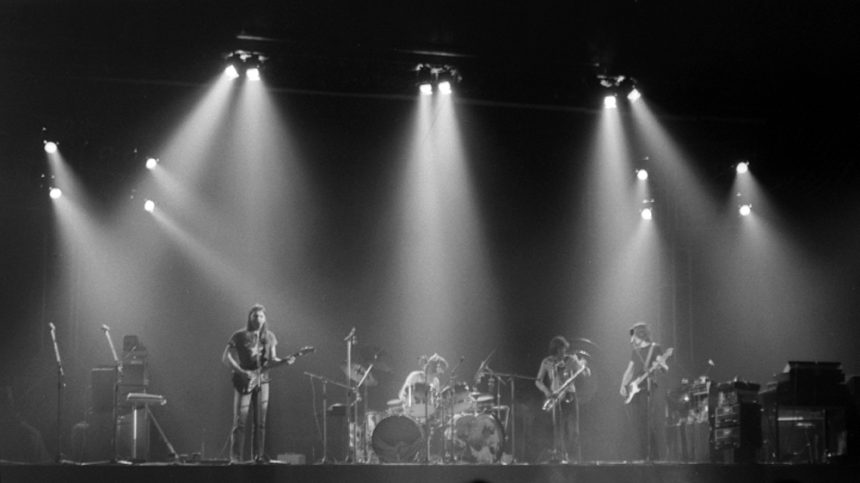
Su Welcome to the machine, Wright uses the usual VCS3, in addition to the Arp Strings Ensemble and the Minimoog. Wright's live setup expanded further as we can see in the photo (photo 3), where in addition to the two Minimoogs, Hammond, Wurlitzer, Arp and Farfisa, he also added the clavinet and a Moog Taurus pedal synthesizer, mostly used in the low frequency range. Meanwhile, the coexistence of the four in the band began to become more and more complex, with Waters and Gilmour acting as prima donnas, but collaborating more and more difficultly, with Mason and Wright increasingly in the rear regarding the decisions of the group. In this climate he saw the light in 1977 album Animals, album of strong protest, with a much harder sound, where Wright used almost the same instrumentation as Wish you were here with the addition of a new Vocoders produced by Korg, the Vc10, used in the central part of Dogs. However, many keyboard parts were added by Gilmour, as Wright was increasingly isolated within the group. For the next tour, Wright even went as far as having three Minimoog on stage, plus all the rest of the usual instrumentation. By now it was so impossible for him to recreate what was the sound of the record, live, that there was a primordial attempt at sequences, that is, one of the technicians, during Shine on you crazy diamond threw a track with some pad parts pre-registered, on which Wright played live Hammond and Minimoog.
In this period the keyboard player released his first solo album by Title WetDream, a decidedly experimental album which at the time was not positively received by critics. On this record, Wright made the acquaintance of many new next generation equipment. In fact, he used a lot of a Obehreim Ob-1, in addition to owning the mammoth Yamaha GX-1, which he used very little and soon sold.
Stay tuned!
The story continues with the collapse and rebirth from 1979 to the present day



Man, you hit the nail on the head. The pre-Dark Side era gets slept on way too much by casual fans, but for me, tracks like 'Echoes' are their absolute peak. That's where the real magic was—that unpredictable chemistry that kind of faded once they became massive. Killer piece, can't wait for part 2!
Reading an article like this means immersing yourself not only in the history of Pink Floyd, but in the very history of the evolution of modern sound.
As the owner of SuonORO Recording Studio in Stigliano, and a profound lover of sound research, I can't help but be fascinated by this band's ability to blend creativity, technological innovation, and artistic sensibility in a virtually unrepeatable way.
Pink Floyd weren't just musicians: they were true architects of sound. Every technical choice—from the Farfisa Compact to the Binson Echorec, from the VCS3 to the Minimoog, right up to the quadraphonic experiments—was never conceived as a mere technological display, but as an expressive means at the service of emotion and musical narrative.
And this is precisely what still makes them an object of study by musicians, sound engineers, producers and sound designers today.
I find it wonderful that the article highlights the immense role of Richard Wright, often less celebrated than other members of the band, but in reality fundamental in the construction of those suspended, ethereal and cinematic atmospheres that made albums like The Dark Side of the Moon, Wish You Were Here and Echoes immortal.
As a studio recording and analog/digital workflow enthusiast, reading details about the use of EMT 140, Leslie, EMS VCS3, Minimoog, Revox recorders, echo chambers and sound spatialization techniques is pure technical poetry.
Pink Floyd demonstrated that innovation isn't just about "using new machines," but having the artistic sensibility to transform technology into emotion.
And this is perhaps their greatest legacy.
Sincere congratulations to Vincenzo Siani for this extraordinarily well-crafted study, rich in historical and technical details, that every sound lover should read at least once.