



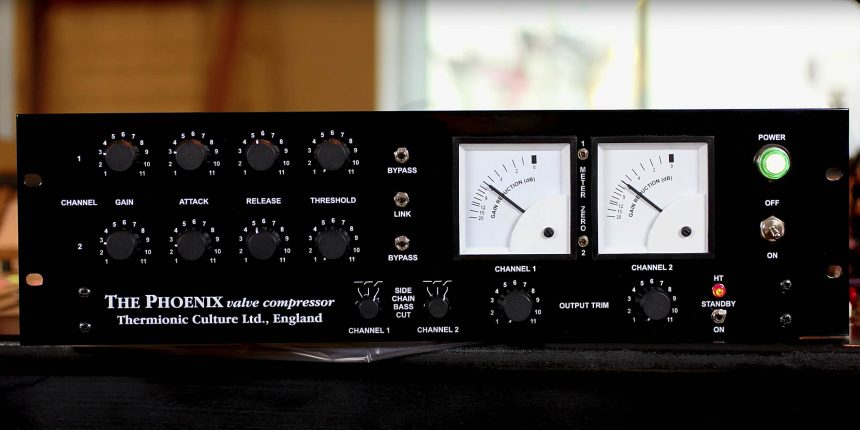
Dynamic is the difference between the highest and lowest level or volume of a signal.
Suppose we have a track whose maximum peak is 95 dB but with a background noise of 5 dB, the dynamics of that track would be of 90 dB; CDs for example have a dynamic range of 96 dB (6 dB for each bit of resolution), but while in classical music this range is fully exploited, as the orchestra plays from pianissimo to fortissimo, in "Pop" music it is necessary to use dynamics processors such as: compressors, limiter, gate etc. to generally crush the higher sounds in order to rebalance them with respect to the lower ones.
We can therefore divide these machines into two main types: those that decrease the dynamics (compressors and limiters) and those that increase it (noise gate and expander).
Compressor
Compressing the dynamic range of a signal is the process of modifying its dynamic range. The compressor consists of an electronic device capable of controlling the level of a signal automatically, and was created to contain the output level from microphones and audio transmitters, in order to ensure that the final level does not distort the next audio chain. The compressors operate following the characteristic parameters which are: the threshold (threshold) or the level above which the signal is reduced, is set in dB, where a relatively low value (for example -60 dB) will usually cause a larger portion of the signal to be treated, the compression ratio (ratio) determines the ratio input/take the exit (uscita) for signals above the threshold. For example, with a relationship 4:1, a signal that exceeds the 4 dB threshold will exit the compressor 1 dB above the threshold.

Attack Time
A compressor can allow you to intervene on the speed of reaction to changes in the input signal, the time taken by the machine to reduce the gain until it reaches the level indicated by the compression ratio is called attack.
Release Time
Il release time, on the contrary, it corresponds to the phase in which the compressor increases the gain in order to reach the level indicated by the compression factor (or to 0 dB, once the input signal has dropped below the threshold). The length of both phases is determined by the magnitude of the change in the input signal and the corresponding change in gain. To make tuning more intuitive, the attack and release controls are often calibrated in units of time (milliseconds). This is the time it will take for the gain to increase or decrease by a certain number of dB, set by the manufacturer and often equal to 10 dB.
Example
If the time constants refer to 10 dB and the attack time is set to 1 ms, it will take 1 ms for the gain to decrease by 10 dB and 2 ms to reduce by 20 dB. In many compressors the attack and release times are user adjustable; some compressors, however, have attack and release times determined by design characteristics and cannot be adjusted. Sometimes the times are automatic or programmable, i.e. they depend on the input signal.

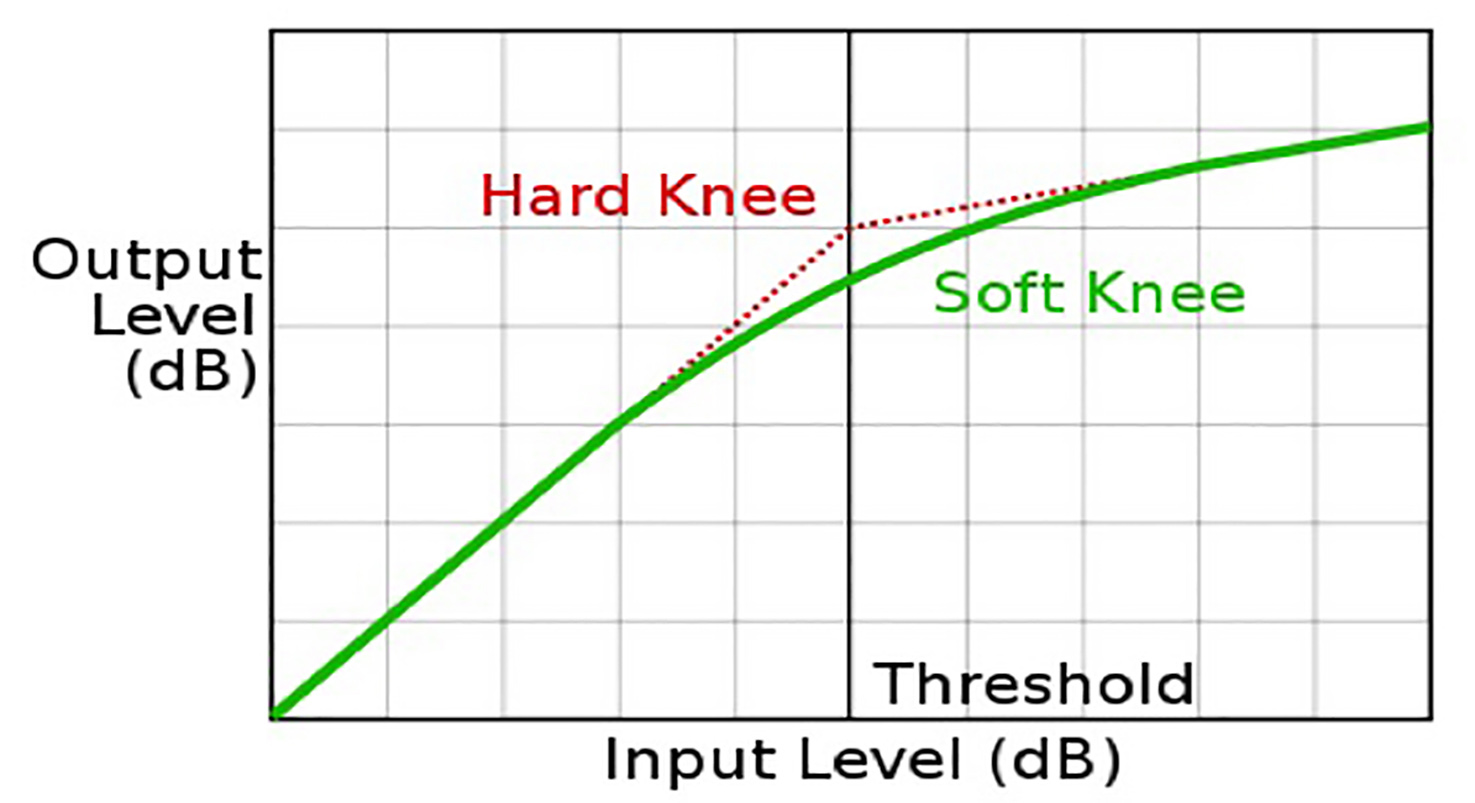
Another possible adjustment is that of compression curve, through this control it is possible to decide how “smooth” the angle of the response curve should become. A sweet passage (soft knee) allows you to gradually increase the compression level (just as the input signal increases) until the preset value is reached.
Control signal
The last parameter that characterizes a compressor is the side chain, which is none other than the control signal who manages the work of compression/limiting. It is necessary to change the level of compression and, almost always, it is a voltage signal derived from the same signal that you want to compress. Being a control signal, it can be further processed with equalizers o amplifiers in order to generate a signal that drives the compressor / limiter in a different way from the original signal from which it derives. Compressors often have an external side chain input, which replaces the compressor's internal one. The side chain is therefore always necessary for the compressor / limiter or, in any case, in any case an automatic change in the level of a signal is envisaged.
Limiter
A particular case of compression application is the limiter which by compressing the signal extremely fast, guarantees the lowering of the level in case of peaks. This processor also has the same parameters as a compressor except for the ratio levels which are ∞:1 (commonly obtained using a real ratio of 60:1) so that any signal above the threshold is lowered to the level of the threshold itself.
De essere
Following the principle of equalization of the sidechain, the de-esser was born together with the compressor, which is a compressor with a sidechain whose signal is equalized to enhance the sibilant consonants. By increasing the frequencies related to the sibilants, the compressor operates on the audio signal whenever these sibilants are detected by the compressor / limiter detector circuits.


