


Hello everyone!
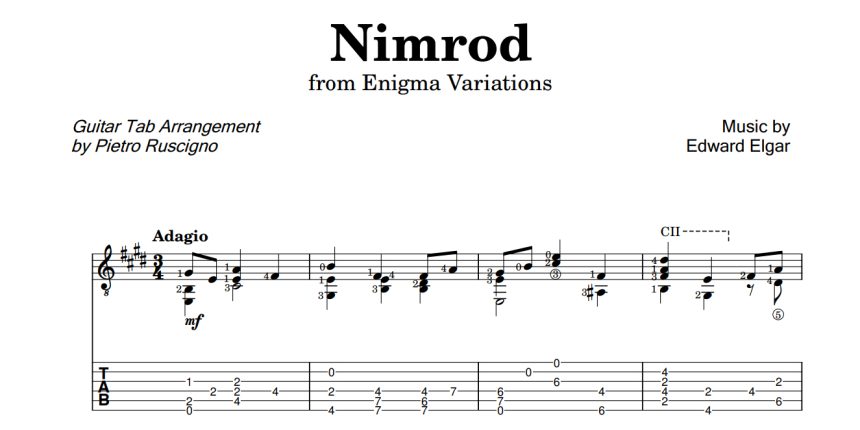
I made a transcription of the ninth movement of the “Variations on an Enigma Theme”, “Nimrod”, and it was almost a challenge for me.
A challenge because the goal was to bring an entire orchestra back to the classical guitar, an instrument that does not have all the power and sustain in the world, and to do it trying to be as faithful as possible to the intentions of the composer (Edward Elgar). About halfway through the work, I found myself having a song that was, after all, listenable, but with several decidedly weak points. Then I realized that something was wrong and I had to, while remaining faithful to the composer, reinvent and re-propose some elements in an original and more suitable way for an instrument like the classical guitar. In this article I wanted to share this experience, talk about the problems encountered during this transcript and illustrate the solutions I have adopted:
1. SPEED OF EXECUTION
For the reason I mentioned above, which is that the guitar doesn't have all this volume and sustain, Nimrod's very long notes are not easily replicable effectively on the guitar. This is why I thought that an acceptable compromise could be to slightly increase the speed of execution, on the other hand there is a lot of rhythmic difference between the various recordings of the orchestra's original.
2. DYNAMICS
The orchestral score starts in piano pianissimo, a dynamics that hardly works on the guitar at the beginning of the piece because it is heard very little and is not incisive like an orchestra. Also there are several crescendos on a single note, obviously impossible to reproduce on the guitar. I had to completely rethink the dynamics in the piece to adapt them more effectively to the guitar, even Elgar had done so in his piano transcription.
3. VERY RICH SCORE
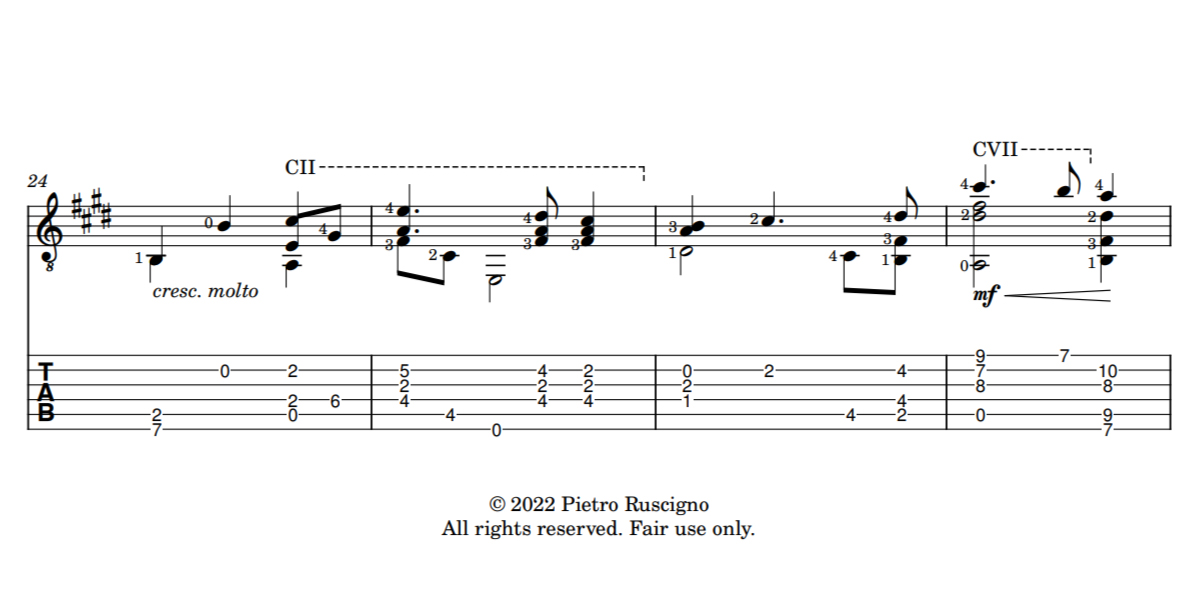
The orchestral score is obviously not reproducible in its entirety on the guitar. Hence the need to select the items and identify the most functional ones within the piece. To do this work I did not need only the orchestral score but also the piano one and, from time to time, I took a look at the choral one (arranged by John Cameron, entitled “Lux Aeterna”).
4. FINAL HARMONICS
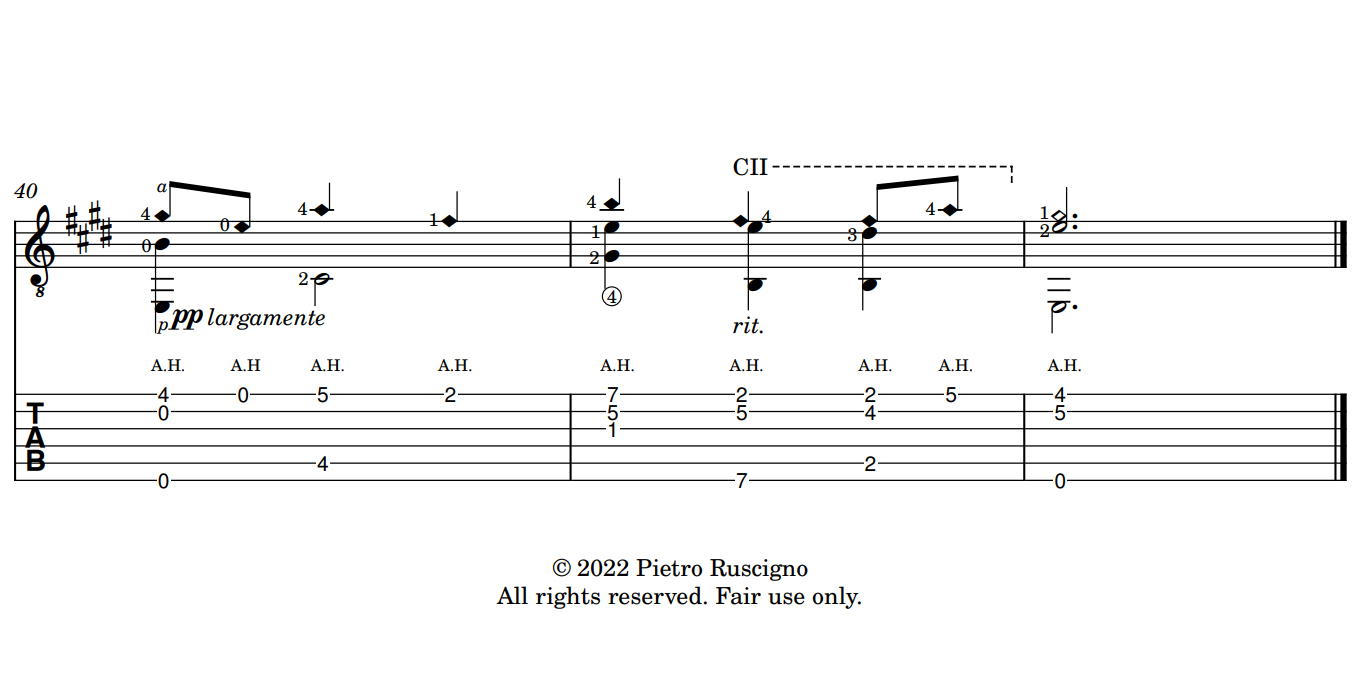
Perhaps this is the greatest freedom I took in the whole transcript. Nimrod ends with the same phrase presented at the beginning, the first semi-phrase in fortissimo, the second in pianissimo. This contrast, expressed very well by the orchestra, I could not make it sufficiently effective on the guitar. So I tried to introduce harmonics as an element of novelty, trying to preserve the initial fortissimo and then introducing them in the second half phrase. I still didn't like it. So I sacrificed the fortissimo and put the harmonics on the whole phrase. It sounded much better, and while it's a far cry from Elgar's original idea, I thought introducing something new at that juncture made the whole passage more listenable on classical guitar. These are the main problems I faced, I must say that it was a quite complicated transcription but it was certainly a challenge from which I learned a lot and I hope I have been of help in sharing my experience.
Useful news
Score made by Pietro Ruscigno: Link
Pietro Ruscigno website: www.pietroruscigno.com
Track played by Pietro Ruscigno: Variations on an Enigma Nimrod Theme.


