

Let's face it right away: reviewing Sienna is a very complex job. As difficult as reviewing a pair of headphones or speakers. The listening act is made by so many factors (including a good dose of subjectivity), so it becomes impossible to establish unshakable and totally shareable ontological hinges. What we agree upon should be concepts rather than individual products.
A review on such a novelty becomes a perfect starting point for some general considerations on what is a "right" listening experience and what kind of sound audio professionals should be pursuing. But first a little information on Acustica Audio Sienna.

What is Sienna?
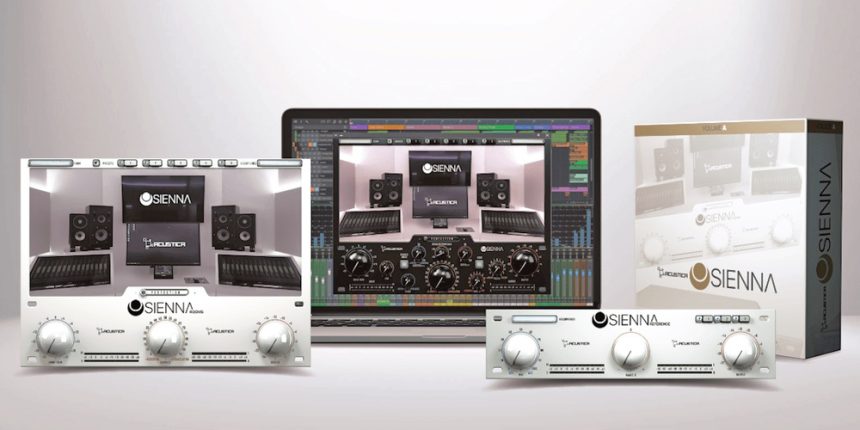
The Sienna Suite consists of 3 plugin, References, Rooms e Guru, which apply different kinds of correction on headphones, promising incredible results.
Referencesapplies the simplest and lightest correction to your headphones, making the listening curve more balanced. At this time, there's a list of 150 headphone models you can choose from, but it's in constant update.
Rooms emulates the listening experience in a mixing or mastering room. Currently there are 2 sampled studios, House of Glass and Acustica Audio. For both emulations you can select different sets of speakers. Other rooms are coming and also other useful listening simulations (for example in a car or TV speaker).
Guru is a "behind the scenes" of Rooms that allows fine-tuning to customize the virtual room with greater amount of control (width and depth of stereo, pan, more or less binaural listening, cross feed…).
I tested them using Studio One 5 Pro's new Listen Bus on two different headphone models: AKG K141 MK II (~ 100 €) semi-open headphones e Adam Audio Studio Pro SP5 (~ 500 €) closed headphones.
GUI and controls
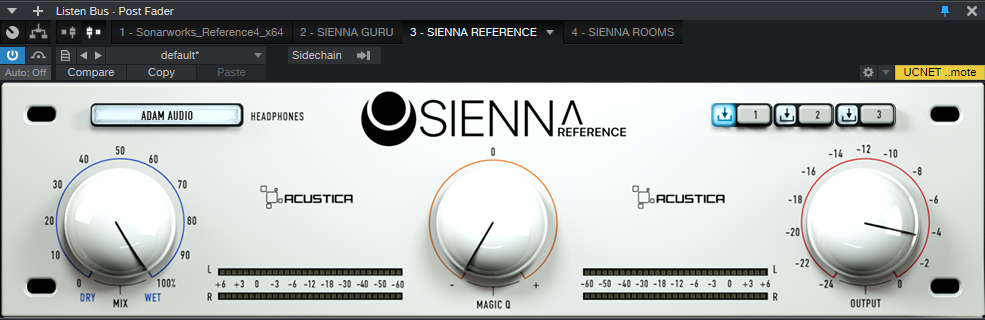
References is presented with extreme simplicity. 3 big knobs to control:
Mix, dry / wet of the correction
Magic Q to get a more linear or more euphonic response according to AA's suggestion
Trim Outputs
The interface is completed with a drop-down menu to select the headphone model, input / output meters and the ability to save / recall custom presets.
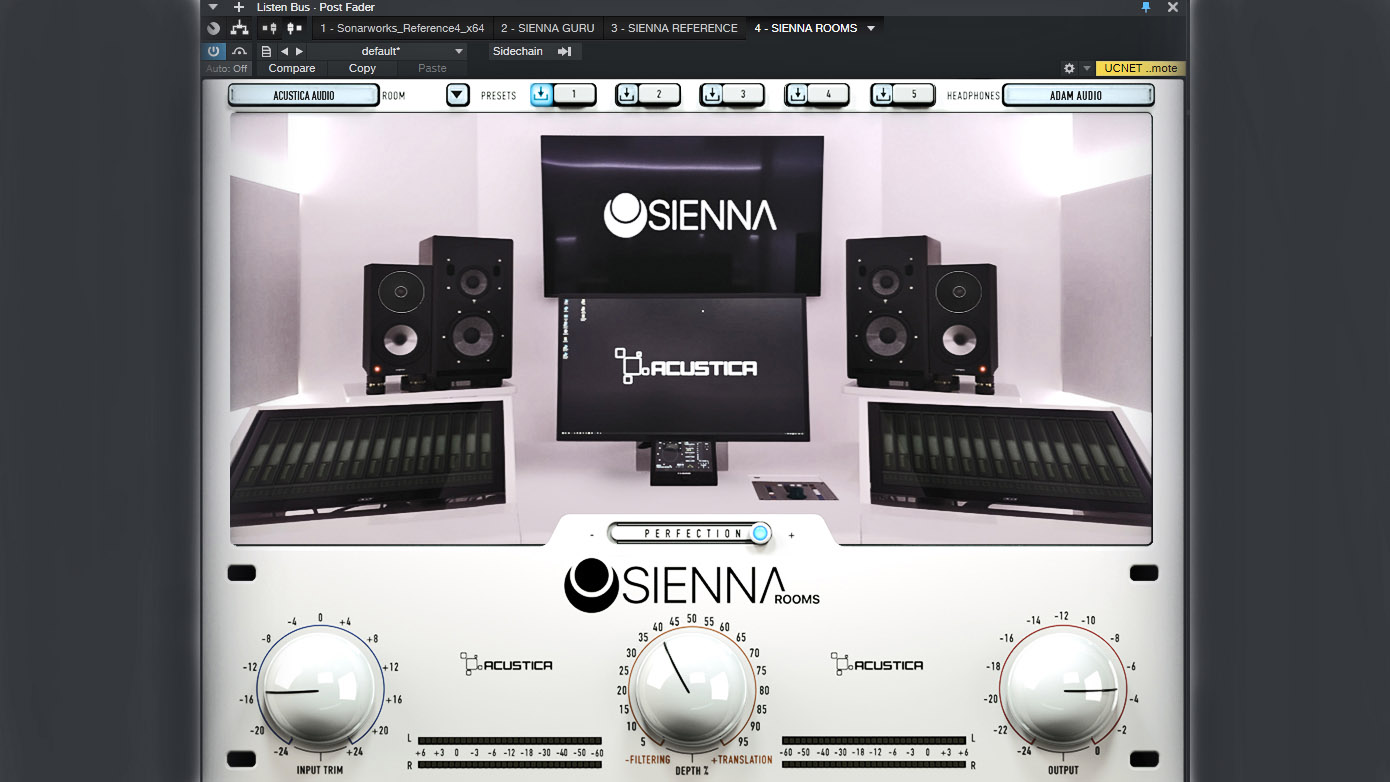
When selecting the headset model, Rooms supports the choice of a room you can virtually position yourself in, with its different sets of speakers, allowing you to listen to your mix with greater depth, including a feeling of "air" (typical of listening on speakers) and reducing the Left / Right channel separation. All with the well-known attention to details and experience from Acustica Audio we already know. Behind the algorithm there was a long research and numerous attempts by the team, until they found a "sweet spot" that represents the maximum of realism. Rooms adds to the 3 knobs a fourth “Perfection” control to get either a linear listening curve or the original response of the speakers sampled in that studio.
The 3 knobs of Rooms are:
Trim inputs which is not a gain control, but rather the response of the sampled speakers in the room in terms of harmonic distortion as the level increases (note: RTFM!)
Depth% controls the amount of room emulation
Trim Outputs
Finally Guru, an upgraded version of Rooms, allows you to control additional parameters:
disabled room to disable room emulation
Disabled Room Gain, gain level compensation trim when the room is off
Bread
Width, modifies the distance from the speakers and then change the positioning angle
Acustica ++, more or less binaural listening
Depth ++, reproduces the depth given by listening on speakers compared to listening on headphones
Pan ++, controls the cross feed
Focus, gives either a drier and more focused listening or listening with more room without changing the volume

To unexperienced ears I would suggest not to play with Guru's controls too much. To fine-tune the parameters we should know where we start from and where we want to get, it is not a "creative" plugin, at least not when using it as a reference listening point for mixing and mastering (some people are already experimenting using Sienna in insert on single tracks).
Customization is for very trained ears.
Pro or Consumer?
To me, there is no doubt: it is definitely a tool for professionals. Only those who have spent hundreds of hours listening in the studio, on different monitors, perhaps not exclusively near field speakers, can really appreciate Sienna's algorithm. I'd say it is ONE of many tools for professionals. No one would entrust to a software, however innovative and amazing, the sole task of finalizing an audio project. The fact that it is not desirable to mix or even master with headphones remains true and this is certainly not the goal behind the work of the AA team. Personally I got more reliable results using the Adam SP5 compared to the AKG K141 sisters, confirming that Sienna's potential is expressed more comfortably if coupled with a high quality product.
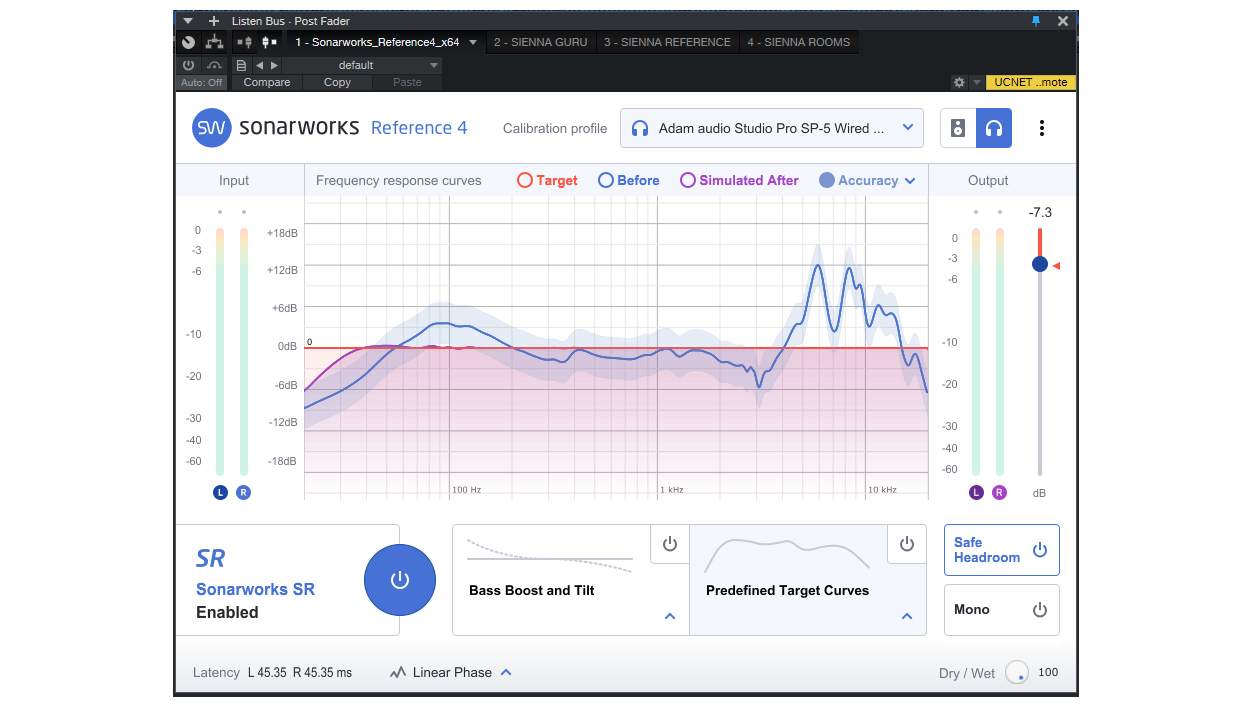
Comparison with Sonarworks
When speaking about Rooms / Guru: “it's like apples and oranges”, the English would say. I have not tested the latest version sound ID, so I will refer to the classic Sonarworks Reference Headphone Edition. We could define Sonarworks "corrective" and Sienna Rooms / Guru "virtualizing": the first has the ultimate goal of making the frequency response as flat as possible, the second sets as its goal to the most ambitious task of bringing a room inside a headset. Regarding Sienna Reference if used with the knob mix at maximum and the "Magic Q" at minimum it applies a linear correction like the Sonarworks colleague, although it does it with the peculiar algorithm by Acustica Audio. The corrections on the same headset are in fact quite different. Which one to choose?
At this point we make a first consideration.
What is Sienna used for?
What is the ultimate purpose of these tools? To make us listen to our projects in a better way? What does "better" mean? It "simply" (not simple at all) means that we can trust more that our listening is linear, that the headphones do not add their own "color" that we will then automatically compensate during the mixing phase. All of this has the incredible advantage that our mixes and masters will translate better on all systems, which is exactly what we want. The difference is huge.
I take the liberty of finding one con: the lack, to this date, of a <b>standalone</b> version of Sienna. StandaloneA great advantage of using a calibration software is that it can also be used when we listen to other people's records to train the ear to precise listening. As a Sonarworks user I can say that to maximize its benefits I always use it, both in the Studio version (speakers correction) and Headphones.
We must make a difference between testing a work on different systems (different monitors, different rooms, telephone headsets, in the car ...) and having our own constant, precise listening, which we can trust blindly and, in the case of headphones, to take with us everywhere. The calibration of my Adam SP5 by Sienna Reference immediately sounded more natural, balanced, changing less the nature of the headphones. However, the idea of entrusting myself to Sienna within Studio One and standalone version of Sonarworks as a “pleasure” listening would confuse a well-established and, in fact, reliable listening. On the site I have glimpsed an upcoming launch for iOS, we can perhaps hope for a standalone version of the software for the future.
Back to Sienna Rooms. Ears get used, ears deceive us, in audio everything is relative, we need a foothold in order not to fall into the traps and for this reason Sienna Rooms can also lead to no good. Let's clarify: of course the plugin helps us to come out of the isolation and closure of the headset. But my real curiosity about this technology is: how does the sampled room sound compared to the real room it wants to recreate? Currently this can only be told by the lucky owners of the two “sampled” studios (50 new virtual rooms coming soon). I turn it on, I bypass it, I turn it back on, what has changed? What should I look for in this listening? The arduous task of transforming the headphones into a virtual room coupled with the fact that most users do not know the room that was originally sampled seems kind of double loop with a high degree of difficulty and many dangers lurking. A A/B between real room and headphones + Sienna would be a godsend to understand how the algorithm works and how to best use this software, as well as the time spent testing the plugin in your projects by evaluating the final result of the mix or master. It is difficult to exploit its full potential right away. Playing with it without knowledge is like tinkering with a knife: be careful to transform a useful tool into a weapon of mass-ter destruction.
A room for everyone
At this point I ask myself: what if the virtual room in that list was my studio? Having my room always inside my headphones everywhere I go? Hell, yeah! I don't know if AA has already thought about this business idea. Being a software house for professionals, a mixing or mastering engineer could contact the Lodi company to have his own room inside the plugin, the one room that was calibrated according to his ear and taste, to have it with him also on an Ibiza beach (and who's got time to go to Ibiza .. only DJs, sic!).
That would make a real difference!
We could have another very useful comparison through Sienna if Manny Marroquin, Noel Campbell, engineers whose jobs we know and love, jumped on the train. How would our mixes change if Stuart White put the “approved” stamp on his virtual room and we could A / B between Beyoncé's Lemonade and our latest masterpiece? (Editor's note: I don't think we would win a couple of Grammys too).
Being a composer and post-audio engineer I also wonder: will a theatre emulation be available in the future to get a taste of how my latest orchestral soundtrack sounds on the big screen while I'm on a beach in Ibiza? (with my DJ friend)
Sienna's potential reminds me of virtual reality. Anyone like me who is passionate about video games knows where VR is right now: enormous potential, technology still immature.
In conclusion, my consideration on Sienna is: Acustica Audio has started a revolution, are we sure we understand what revolution it is?
Useful Information
Product: Acustica Audio Sienna
Price: 89 euros only online