

I had the pleasure of meeting and interviewing Sharon Farber at the Guitar Oasis International Music Festival 2022 held in the first week of July at Torchiara (Salerno, Italy).
Sharon Farber is not only a composer of film, TV and concert music, but also
member of the executive committees of the film and television academies, four times nominated to theEmmy Award, board member of ASCAP, winner of GRAMMY, VP of Alliance for Women Film Composers, winner of the "Society of Composers and Lyricists Award” for “Outstanding work in the Art of Film Music” and the Telly Award.

Lorenzo Sorbo: I'd like to start our conversation by asking how you got into making music, composing and your education in particular.
Sharon: Can you see this? (showing her old piano) That's how I started.
Lorenzo: The family piano?
Sharon: Indeed! I come from a very musical family, my grandparents were both excellent amateur musicians and played guitar and mandolin. My uncle is a great songwriter/composer in Israel. My father played the piano. When I was young my mother was a dancer. At the age of seven I started playing the piano with my sister – she is two years older than me – and after two years she told me: «I don't want to do it anymore» My mother very intelligently told me: «You are 9 years old. Now you're grown up and it's up to you to decide if you want to continue. Wanna do it ?» I said yes.
And later I went to the art school where I also studied harmony, theory, history of music and all related musical subjects. All of this paved the way for my life in the music business.
Lorenzo: I therefore assume that you have done traditional studies. When did you start studying composition?
SharonI started out as a purely classical pianist, but I've always had a very good ear so I could pretty much play whatever I wanted just by listening to a song on the radio. I have to thank Sarah, my piano teacher, who was like my second mum and encouraged me to start composing. Which was funny, because when I was about 15 she said to me: «You should start composing music.»
It seemed to me something like: I can't cook - although I could make "spaghetti alla bolognese" (a typical italian first course) How do I start? I love music, I love playing and I always improvise on the piano… but… to compose serious music? It was something I hadn't considered until then. But I started and never stopped.
After high school I served in the army because it is compulsory in Israel, but I continued to play the piano. After the army I gave many private piano lessons, but I also started composing more seriously. I wrote music for the theatre, used to direct music, but felt I had to spread my wings to expand my skills. I also met someone who introduced me to the art of film music and I was fascinated by it. I fell in love with it, which led me to join the Berklee College of Music in Boston.
I got a scholarship and my plan was to do a one year certificate program. But after a few days I realized how much I liked it and changed it to a double major (Film Music – Composition and concertation). Thanks to my prior knowledge, I graduated in six semesters and was assigned the internship at the TV Academy in Los Angeles where I moved. I've done all kinds of music works: internship at TV Academy, ASCAP film music workshop which gave me the opportunity to record with a full orchestra. I also attended the mentorship program of the Society of Composers and Lyricists. I wanted to try everything.
Jonathan Wolff, my TV academy mentor (composer of Seinfeld and many other shows), introduced me to Shirley Walker. Shirley was the pioneer among female composers and none of us female composers would be here without her her groundbreaking work and all that she has done for subsequent generations. Shirley really liked me and she took me under her “musical wings." I started working as an orchestrator on Batman and Superman, the animated TV series for Warner Brothersand later I wrote for the show. But soon after my time with the great Shirley ended I started my individual journey in the film, TV, concert music industry. I like everything, including songs, world music. Music is magical and there is always so much to discover and explore! Every project is different and gives me a new opportunity to compose different music!
Lawrence: What is your working method when composing? I understand that it can change every time, but in general do you compose writing traditionally in the score? Do you mostly use the piano or other instruments?
Sharon: This is an interesting question because it really depends on the project. If I'm working on a movie, I start by reading the script. If available, I sometimes get the movie and never read the script. Or I watch the film, digesting the story and the different elements. Then I discuss it with the director and after that I have a “spotting” session where we decide where the music comes from, when it comes out, etc. And then I start to work.
When I'm working on films, I usually just write the main musical ideas and the rest I do on the computer, as time is usually short and deadlines have to be met. I need to work in an efficient way and one that can use my inspirations to create music that supports the film in all its elements. It's a beautiful process and truly an art.
Some people like to write the piano part first and then the orchestration. I hear the orchestration as I write, so it's easier for me to orchestrate as I go. But the method doesn't matter, as long as the result is good.
In concert music, for example, I tend to work more on the piano with pencil and staff. Since I'm not limited by visuals or dialogue, I'm free to use my musical imagination and the piano is my vehicle for doing so. Next, I input the music into the computer and make it presentable to the orchestra. Working with text is different too, but ultimately it's about working the way you feel most comfortable.

Lorenzo: Talking about the computer as a tool, surely you know that our music magazine "Age of audio" deals with home recording, software, hardware, etc. In short, everything that revolves around music technology. When we interview artists we are curious to know what technologies they use. Do you use a computer with some particular software or do you prefer some plugin? Do you use Mac or Windows?
Sharon: Always Mac. It's the standard in our industry. It makes everything smoother and better. As for the sequencer, I use Digital Performers (DP), for notation Sibelius and I have many sample libraries that I use with Vienna Ensemble pro as it saves a lot of memory and makes everything better, faster and easier.
As for the samples, I have a lot of them, from Cinematic Studio Strings to Omnisphere, Kontakt Komplete and many many more. I think it's not about how much you own, it's about how well you know how to use these tools because you can really create beautiful demos that sound real. Of course nothing can ever replace the power of the orchestra (I hope) as the human element is unique to each musician. However there are sounds that the orchestra can't create and you can use your own libraries to create a hybrid score that sounds amazing.
Lorenzo: Once you have written a new piece, how do you produce it? Do you make a demo in your studio and then finish the work in a professional studio?
Sharon: I work in my studio and it depends on the project. Sometimes I produce exclusively in the studio because the production cannot afford an orchestra. But I try to always use my mixing engineer, even though I'm a pretty good mixing engineer myself. I like to have someone who can put their magic touch but I prefer to be the producer of my own music. I went to school to study how to become a better composer. Others went to school to study how to become better engineers. It is always better to have some expert in professional mixing.
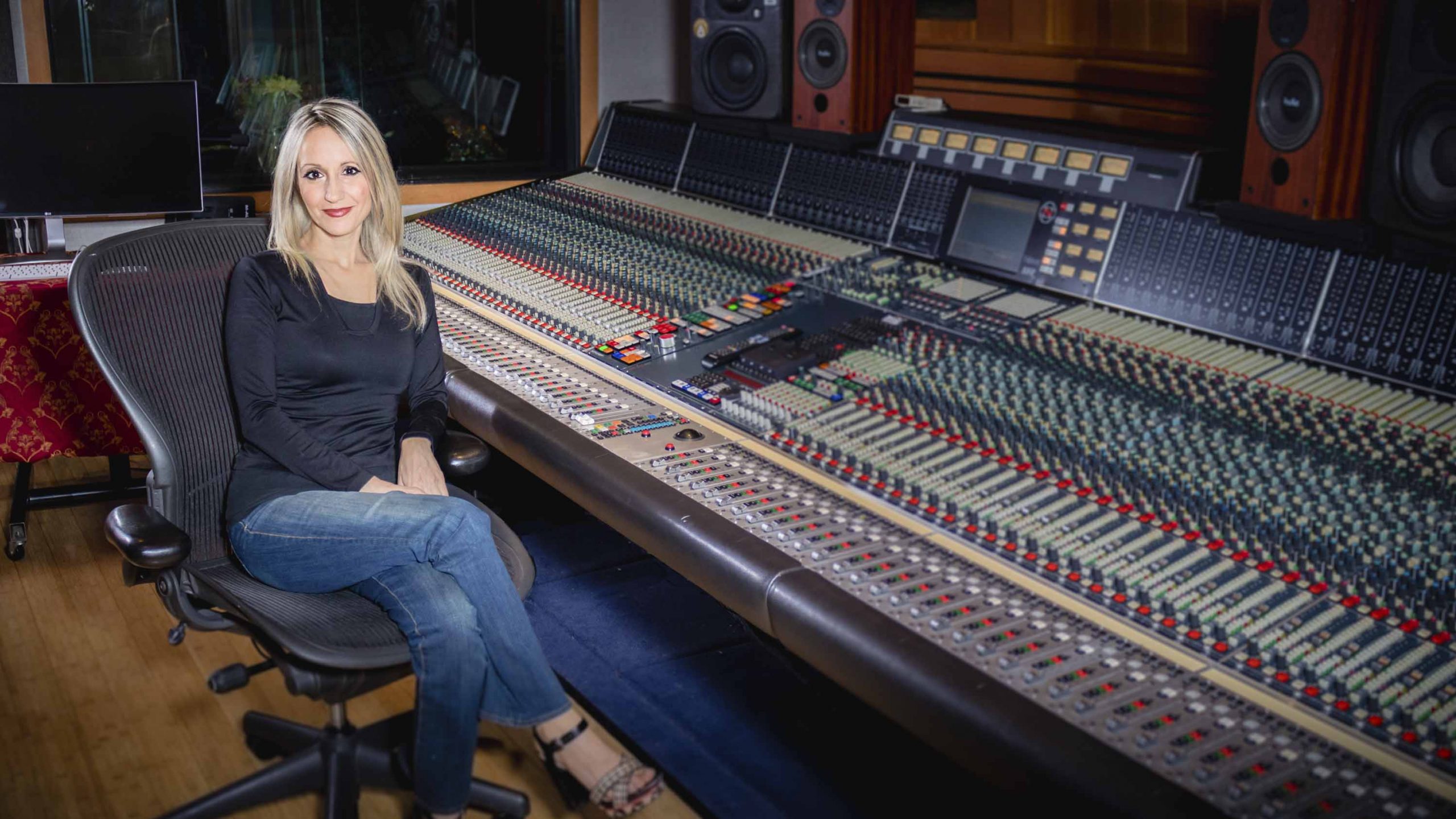
If I have an orchestra, after I've composed and orchestrated my music, I usually send it out for music copying and preparation, so I can focus on preparing for the session and making any last minute adjustments. The copy service takes care of making the parts for the musicians, putting everything in recording order and making everything easier for everyone.
In some projects I use a music editor. Again, it really depends on the size and scope of the project. Plus I have a wonderful assistant who helps me organize everything. She is someone I can trust and she is also a good composer. Throughout your career, you tend to pull your team together and trust every member of your team to do their job professionally.
Lorenzo: Talking about soundtracks, in the world of entertainment – as well as in films – the way in which productions are conceived, produced and distributed is rapidly changing. All this necessarily implies a different approach by the composer. What future do you imagine for the soundtrack? Considering video games look more and more like film productions, have you ever thought about writing music for a video game?
Sharon: It's a great question. Yes, things are changing and physical CDs are almost gone! My new soundtrack for BRAINWASHED: SEX-CAMERA-POWER it has just been released commercially and will be all in digital format. I might have a few CDs made just for the fun of it, but most of it is digital. Most computers no longer even have a CD player inside their computers. As far as video games go, I think it's a fascinating area of creation and while I haven't yet, I hope to have an opportunity in the future. It's something I'm really considering because you get the chance to work with a large orchestra and create adventurous and dramatic music, which I love.

Lorenzo: How challenging is it to work with a large orchestra in big productions? Are there any special requirements?
Sharon: Working with a large orchestra is an extraordinary experience. Nothing can ever replace it. It's a challenge that there are many elements. From writing the music to orchestrating, preparing the parts, the “click tracks“, the recording, the mixing… but it's wonderful. Sometimes though, even if there's a budget, the producer doesn't choose an orchestra. A friend of mine just told me that he had this experience. The manufacturers have thought that the mockup was good enough… and this is a big movie with a famous director.
Lorenzo: Is it a big production with a big budget?
Sharon: Big budget and big action. They prevented the composer from using a real orchestra. You can imagine how disappointed he was because he couldn't wait. I think composers who work with live musicians are the best.
But there are other challenges for composers. AIs (artificial intelligence) are now capable of composing music so it will be interesting to see where we go next. I think human creation has no limits and even the best computer is based on data rather than the human mind, imagination and inspiration. On the bright side, though, we're getting back to good tunes and it's great because a good tune goes straight to the heart of the viewer!
Lorenzo: What was the most challenging score to write?
Sharon: I think it was my last job BRAINWASHED: SEX-CAMERA-POWER. It is a very mysterious, dark and heavy soundtrack that explores the sound of old Hollywood but with my own style. You can see the trailer with music here: https://kinomarquee.com/film/venue and some more excerpts here: https://play.reelcrafter.com. It's a documentary about how women are filmed during the Hollywood days – camera angle, lighting, requests for certain positions – and how it all contributes to the sexualization of them. The director Nina Menkes used the soundtrack of Vertigo by Hitchcock (composed by Bernard Herrmann) as a “time track.” It is a working method by which the director uses a particular piece of music during the shooting/editing of the film to give the composer an idea of what he is looking for. And this soundtrack has a very unique “old Hollywood” sound. It was difficult to create a mysterious and dark soundtrack, but I loved trying my hand at it.
For Menkes it was the first time working with a composer, so she was a little worried until she heard my music designed for the first four minutes of the film. She was immediately enthusiastic about it. I was able to accomplish what she was looking for, but I also offered my “version.” She was so excited that she said:«Yes, this is exactly what I was looking for!» Besides it, I had to work with 190 video clips and I had to do a long job of assembling, matching the shade, the style… it was a long process.
However we have created a wonderful collaboration which has resulted in a soundtrack that I am (and she is) very proud of. The film hits theaters this weekend (21.10.22)
Lawrence: I saw your site and noticed many collaborations. Is there an artist you have collaborated with and to whom you feel professionally close ?
Sharon: Not really, I'm a freelancer and I compose my own music. I've never worked with another composer, but I'm open to collaborations. I have worked with songwriters whose music I have arranged. For example, do you know Diana Warren?
Lawrence: Sure
Sharon: She is my good friend. This was an example of a wonderful collaboration with an amazing artist. I am so happy that she is getting her well deserved Oscar. I took her song from her I'm standing with you and I arranged it for 17 solo singers and 160 backing singers, orchestra, additional instrumentalists… it was a crazy project that we did with the United Nations for their “Corona” relief fund. It was a wonderful collaboration because it gave me a free hand to take the song and arrange it as I saw fit, whatever I wanted to do. You can see it here: https://kinomarquee.com
Lorenzo: Are there any composers from the past who have inspired you?
Sharon: Yes. The great masters, of course, from Bach to Stravinsky to many others, but more recently Shirley Walker. Shirley pioneered female composers and paved the way for other female composers. She was truly amazing, so knowledgeable and creative. I learned from her how to take a small orchestra and make it sound big and impressive. And, of course, I love John Williams who writes not only film music, but also concert music. Everything he writes becomes a masterpiece. Other composers I like are James Newton Howard, Danny Elfman and many others.
Lorenzo: Last summer you took part in a film music workshop in Torchiara, a wonderful seaside village in southern Italy as part of a festival organized by Tali Roth, founder of Guitar Oasis Int. as well as guitarist of the prestigious "Juilliard school of music" in New York. Have you got collaborated with Luciano Tortorelli, renowned guitar teacher at the Conservatory of music “G. Martucci” in Salerno and high-profile composer. How was this experience?
Sharon: Torchiara was wonderful. First, I loved the place, the people and the authenticity of everyone. Even the mayor and the police chief came to our concert! And I loved the students, aged from 14 to 50! They were all so passionate and loving. Most of them didn't know anything about composition, but after I gave my first film music lessons, they all wanted to write.
It was definitely challenging for the students to study film music. Most of them have never tried to compose music for film or any other kind of music, but when we finished they ALL wanted to compose and it made me feel so good, knowing that I really inspired them. Technically it was challenging as many of them didn't speak English, but we used 'google translate' and after all music is a universal language!
Another challenge was the lack of technical tools as we didn't have computers. The students received a scene for the soundtrack belonging to one of my films and were given a few days to compose it on guitar or piano, writing their music simply with pen and paper. Marvelous! At the final concert everyone performed their music in sync with a clip and I was so proud of each of them! They worked hard.
Some of the students chose to compose a piano piece or a song and we worked on their composition style without visuals, which I also usually do. They really wanted to learn and acquire more skills. Many of them wrote to me afterwards telling me how this festival changed their lives. They wrote to me about their passions, hope for the future in general and the musical one in particular. They have to believe it, because many people don't see music as a profession and often advise against beginners by requiring them to stop and look for a "normal job".
But if you have passion you have to try, otherwise when you're older you'll just be unhappy because you didn't do what you wanted to do. Your life will be filled with regrets and this is not a good way to live.
We only live once, as far as we know. Why not live with passion?
Lorenzo: Right, in our own small way we too at "Age of Audio" try to spread the passion for music and technology. Now I would like to ask you one last, but classic question. what are your future projects?
Sharon: Right now BRAINWASHED: SEX-CAMERA-POWER is on theatrical release in the United States alongside the album. I'm excited! I'm also working on two movies, a TV series, a commission for a 220-singer choir, and a concert in Washington DC. They're both on the same day! Maybe I should clone myself! Then a trailer for a video game… a lot! Another film of mine is coming out early next year and I'll tell you all about it when it is, but I'm really excited because I also wrote a song from the film which is sung by my 11 year old daughter who is a great singer.
I also work in different organizations like the Motion Pictures Academy (OSCAR), the TV Academy (EMMY), the GRAMMYs, I'm the VP of the Alliance for Women Film Composers, I'm on the board of ASCAP… so my plate is full.
Lorenzo: Since you mentioned it, I would like one last word from you on your daughter's voice which was a real discovery for all of us in Torchiara.
Sharon: Thank you! She's really an amazing young singer and that's why I'm so excited about the song in the film. She has another big project coming up, but I'm not sure when she'll come out yet.
She has a new agent, so I'm sure there will be some really great stuff for her. She wants to be like Lady Gaga who plays the piano, sings and acts – a true artist… But she also wants to be like Adele! Let's see what the future holds for her.
Lorenzo: Sharon, I would say that I just have to thank you for the time you have dedicated to us and we hope to see you again soon.
Sharon: We hope to be back next year. Thanks for this opportunity!