


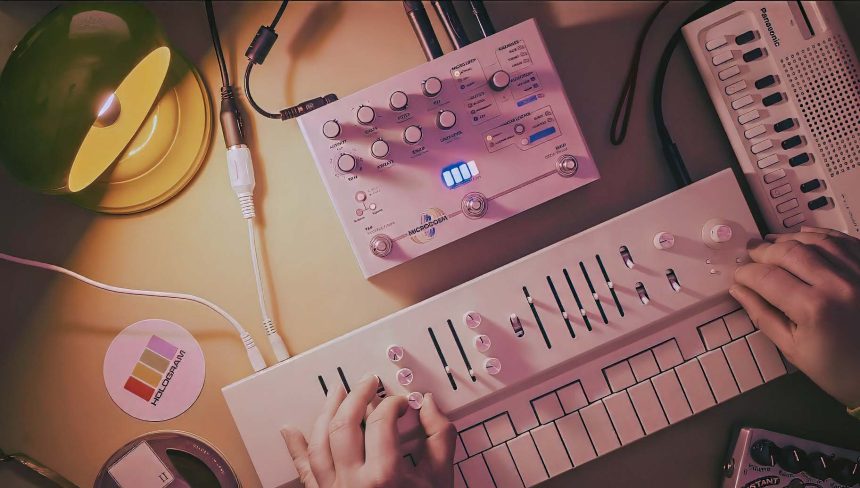
Many of you, browsing Instagram, will have come across videos where some musicians, more or less well-known, more or less influencers in the sector, play synthesizers together with pedals.
At first glance, the impression one gets is one of promotion or vanity. This is partly true, partly false. Having made videos for a couple of years, including for companies, I've come to the conclusion that the underlying structure is much more complex and perhaps it's worth analyzing at its various levels.
The sound demonstration
The first level is that of the sound demonstration, which is what all or almost all of us have done at least once in our lives on social media: a thirty-sixty second reel It has the immediate ability to showcase and demonstrate our sound in context, immediately, without verbal mediation (and fortunately, often without scathing comments!). The limitation to a short format of a few seconds is a godsend for those of us, like many others, who lack the time, desire, and courage to write a full-length song. The short format works well: it doesn't judge you. It doesn't force you to do things against your will.
The visual identity
The second level is visual identity. This comes later, precisely when you realize the level of video on social media these days is very high: color correction, shot placement, timing, distinctive characters. All of this, if implemented, inevitably leads to a sort of "branding" of your profile, whether followed or not. A recognizable image is an image you remember. Many of us already know who that guy is before even hearing the audio of that guy because the "format" he uses is his calling card. This card communicates an approach to music, influences, a cultural positioning. Do I sound exaggerated? A person in a video playing a synthesizer with a Tube Screamer, a Boss DD-8, and an MXR Phase 90, in 99% of cases, tells a different story than someone using a Hologram Microcosm, a Strymon Volante, and a Chase Bliss Mood. No caption needed.
Synths, pedals and visual language
Let's take an example: you've probably been fascinated by someone playing a synthesizer and a few pedals compared to a guitarist with his guitar and a few pedals. Regardless of the musical genre, there's one difference: the relationship with the pedal.
Ambient is probably one of the most tactile and visual genres, naturally suited to the Instagram video format. A shot of hands moving on a pedal during a performance conveys something immediately understandable: there's a person doing something, making decisions in real time, and the resulting sound depends on a precise physical gesture. This is very different from the classic relationship between a guitarist, where the pedal is usually simply activated and deactivated. In ambient, for example, and in other electronic music genres, the pedal is visible, tangible, and legible: you see the hand turning the knob and you immediately hear a change in sound. There's also an aesthetic connection that shouldn't be underestimated. Ambient is a visual genre by definition, historically associated with images, landscapes, and states of mind.
Brian Eno He understood it before Instagram existed: this music is designed to coexist with a visual environment. A synthesizer filmed with beautiful, perhaps slightly smooth lighting, a color correction with undersaturated and sparse coloration, is already an ambient image. The sound and its visual representation speak the same language, and on Instagram, that overlap is a narrative advantage that very few other genres can boast.
Micro-influencers and boutique brands
The third level, the most interesting from a market perspective, is that of the distributed influence economy. Brands in the sector have learned in recent years that micro-influencers A well-established, technically savvy audience is often worth more than a famous name with millions of generalist followers. An account with ten thousand followers, composed primarily of active musicians, producers, and synth enthusiasts, has a vastly higher conversion rate for specific products than a generic influencer. Boutique companies understand this well and build their image around these musicians.
But that's not all. There's a deeper connection. Boutique brands, in many cases (and I've seen it firsthand), don't have the budgets of large manufacturers for traditional advertising campaigns, and ultimately wouldn't have the use for them: their audience is too specific to be reached with general media or advertising. They need someone who speaks the same language as their buyer, who can demonstrate the product in a real-world context, and who already enjoys the trust of that community. The technical micro-influencer is invaluable in this case.
The interesting point is that this relationship only works if it remains authentic. The beautiful thing is that it's very often authentic. If the creator demonstrates something they wouldn't actually use, the community senses it, and the reputational damage is immediate and irreversible in such a small and cohesive environment. So both have an interest in maintaining real consistency: the brand sends gear to those who will use it seriously, the creator feels part of the brand and sees this gift as a sign of respect and love for their work from the brand. This is the most effective communication system in this industry. Have you ever noticed the love young musicians have for these instruments? Believe me, there's real passion and love when a bond like this is created. Often, a collaborative relationship develops that goes beyond the video: they become beta testers, alpha testers, they try to offer advice, and that "I'd love for the next pedal to have this..." feeling is born.
When video becomes daily practice
A funny thing happened when I started making videos: someone I knew said to me, "You've changed since you started making videos, you're showing off." Actually, it almost all happened by chance: before the pandemic, I bought a camera that wasn't really suited to making videos, just to take a few photos. I liked the fact that I didn't necessarily have to make something three and a half minutes long, but that a minute was enough with a small idea, perhaps written down the day before. This "fulfilled" me and freed me from a lot of guilt, guilt perhaps due to the fact that I didn't play much. Today, I compose new music almost every day. Maybe that's what's changed. My first videos, and the ones I still make, are always shot with the same camera. In any case, it's a small but important thing, and in my case, I always try to take the utmost care in making a commissioned video. As absurd as it may seem to the untrained eye, it's not easy at all.
A solitary, direct, human work
Micro-influencers in the music industry almost always work alone. They don't have an agent, a press office, or a structure that mediates between them and the brand. The relationship is direct, informal, often based on genuine mutual respect—and precisely for this reason, it's difficult to manage when something doesn't work out. Saying no to a request, or expressing disagreement with how a product is being presented, means doing so in person, without filters, with the real risk of compromising a relationship that has both financial and human value. If you find yourself in difficulty, for whatever reason, always be sincere and professional; it's the best thing to do.
To the next article


I completely understand your point. It's easy to immediately see the promotional side, but there's often also a genuine passion for music and experimentation that shines through.