

It would seem like a déjà-vu, yet it is not at all. French Arturia, after having tasted success with her previous simulations of analog synths such as the Minimoog, the Moog Modular, the ARP 2600 and the Yamaha CS-80, now launches into the world of Sequential Circuits almost desecrating another monster sacred of the instruments of the past, or rather two: the Prophet 5 and the Prophet VS. As for the first, other houses have already tried simulations previously, some even excellent, but it is the first time that we see the Prophet VS simulated in the software field. What's more, it's the first time we've seen them both in one plug-in. Let's find out where the news is.
Dave Smith and his creatures:
La Sequential circuits was founded in the mid-70s by the American Dave Smith (Insert photo "DaveSmith.jpg" with caption: "Dave Smith, founder of Sequential Circuits") and a group of experts in musical electronics, including a former engineer of Moog, contributing to the evolution and history of synthesizers in an absolutely unique way. Sequential's first and biggest hit was the Prophet 5 (Fig.1), which was not only a great instrument but above all the first polyphonic synthesizer controlled by a digital microprocessor, with the possibility of saving presets. In the following years many other electronic instrument houses followed the same trail with similar instruments, including Moog with the polymoog and subsequently the memory moog, closely followed by the Japanese Korg, Roland and Yamaha with instruments such as Polysix, Juno 106, etc.

Il Prophet 5 saw a total of three revisions, among which the first model was entirely built by hand, rather fragile and unstable, while the most widespread and perhaps the most stable version is the third, released around 1980. Between one and the other c 'were also subtle construction differences, including the choice of brand of some components (the former used SSM integrated while the latter used CEM), and the presence of a few more controls on the front panel. What made the synthesis model of the Prophet 5 unique was the Poly-Mod section, i.e. the polyphonic modulation, which allowed to use the filter envelope and oscillator 2 to modulate the frequency of oscillator 1, the pulse-width oscillator 1 and the filter cut-off frequency. This system, combined with the possibility of hard-sync between the two oscillators, gave life to a new range of sounds never heard before in other analog synthesizers.
A few years later, Sequential created another milestone in the history of synths: the Prophet 600, a cheaper version of the Prophet 5 but which introduced a name that today, almost 25 years later, is an indispensable standard in the audio field: MIDI (Music Instruments Digital Interface). In 1982 the Prophet 600 (Fig.2) was the first electronic musical instrument to have a MIDI interface capable of being connected to other instruments with the same interface to exchange data and synchronize performances. At the 1983 Winter Namm Show, Roland presented the JX-3P and the official demonstration of the MIDI protocol was made for the first time by connecting the two synths together: spectators were fascinated by the fact that by playing only one keyboard, two instruments could be heard perfectly playing. in unison.

1987, another great invention: vector synthesis. Three Sequential engineers experiment with a new synthesis engine capable of creating new sounds, always variable over time, thus giving life to the Prophet VS (Fig.3), a tool with a digital, innovative and very promising heart. 61-key dynamic keyboard, two-dimensional joystick, new multi-point envelopes and a complete modulation matrix are the hallmarks of the VS that have made it as famous over the years as its predecessors. But unfortunately those were not such happy times for Dave Smith's industry, so much so that around 1989 the patent of the Prophet VS was sold to Korg which introduced the famous Wavestation on the market, and the following year the company was sold to Yamaha. , which in 1991, coincidentally, launched its SY-22 ... vector synthesis (Fig.4).


Nowadays, while Dave Smith is back on the market with the DSI and his Evolver series synths, in France a group of programmers and sound engineers takes up the myth of Prophet with the Prophet V synth software. Ah, while we're at it, do you know what was the first real software synthesizer in history? In 1997 Seer Systems presented Reality, the work of Stanley Jungleib and… Dave Smith!
Installation and licensing:
In the Prophet V package we find the installation CD-rom, a beautiful 128-page printed manual in three languages (but Italian is missing as usual!) And a USB key for the Syncrosoft protection system (Fig.5 ). Installation is not difficult, just follow the instructions on the on-screen screens. A little advice: if you find a version lower than 1.1 on the CD, run immediately on the Arturia website to download the update as in the first versions there was an endless list of bugs (what I call "the bugs of the race to release "). But let's talk about the license: recently Arturia has decided to switch from the old protection system challenge / response to the USB dongle for obvious reasons, but perhaps for many this was not an entirely appropriate choice. Let's face it, the USB ports on our computers would never be enough, and it bothers us a bit having to waste them just to run programs. The advantage is that we can easily use the same license on multiple computers, one at a time, simply by plugging the dongle into the computer we want to use. But the swindle, on the other hand, lies in the fact that the dongle is also required simply to use the DEMO version of the software. However, taking a quick look at the Arturia website, I discover that perhaps they have listened to the voices of many potential buyers who do not agree with this commercial policy, so the “No dongle? No problem! " which gives the possibility to buy a Syncrosoft dongle on their online shop for only 9 euros with the option of being able to return it within two months from the date of purchase requesting a full refund of the expense. Will it be solving the problem? Meanwhile, our NFR is also limited, and when the license installed in the dongle expires, only a piece of otherwise unusable plastic will remain, especially since it proved impossible for me to transfer the Steinberg licenses to Arturia's dongle or operate in reverse, even if both being Syncrosoft systems. Will the dongle also be protected?

The interface:
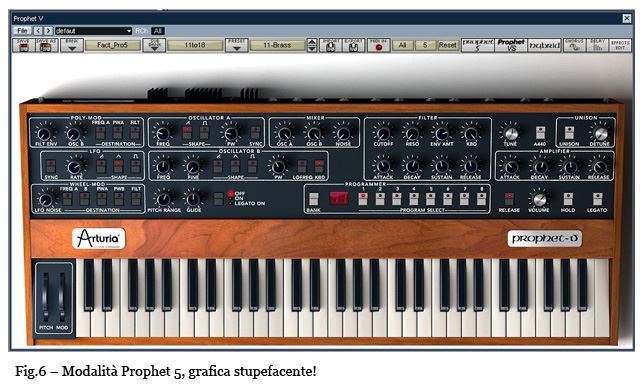
This is in my opinion the best part of the Prophet V, the graphics. I would dedicate a standing ovation to the graphic designer who designed the 3D model of this plugin as the shapes, proportions, colors, lights and all the smallest details correspond almost exactly, I would say 99%, to the real counterpart of Prophet 5 (Fig.6). As for the section dedicated to the Prophet VS, vice versa, a reconstruction of the panel was made using the same colors and the same style, but making everything more suitable for a software plug-in where, instead of a simple alphanumeric display and of the multifunction buttons, we have graphics and rotary controls that are undoubtedly more practical to handle. Not only is the interface very beautiful to look at, but it is also pleasant to use: by varying the status of any command, a pop-up appears indicating its current numerical value, and in the VS section we have the editors of the programmable envelopes by strokes of mouse. In the upper part, the one that is not part of the synth design, we find global functions such as the management of presets, organized in banks and sub-banks, the selection of the midi channel in reception, the management of polyphony, the three buttons that allow us to choose between Prophet 5, Prophet VS or Hybrid mode, finally we find the controls for the Chorus and Delay effects. At start-up, the plug-in appears in Prophet 5 mode, but by choosing other modes we see a nice animation showing the panel rising from the wooden casing and then overturning or reassembling a bit as if it were a deck chair. beach! Well, beyond the scenic aspect, now we know in detail the commands of the instrument.
Prophet 5 mode:
Here I would say that the thing is very simple, and I guess many have already used a plug-in very similar to this one known as the German Pro-53 Native instruments or the Profit-5 of the Creamware and, needless to want to hide it, the comparison is necessary. In the Pro-53 some controls are arranged a little differently, but that's the gist of it. On the right side we find the three panels dedicated to modulation, from top to bottom the Poly-Mod section, the commands for the global LFO and the Modulation Wheel controller. All other sections are, as the British would say, self explanatory, they make themselves understood very well.
The oscillators can be synchronized and tuned separately, the first can play both the sawtooth and the square wave simultaneously, while the triangular wave is also added to the second. Given the functioning of the Poly-Mod section, the second oscillator can also be detached from the keyboard control through the KBD key, while with the LOFREQ key it can become a real LFO, more or less the same logic as the Minimoog. The Mixer section adjusts the volumes of the two oscillators and the pink noise generator. The filter is a 4-pole, self-oscillating low-pass filter and can also be used as an additional sound source. The ADSR of the filter is very important as it is also linked to the Poly-Mod section, in fact alongside the CUTOFF and RESONANCE knobs we also find the usual ENV AMT which regulates the incidence of the envelope on the opening of the filter. Proceeding to the right we find the envelope of the VCA, the TUNE knob for the general pitch, the UNISON section and the general volume. Finally, the buttons at the bottom center recall the presets.
Prophet VS mode:
Here, on the other hand, things get a little more complicated: as I said before, the controls have been reorganized by Arturia to simplify our life a little (Fig.7), but let's get to know them step by step. On the left we see, one on top of the other, the four oscillators. In this instrument the oscillators are reproducers of sampled waveforms, selectable from one wavetables of 96 samples, from 32 to 127. By clicking on the number placed above the END knob, you can choose the wave to use, also displaying it on a convenient pop-up display. The two knobs regulate the pitch. Further to the right is the Joystick, the real one the heart of vector synthesis. It is nothing more than a command through which we can mix the levels of the four oscillators. Joystick movements can also be recorded and played back in different modes, and transition times from point to point are adjusted with the four knobs at the bottom.

Scrolling to the right we find the commands relating to the VCF and the VCA, plus the two LFOs. Finally, the most complex part of the VS is found on the large panel drawn on the right side of the interface. In this display-like there are four pages: Modulation, Envelopes, Effects and Play Mode.
In the Modulation page we find the modulation matrix through which we can connect all the modulation sources to any modulable parameter of the synth. The setting is very similar to other matrices found on other similar plug-ins, with the classic "naval battle" structure: for example, to connect LFO 1 to the pitch of the first oscillator, I click on the dot corresponding to the crossing of the two axes and I regulate theamount at the horizontal axis. When in VS mode, some sources and some destinations are grayed out and not accessible: these are the additional modulations we can use when the synth is put in Hybrid mode.
The second page, Envelopes, shows the graphs of the two 5-point envelopes relative to VCF and VCA, and the mixer graph two-dimensional controlled by the Joystick (Fig. 8). Anyone who has ever used a Korg Wavestation will find a screen that will be very familiar to them. The last two pages show the commands related to the Chorus and Delay effects and all the global parameters such as the general volume, the monophonic mode, the glide time, the tuning, etc.

Hybrid mode:
By activating the hybrid mode, the two interfaces overlap (Fig.9) and you get a total interconnection between the two synths, and this is precisely the novelty introduced by Arturia's Prophet VS. Not only the two sound sources are joined, but all the parameters of one become an integral part of the other, effectively creating a new type of synth with two filters, 3 LFOs and much more. In the Modulation page we saw earlier, now the rest of the matrix is also enabled which connects the different modules of the two synths independently. For example, I can use the Velocity and Aftertouch of the Prophet VS to control, respectively, the VCA and the VCF of the Prophet 5. Also, always in the big right panel, we enable a new page called Audio in which we can route the signals of the oscillators towards the filters and towards the VCAs according to pre-established schemes.

What makes the difference:
We have broadly described the fundamental aspects of this plugin, specifying that from some points of view it is a novelty in the software field but that it can also be easily misunderstood and harshly placed in conflict with other similar products. Let's now take a look at the technology behind the Prophet VS, what Arturia calls TAE, which stands for True Analog Emulation. Already widely tested also for the previous products of the French software house (except Brass) this technology would guarantee an accurate simulation of analog circuits thanks to the digital reproduction of the behavior of the electronic components. However, I would immediately think that other manufacturers have advertised similar technologies, such as Korg which in the "Legacy" suite claims to use CMT (Component Modeling Technology) technology, or WayOutWare which, to program TimewARP 2600, claims to have used a similar technique, so much so that in the PDF manual there is a whole course about it (and I highly recommend you download it!). In short, everyone says they have perfectly recreated an analog circuit in the digital domain, but is it to be believed? Well, hard to say. But Arturia decided to model not only the merits of the electronic components, but also the defects. In fact, in the Prophet V we will not only notice the total absence of unpleasant aliasing effects on high frequencies, but if we listen carefully, we can also perceive those small sound defects that only an analog synthesizer can cause, sometimes annoying, but all the more often making the final sound is colorful and rich. Of course we can't expect to feel the same power as a real Prophet 5 since, as we all know, a software plug-in can never 100% replace an analog synth, but we can take advantage of the software to be able to record in our projects what the poor wallet would not allow us to buy!
As for the comparison with the other competitors, I can say that there are pros and cons on both sides: the German Pro53 is much lighter on the CPU but sounds a bit thin, the French sounds "big" but lacks speed and stability; the German does not entirely respect the structure of the original Prophet 5, while the French is very close to it, and has a much nicer filter. As for the Prophet VS, the only imitation attempt I am aware of is called Augur, a freeware VSTi that has been in beta for years and may never be completed.
Last but not least: the Prophet V not only has a rich set of ready-to-use presets suitable for all needs, but we will also find in the list the complete series of the original presets of both the Prophet 5 and the Prophet VS, much for the joy of reliving the moments in which, as children, we played these magnificent instruments for the first time!