


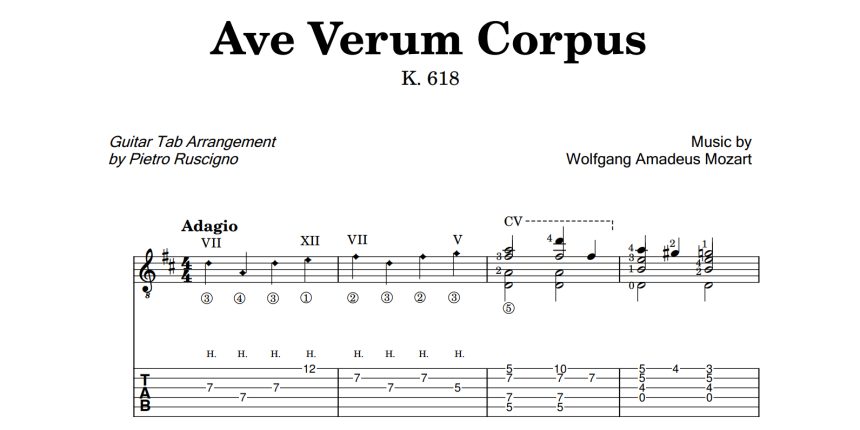
Nowadays guitar transcriptions have undergone a huge increase in popularity. In fact, they have always enjoyed a certain success in all eras, especially from the nineteenth century onwards. Today, however, several guitarists earn their living by selling them in online stores, making videos with millions of views on YouTube and so on.
I make transcripts that I post online on mine the website and on my channel Youtube. It is an experience that opens your eyes and that makes you learn a lot about how to analyze a piece and the infinite solutions with which it can be rendered on the guitar: a work of this kind means that you learn to know all the aspects of a piece and of a composer, but above all he widens the knowledge of the instrument making us feel more at ease with the guitar.
Furthermore, having to adapt the piece to another instrument presupposes a large number of musical choices to be made: this makes us grow as artists and educates to sensitivity. Making a good transcription is not a simple and immediate job, in this article I would like to talk about eight tips that I would like to give to anyone who wants to approach this world and who is about to make their first transcription:
1 THE ORIGINAL SCORE ALWAYS IN YOUR POCKET
It is almost impossible to memorize without making mistakes, big or small. Before starting, it is necessary to study the original score and identify the main characteristics of the piece, that is, tonality (which can be changed to adapt it to the instrument), conducting the voices, style and so on. If the score is written for a large group, it is advisable to also have a piano transcription with you to identify the main voices.
2 - TRANSCRIBE DOES NOT MEAN COPY
Copying is easier than transcribing. It is not enough to simply copy and paste the notes but try to adapt the piece as much as possible to the instrument. I personally tend to stick to the composer's original ideas, but when do these ideas not work on the guitar? You are more than entitled to expose this passage in a different way by exploring unusual solutions always with taste and trying to make a musically interesting product.

3 - THE CLASSICAL GUITAR HAS NO SUSTAIN
This is one of the characteristics of our instrument that does not have the same sustain as a bow or a wind instrument, so let's adjust accordingly: choose pieces that can adapt well to this situation (sliding phrases and not too many long notes) or invent ways originals of transcribing pieces that seem to sound bad on the guitar. For example, if you want to transcribe Ennio Morricone's C'era una Volta il West you could use a tremolo. Will it work?
4 - STAY FAITHFUL TO THE COMPOSER
How many times have you heard transcripts with wrong chords? They stand out very much to the ear and one is enough to frustrate a long and complex job. Stay faithful to the harmony of the piece and do not make harmonic choices that are too different from those of the composer without being aware of it (if you want to arrange the Cantique de Racine in bossa nova style you are free).
5 - TAKE A LOOK TO THE FINGERING OF THE LEFT
It may happen that a passage within the transcription is very difficult (if not impossible) or risky, so much so as to compromise the fluidity of the piece. This problem can almost always be avoided with a different location or solution. The left hand is where the biggest mistakes lurk, so beware: often the same passage can sound good in at least three different positions, it's up to you to choose the best one. Do not play the whole piece in the first position because it is more immediate, always explore all the possible solutions that offer different timbres and colors.
6 - LEARN FROM THE MASTERS
Several authors (one above all Tárrega) have transcribed works for classical guitar. Study their styles and their solutions, there is only to learn. Your goal is to make it interesting to listen to a song written for another instrument on the guitar. Asturias for example, traditionally known as a guitar piece, it is actually a transcription of the original of Albéniz for piano. There are songs whose transcriptions have more luck than the original, especially if they are of good quality and best express the characters of the guitar.

7 - GIVE IMPORTANCE TO THE LAYOUT
The formatting of the musical text is not an appendix to our work. If we want others to play our transcription we need to make sure it is clear, legible and looks professional. How long does it take? Personally, it takes me about three to four days after I have finished transcribing the whole piece, sometimes it takes longer to format the work than to transcribe.
8 - PAY ATTENTION TO COPYRIGHT
Before posting your transcript, check if you have the rights to do so. To understand if the copyright on a song has lapsed, the principle is usually applied life + 70 (life of the composer plus a further 70 years). However, this is not valid in all countries and it is not a rule for each piece, so always check the situation of each piece.


