



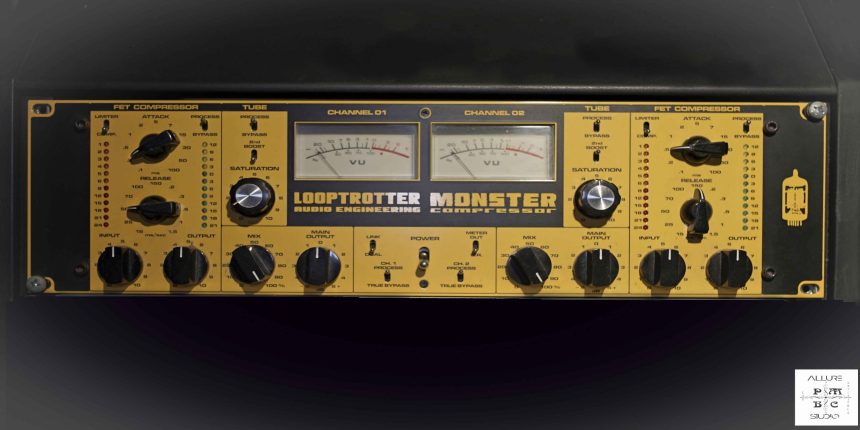
Another type of construction of a dynamics processor it is the FET (Field Effect Transistor) one.
The FET is a special type of transistor, which is driven by a tension instead of from current, it has a remarkable thermal stability and a lower noise value than a bipolar transistor. This type of transistor can be used as variable resistance, when a voltage is applied to its gate, an increase in voltage at its gate reduces the resistance between drain and source. A FET compressor therefore reacts much faster than an optical one, but on the other hand it can handle lower signal levels than those of a photoresistor. All this actually forces us to attenuate the input level to adapt it to the limits imposed by the FET and then increase it again at the output to the detriment of the signal / noise ratio.

The most famous FET compressor is the L 'Urei 1176. The first peculiarity of this machine is that all the rotary controls move counterclockwise, an unusual thing since up until now we thought by increasing the values in a clockwise direction. Unlike optical compressors, here among the various user-adjustable controls there are both attack and release times, which however are not continuous but jerky. The input and output knobs are used to, as reported a few lines ago, attenuate the input level by adapting it to the values set by the FET and then increase it at the expense of the signal / noise ratio, this aspect strongly characterizes the timbre of this device, making it suitable also to an unorthodox use of PRE signal amplifier (since it gains 40 dB). The circuit of PRE emphasis it is not adjustable, but it is possible to set the ratio on five values, even if on the panel you can see only four, already with the ratio 20:1 the machine actually behaves like a limiter. The fifth value instead, born for a construction defect, is the result of the pressure of all four buttons at the same time, generating an anomalous behavior, but which is well suited to certain types of extreme compression. Finally we find the display settings of the VU meter which are: gain reduction, input signal, output signal and, the key that deactivates the meter.


