

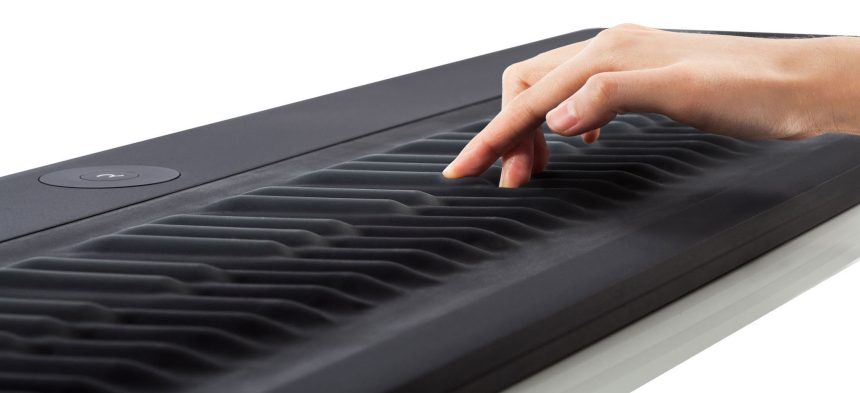
The last time that a keyboard instrument appeared all black and with very few buttons was 1988 and the Korg M1 was launched on the market: the era of DX7 (FM synthesis) ended and the era of workstations began. Today history repeats itself, and another keyboard instrument looks black and threatening, practically without buttons, and with really very "strange" keys to the point of making it look like an instrument from Mars: the Roli Seaboard has arrived on planet earth

The 61-key version (if we can still call them keys ...) despite being just over 3 cm, weighs well 7 chili, so make no mistake: the fact that it is as high as a "pizza" does not mean that it weighs as much ...
What is the SEABOARD?
A synthesizer that, like the M1, will change the future of this category of instruments. Let's see its characteristics better starting from the most interesting feature:
Roli Seaboard: The keyboard
We don't actually have keys, but a rubber mat modeled on the shape of the standard piano key which, applied to the philosophy of the great Ford (do it in any color as long as it's black!), Has a controller look out of NASA! Under each key there is a tape sensitive to the minimum pressure, practically a sort of Continum Controller which, unlike theAKEN Continuum, it has a keyboard and is not shaped like a giant KIT KAT!
The keyboard also ends down on a real one Ribbon controllers, but unlike other synthesizers equipped with ribbon, there is no need to finish on it to perform a glide because the keys, being of a material very similar to a gel, allow to be “glided”. But at this point one wonders what the underlying ribbon is for: imagine playing a melody and swiping from one note to another with your thumb without taking your hands off the keyboard.

Understanding how this phenomenal tool works is complicated. I myself had to wait to try it during a demo made atIRCAM of Paris, to get an idea of what it's like. The sensation you get is the same as that of a latex mattress: the finger sinks without yielding to the pseudo-key and at the slightest movement the keyboard reacts, creating variations in the sound unthinkable until today. ROLI has built an instrument that is able to perfectly perceive and interpret every movement of the finger, creating timbral variations (if you control the filter), dynamics (if you control the volume) or height (if you control the oscillator), or why not, the latter mixed together.
The structure, despite the lightness that inspires its subtlety, is solid and robust. The matte black becomes slightly lighter on the black keys and a slight light emanating from an LED located under the dial control positioned in the center of the instrument, helps to give the performer a truly mysterious atmosphere. It is powered by external transformer 9/12 volts, has three connections for expression pedals (Foot Controller) or switch (sustain), possesses a wheel which controls the volume and presents two USB connections of type A e B.
The sound engine
Is called EQUATOR and was created by a pool of engineers from renowned brands such as ARTHURIA e NOVATION. It is a hybrid synth which exploits multiple types of synthesis, from simple subtractive through additive, FM and sampling, all wisely dosed with a sort of morphing. The sound designers who created the EQUATOR patches come from BUCHLA, KURZWEIL e STEINBERG.
The sounds are warm and scratchy if necessary, acidic like a powerful analog, despite the synthesis being digital. The hundreds of tonal variations that the patches possess are also enhanced by the particular keyboard. The synth is controlled by an editor currently only available for MAC OSX, while the version for WINDOWS is still in the works.
A few more words we have to spend on the MIDI protocol implemented on the machine which is actually a named native protocol MDC and uses a 21 bit (against the 7 of classic MIDI !!); it can be considered a natural extension of the standard MIDI protocol. Only in this way is it possible to make the most of the instrument's potential also as a controller.
The SEABOARD comes out in three distinct versions:
The 37-key version that is called SEABOARD GRAND STUDIO, the 61-key version that is called SEABOARD GRAND STAGE and the 88-key version which is called SEABOARD GRAND PIANO.
The only sore point? You think?
But the price of course, respectively of 1.999 2.999 e 8.888,88 (I'm not kidding)
Fortunately we are talking about dollars…… (sigh ..)
Good music everyone!