

All easy easy!

EZdrummer is sold in a pretty nice-looking package, which contains the software DVD and nothing else. In fact, the manual is in .pdf, the well-known Adobe format for which the widespread and free version is available "Reader". The software has been developed for both Mac and PC and is available both as VSTi (PC / Mac) and as Audio Unit (Mac) plugin; however, it is not available as an application "standalone", Therefore it will be necessary to rely on a host platform such as Cubase SX, Logic, Sonar, Fruity Loops etc. RTAS support is planned for Autumn 2006. The installation is smooth, even if you need to be careful when you are about to install the library on the hard disk: in fact, in case you want the samples to be placed in a path other than the default one, it is necessary to intervene before the installation process, as it will no longer be possible to make changes at a later time. The software protection system is of the "challenge / response", In all respects similar to that used for Spectrasonics products: each new installation of the product generates a unique code, which, together with the serial number on the package, must be entered in the registration web panel on the Toontrack website , or rather on the specific site of EZdrummer. The authorization code will then be sent to the email address provided and the audio workstation on which the software is installed does not need to be connected to the network. The complete setup of the program takes about ten minutes. It is good to underline a feature that is very useful in terms of saving resources: it is the "TPC"(Toontrack Percussive Compression), a compression system of the sampled material patented by Toontrack itself, whereby the samples of the library are compressed in real time both on the hard disk and in the memory, without any kind of loss of audio quality or noise during decompression, even if this process occurs while EZdrummer is in action. The Digital Audio Workstation used to test our “virtual drummer” is composed of an Intel Pentium IV 3,2 Ghz CPU, 2 Giga Ram, 120 Gb 7200 RPM external hard drive with 8 mega cache and MOTU 828MKII sound card. Cubase SX3 was used as the host application and the KRK model RP8 monitor speakers did their good job as usual.
The "easy" interface:
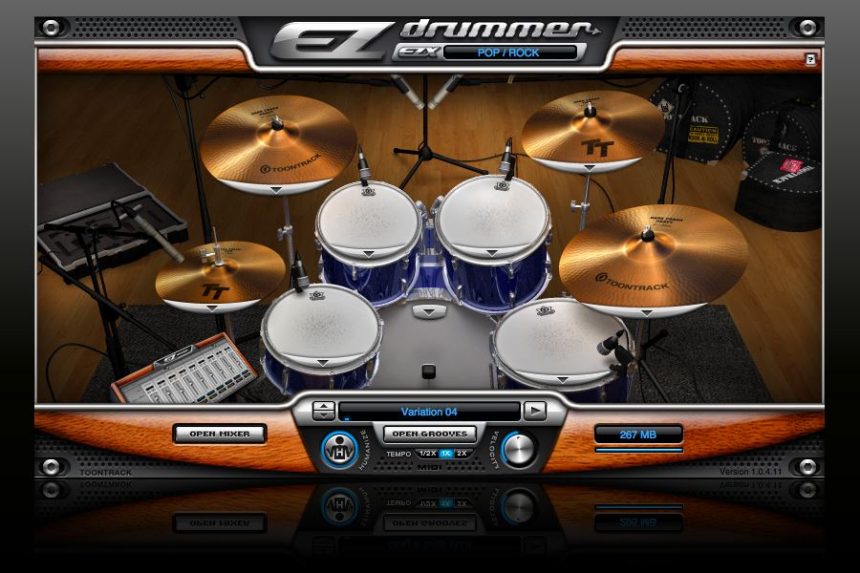
The EZdrummer user interface (Fig.1) is the synthesis of Toontrack's philosophy: products developed by musicians for musicians. When you start the plugin you are faced with a complete set of drums, complete with microphones positioned on each component, and it almost seems to be present on the spot, ready to play! What is striking is the remarkable rationality and ergonomics of the graphic interface, something immediately puts the user at ease. The three sections, of which we are about to analyze in depth the characteristics, are all present in the main screen: in the center we find the drum set in use, on which you can intervene in terms of choosing the sample relating to each of the components of the set, by clicking on the "construction bar" concerning (Fig.2). It is possible to listen to the various samples by virtually hitting the single piece of the drumkit with the mouse, with simultaneous visual reproduction of the hit on the skin or on the cymbal. At the top of the interface, the button EZX it allows you to choose between various optional drumkits, of which Toontrack has already produced three: "Latin Percussion", "DFH" and "Vintage Rock - Brushes & Sticks". In fact, when buying EZdrummer, it comes in "bundle”The EZX“ Yamaha Club Jordan Cocktail drumkit ”kit, oriented to Latin sounds. The installation of the EZX is the same as that of a normal software; once the setup is finished, just press the EZX button to access the chosen kit. Always at the top and more precisely on the right side, the button with the question mark allows access to the help functions, such as: access to the user manual, to the Flash virtual tour visible using the Macromedia "shockwave player", but above all to the complete description of the MIDI mappings for each of the kits. The third and last section, the one at the bottom, is the richest in controls; from here, in fact, you can access the features that make EZdrummer a unique product of its kind: by clicking on the "open grooves"(Fig.3) the "GrooveBrowser"(Fig.4), from which it is possible to choose between about 8000 MIDI loops, organized in banks (separate for EZD, EZX and User Libraries), bpm, musical styles and variations. This massive amount of material, created by famous professionals, makes song building intuitive and fun, as well as simply listening to the various grooves, all without having to have the slightest technical knowledge. This happens, and I repeat myself, when the products are made by musicians for musicians, a peculiarity that, in my opinion, is often lacking. After choosing our bank / tempo / style / variation combination, we can hear the groove by pressing the "Play"(Fig. 5-1) placed in the center in the lower part. It is possible to listen to the various "grooves"While EZdrummer is in"play"By simply clicking on the variations or on the increase and decrease buttons (Fig. 5-2), through which the presets adjacent to the one in use are scrolled. Building a song is a real breeze: after choosing the right groove, just drag the object to the MIDI track of the host application in which EZdrummer is used and a MIDI part is created, to be chained to any other MIDI loops that will be gradually added. Also in the control bar, on the right, a counter is constantly visible (Fig. 5-3), which indicates the use of RAM memory in real time. In fact EZdrummer does not use disk streaming and loads the entire drumkit in memory: it is precisely for this reason that TPC compression is essential to keep the amount of memory used during performances at reasonable levels. At this point we have a groove that sounds convincing, thanks above all to the excellent quality of the samples in the library, taken directly from the DFHS, but the program provides us with other additional tools to enhance the expressiveness and realism of the performance; the button "humanize"(Fig. 5-4), if pressed, introduces dynamic variations that make the performance more unpredictable, less mechanical and therefore more human. The button "Velocity"(Fig. 5-5) affects the dynamics more consistently the more the potentiometer is turned to the right. By pressing the "OpenMixer"(Fig. 5-6) you enter another very important section, that of the Mixer (Fig.6): since every self-respecting real acoustic drumkit is equipped with microphones and the signal of the latter must necessarily be conveyed into a mixer and then sent to the amplification section, in EZdrummer there are no distinctions between the real and the virtual : from the mixer we intervene both on the signal of the microphones placed on the single pieces of the kit and on the two ambient microphones ("overhead") that are located above the two central cymbals, typically two "crash cymbals". Each track allows you to intervene on the "panpot","Mute","Only"And level through the"fader”, Under which the usual level indicator in db is positioned. It is possible to “link”, or to connect, the channels among them simply by clicking on the name of the tracks, in order to act on all the channels simply by acting on one of them. With the command "Bleed control”It is possible to listen to only the cymbals section, or only the snare section, thus allowing to increase the level without affecting the rest of the kit.
How it sounds:
Well, we have seen the logic of the software, but the most important thing to understand is: “how does it sound” Ezdrummer. Who got to know "Drumkits from Hell Superior"(Fig.7), he is already clear that this is one of the best libraries ever created relating to the world of acoustic percussion; Ezdrummer, which in some ways can be defined as the "Light”Of the aforementioned DFHS, maintains the same high quality audio material recorded in one of the best studios in the world: the Avatar Studio. The drumkits have been sampled using the most renowned instruments, played by excellent professionals and the component "Ambient"Which makes available the environmental samples of the aforementioned study relating to the various"dry samples". For each timbre, there are up to fifteen multisamples at various levels of dynamics, thus guaranteeing accurate levels of expressiveness. However, probably also due to the fact that in the system there is only the Pop / Rock kit and the Latin “Cocktail”, I find that it is of some importance not to be able to choose among many types of samples and this is quite evident especially on snare drums. It is true that the audio quality is that of DFHS, but here the fact that it is necessary to purchase additional packages and, even more bindingly, it is necessary to wait some time before the EZX are put on the market. The function "humanize”Is effective, but intervenes only on the dynamics parameter of the timbres and not on the micro-variations over time of the performances, typical of a real-life drummer. A wise use of "Groove Quantize" and of "Iterative Quantize”Of Cubase SX leads to results of a very different level. The other software on the market that can contend with EZdrummer for primacy are: DFHS and Steinberg's Groove Agent 2 (Fig.8). The first has an audio quality at the highest levels, but it is not as simple and intuitive as EZdrummer or Groove Agent 2; moreover, the library is massive (at the time of installation about 40 Gb of samples are copied to the hard disk and this has its weight in terms of hardware resources required). It should be noted that DFHS also uses compression technology in "realtime”TPC, but with the difference, compared to its smaller brother, that the entire library of samples is not loaded into memory, but only the samples needed at the moment. This feature, more than logical, would have been appropriate to implement it also on EZdrummer; It is true that the entire library takes up about 267 Mb of memory, but this does not mean that we cannot further optimize the performance of the DAW. Groove Agent 2 is much closer, in terms of immediacy, to the product under test, even if it never manages to compete with the latter in the simplicity of arranging a song, for example. In addition, these two software, despite being excellent in quality, differ greatly in their construction philosophy: Groove Agent 2, which costs significantly more than EZdrummer, immediately offers many styles and drumkits, while EZdrummer is sold with a couple of kits ( Rock / POP and the "Cocktail" bonus) and any additional kits must be purchased separately. From this derive a couple of considerations: Toontrack unequivocally focuses on the quality of the single drumkit, allowing customers to buy only what will actually be used, unlike the Steinberg product, which makes everything available immediately, but at the expense of quality in the details; on balance, considering any purchases of EZX kits, EZdrummer has a higher cost than Groove Agent 2.
Let's sum up:
Let's say right away that EZdrummer is a brilliant product from many points of view, the ease of use is proverbial, the quality of the samples is very high and I think we can talk about "Toontrack sound", as the dynamic and crystalline timbres produced by this company have become a real brand of recognition. The product has been subjected to very hard tests, aimed at putting its stability to the test: although the program has been closed and restarted several times consecutively and in various moments of work, our "drummer" has never crashed and has not never created the slightest problem in Cubase SX. In addition to the simplicity of use, what is particularly striking is the low load on the CPU: at full capacity the processor is never used for more than 15% of its potential and this undoubtedly leaves room for the use of EZdrummer together with other VSTi and plugin. What is less convincing is the little choice of sounds, considering only the basic kit and the impossibility of changing the "path”Of the library after installation, as well as the massive loading of the entire library into memory. To conclude, the product is intended both for non-professionals, thanks to the extreme simplicity of use, the non-existent learning curve and the objective excellent workmanship of the audio material and for professionals looking for a stable, quality virtual instrument on the which you are willing to spend over time to expand its tonal capabilities.