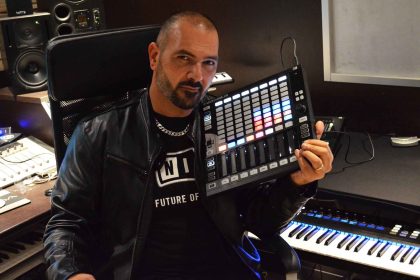


If you think this is the usual controller, wait until you change the article, there is something that might surprise you!
Eigenharp is currently in my opinion the best hardware-software controller project on the market. Seen as a whole it could be considered a new musical instrument or at least a new way of understanding it: it has its own fingering, proprietary sounds, peculiar characteristics.
The three-dimensional keys are incredibly sensitive to touch and are programmed via software with relative simplicity.
English by birth, he began his career in 2001 with a bet by the small team of developers of Eigenlabs who brought the first Eigenharps to the market towards the end of 2009.
On the market there are the three models Alpha, Tau and Pico all based on the same concept:
- attractive design
- key sensitive to horizontal, vertical and pressure displacements
- mouthpiece for wind control programmable on different parameters
- a proprietary EigenD software which we will discuss later
- slide bar for various functions
- USB connection
The larger Alpha model also features a phantom powered microphone.


Pico
In this article we will talk more about the smallest model in the series, the Pico:

- 18 frets
- breath control
- slide bar
- 4 function keys
- shoulder bag
- USB power supply
The road test
After installing the software on the Windows 7 or Apple platform using the supplied 8gb usb pen and connecting Eigenharp via usb, you have immediate access to the basic sounds: bass, piano, clarinet, cello and synth sounds. Also in the drum section there are the first rhythms of a well-stocked list.
What immediately strikes when playing it for the first time is the sensitivity of the keys: 10bit resolution and 2000 samples / second per key, personally I had never experienced anything more sensitive, practically touch-proof.
The slide bar has different functions according to the chosen tool. It can be a pitch bar for the bass / synth or in the case of the cello a controller for the bow, transforming a virtual instrument into a real model. The breath controller is also multifunctional: from the sustain for the piano to the attack on the clarinet - as in a real one -, to the cutoff for the synths. In short, it seems a complete product, which embodies most of the characteristics of the controllers on the market, transforming itself into a string, wind or keyboard instrument.
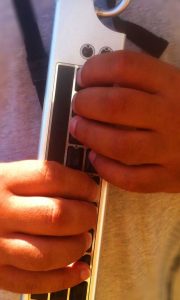
- fingering - Photo M. Baciu

The fingering and the scales
It is possible to use various fingerings also depending on the scale used. Eigenharp allows you to choose between a considerable number of scales, from chromatic, to blues, to Indian ... Personally I use the left hand for the first 8 notes of the chosen scale and the right hand for the other 8. The last two keys (there are 18 in total) have special functions and are generally used to navigate within the management software.
It is generally played vertically supported by the special strap. The larger models rest on the ground like a cello.
The 4 function keys are used for the transposer (the two lower ones), for activating the metronome / drums and for accessing the functions and instruments of the controller (the two upper ones).
EigenD - the software
Eigenharp is not a stand-alone controller, it needs its own EigenD software through which it is possible to access the countless functions. The software is obviously necessary for programming but it is also the gateway to proprietary sounds - some of great quality - and external vst. Eigenharp is however a midi controller and can therefore be used to play vst instruments or external midi peripherals (always via software).
Once Eigenharp has been programmed with a set of instruments, drum loops and scales, it is possible to move directly from the controller using the function keys. Interesting is the ability to load external soundfont allowing access to thousands of existing libraries.
EigenD also has a proprietary language Eigen Commander which allows you to quickly access some functions.

- EigenD

While it is possible to use the software directly from the realtime controller it is highly unlikely that this will happen during a performance, it is much easier and safer to use a mouse. However, it is preferable to set the necessary set for the song before starting to play. It is obviously possible to save more configurations and recall them if necessary.
The introduction of “Stage” is recent, a module that allows the control of the parameters of the loaded instruments and of the scales that promises to interface with Iphone / Ipad.
Eigend is compatible with VST so it is possible to use them both inside the software and outside via midi and virtual midi port (to be downloaded separately).
On each instrument it is also possible to insert effects and also here it is possible to access the VST ones
Loop station

One of the most interesting features of EigenHarp is the possibility of using an internal loop-station for recording sounds. On the Pico, access is a bit cumbersome due to the limited number of keys, but on the larger versions the use is easier. You choose the instruments to record, the number of beats and off you go. Loops are not audio recorded but retain their structure note-by-note. Therefore, modifying an instrument involved in a recording also changes the sound of the loop.
Drum loops which are audio samples are an exception. This feature is a bit perplexing because if you increase the speed of the metronome, the audio sample suffers from the variation because it is stretched or shortened. It is possible to insert any instrument in the loop, be it internal to the software or external, controlled via midi.
Considerations
I must confess that I have experienced moments of love and hate towards the product. It was born for an OS platform where performance is still better today. I waited patiently for the release of the first stable Windows version before buying it and then the problems started! Stability was unfortunately an opinion and too many bugs to think about working seriously. I have been collaborating with - I must say - the helpful and kind programmers at Eigenlabs for months in an effort to solicit changes and corrections. Then finally came a certain peace of mind with the "testing releases", software not yet complete but still released because they fix bugs. Windows users are however still waiting for a stable version which has been announced but not yet released.
Although I must necessarily express my dissent towards this policy in which the word "stable" is misused for obvious market logic, I still have to thank the Eigenlabs technicians for the efforts made and for not abandoning those like me who believed in it and invested. I therefore waited for most of the bugs to be fixed before writing this review.
The Pico is the only one in the series that runs on Windows 7, trials are underway for Tau and Alpha products.

- o8o8 - photo Michael Deusinger

Configuration
EigenHarp having a realtime sound management (even if recorded with loop-station) absorbs a considerable number of resources, significantly loading the CPU. A processor at least Intel i3 is therefore preferable. We did some tests with a Core Duo 8400 (very respectable when used with Cubase and VST) but the cpu overloaded easily. On Mac the use of resources is more contained and a 2Ghz / 2gb ram processor is enough.
Cons
- it is not a stand-alone controller it takes a computer to make it work but whoever buys it knows it
- the price is quite high and the higher versions are much more expensive.
- on the Windows platform the software works but is still in the "testing" release
- the cpu works too much when compared to "heavy" VSTs like Omnisphere, Trilogy, Stylus. It was explained to me by one of the programmers that the number of messages exchanged is considerably higher than that of normal controllers.
- given the price I would have liked a carrying case (the box is a kind of case but it is bulky)

In favor
- it is very flexible, it adapts to many needs
- you play with pleasure and the keyboard is very fast
- is a controller that integrates the possibilities of an advanced keyboard with those of a breath controller
- the software is very powerful and quite intuitive
- valid video documentation
- broad development prospects can be seen, both for the sound libraries and for the playability of the instrument

Eigenharp Pico's profile
- producer: Eigenlabs www.eigenlabs.com
- Tested software version of EigenD: "testing release 1.3.26" on Microsoft Windows 7
In Italy it can be found at luckymusic.com and rodsgarage.net (maybe others but I haven't found many)
It is also possible to rent the Pico and Tau model from the eigenlabs.com site at prices that are not really low but it is a hypothesis.
price 459,00 pounds (about 500 euros)
Just for completeness, we also list the prices of the two superior models:
- Dew
price 1995,00 pounds (about 2200,00 euros)
- Alpha
price 4080,00 pounds (about 4500,00 euros)
Fabio Pesce