


One of the most frequent problems of those who make music their “status vivendi” is that of not being able to take advantage of prolonged listening times before being able to make a certain and reasoned purchase. The phenomenon becomes even more complex when the market saturates with products with similar characteristics; the lack of possibility to make "trial" purchases, which would certainly allow a genuine subjective comparison between the products and their characteristics, is often the fundamental reason why we end up adopting a choice based on data sheets, reviews and often conflicting opinions . But the two of us are here for this and to try to shed some light on the dark path of your perplexities.
Prologue
Thursday evening I arrive home and find a “mysterious” package sent by the company Backlines. I bare the shipping "clothing" and find myself in the presence of a pre-Art valve with digital control (the title already says a lot). In truth, I have never been a big fan of ART products: I liked some of them in terms of sound, but they were too loud for professional use. I look closely at the picture of the instrument on the packaging and ask myself: “Why be biased? Ten years have passed, perhaps this lapse has been a problem solver and a harbinger of improvements? We'll see! Opening the box and placing the outboard on my work desk what I immediately notice is the very professional design (Fig.1), not the usual overcrowding of buttons and potentiometers, all the controls where my intuition guides me. I also take out of the box the power cord and the instruction manual, in English (Fig.2).
Before I turn him on to admire his "on" look, I begin to scrutinize him with curiosity. I really like the "VU Meter", it gives me the idea of a well-made and medium-high-end instrument. The potentiometers give a good "feel", not those that wobble under the fingers, the connections in and out are "Neutrik", it gets interesting. But let's go in order and see what this little gem of Art looks like.

ART DPS II as it looks
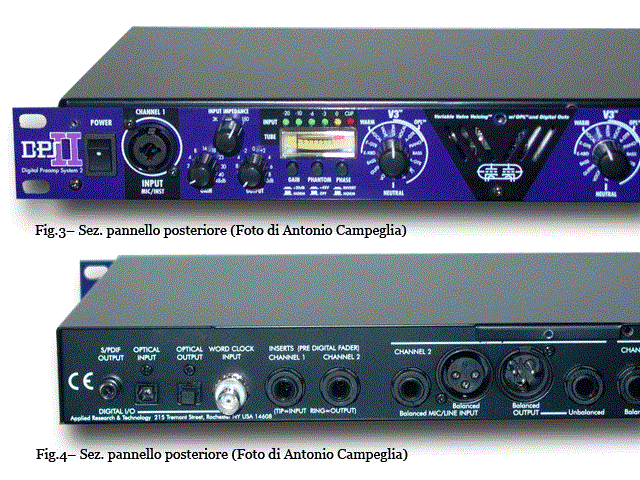
The machine is stereo, in standard rack format (one unit) in metallic blue color (Fig.3). From left to right we find: the "Power" button, the analog input with automatic switching from microphone to instrument, a linear rotary control of "Gain" that starts from a value of 0 dB to a maximum of + 48dB, a control rotary to vary the impedance from 3 ohm to 150 ohm, a rotary control for the output that starts from a minimum value of 0 dB to a maximum of 10 dB. The output value is monitored by six LEDs with relative value from -20dB up to the digital clip. Below we find a “Tube” control and nothing but an analog moving coil Vu Meter. Below there are three buttons, the first is a control of Gain +20 dB and Normal, the second is used to activate the Phantom (48 Volt) and the third for phase inversion. Finally we come to the most important section, that of the “presets”, which is controlled by a rotary potentiometer with clicks. Here we find all the “presets” of the house set for both the NEUTRAL, WARM and OPL section. Could a touch of class be missing? Here is a beautiful grille where you can see the valve. At the end of the channel, near the Input Channel 2, we find the section that manages the digital signal and some knobs that have the task of managing the signal output of the digital outputs. A small button for the "sample rate", two "LEDs" and a small button used to address the output channels for the "ADAT" or "SPDIF" protocol complete the picture of the front panel. On the rear panel from left to right we find (Fig.4): a S / PDIF Output, an Input and a Stereo Optical Output, not to be confused with the ADAT one; a word clock synchronization signal and 2 Insert channels (Pre digital fader). The first is the TIP = Ring, the second a Ring = Output and a Word Clock synchronization signal. After the digital section we find the section with the analog connections: from left to right we find the CHANNEL 2 section consisting of a balanced Jack input and an XLR input, an XLR output and a Jack but this time unbalanced. The same scheme is repeated for the Channel 1 section. To monitor a possible digital clip to monitor a possible "led" digital clip and a small button that serves to address the output channels for the "ADAT" or "SPDIF" protocol complete the picture front panel.
On the rear panel from left to right we find (Fig.4): a S / PDIF Output, an Input and a Stereo Optical Output, not to be confused with the ADAT one; a word clock synchronization signal and 2 Insert channels (Pre digital fader). The first is the TIP = Ring, the second a Ring = Output and a Word Clock synchronization signal. After the digital section we find the section with the analog connections: from left to right we find the CHANNEL 2 section consisting of a balanced Jack input and an XLR input, an XLR output and a Jack but this time unbalanced. The same pattern is repeated for the Channel 1 section.

Technical impressions
It's not a PRE completely analog, in fact it has “presets”. So why so much accuracy in the choice of components if in the end the product is aimed at a semi-professional user? Let's open it and see what "pasta" it is made of (Fig.5). It is an ART, developed in the USA but manufactured in China! 🙂 The circuitry looks solid and clean although I can't help but notice that most of the components are SMD, so no friendly or "do it yourself" repairs. There is also a well-made toroidal transformer but nothing highly professional. The valve placed in front of the interface reminds me a lot of those found on the new Korg batteries of the Electribe series, they are used more to show off than to obtain a real sound texture, among other things there is only one valve for two channels , is a 12ax7A, a double triode. The expedient of putting a single valve for two channels is now widely used; in my opinion it is not the best solution because the two channels could interfere with each other. However, the diagram can be divided into two logic blocks. The first block, starting from the left, is where all the "routing" of the digital signal takes place (Fig. 5-1). Going deeper we discover that as internal converters it uses AKMs, precisely the AK 4528VF (Fig.6). I am referring to what is technically called CODEC (codifier-decoder) in the sense that it deals with both A / D and D / A conversion. This codec has two channels, that is, it converts a maximum of two distinct signals at a time and is the same as the interface of the Tascam FW 1804; it is a medium-good quality component, maybe this will be the secret of excellent dynamics and clean sound? Section A / D presents:
- a full differential input (ie a differential input), certainly a more advantageous solution than a single-ended.
- 24-bit / 96Khz two-channel conversion with 64X oversampling
- dynamic range (ie the "theoretical maximum dynamics") considering the Signal / Noise ratio = 108dB Signal / Noise + Distortion = 94 dB (it is a parameter that gives the idea of the "actual dynamics" if "mediated" with the one above)
-THD (total harmonic distortion) = -94dB


Regarding the D / A section we have:
- Full differential output - two-channel conversion at 96Khz 24 bit with oversampling at 128X - dynamic range S / N = 110 dB - S / N + D = 94dB - THD = -94dB Looking closely at the circuitry we notice a very strange thing: what will they ever make us Alesis integrated AL 1402 and AL 1401A (Fig.7) in an ART circuit? Marketing Mysteries.
The second section is the one where the passage of the analog signal takes place and where the small valve 12 ax7a resides (Fig. 5-2). We tried to replace it with compatible models to see how much it affected the sound; there were some small changes, I don't mean improvements, but we managed to get a slightly different sound texture. Perhaps one of the reasons why we have not noticed notable sound mutations lies in the fact that, in reality, the path of the analog signal is not transformed by an analog circuitry (copper wire, transformer, valve) but by means of integrated programmed by the parent company. . Attention!!! It is good practice that the circuits are constructed in such a way that the parameters that characterize the active components, such as the gain of a transistor or that of a tube, should not significantly affect the behavior of the entire circuit; this operation goes under the name of “stabilization of the working point towards the DISPERSION of the parameters of the active components”. If this were not the case, replacing a broken valve with another of the same code, even if not perfectly identical, could lead to a malfunction of the whole circuit (increased noise, overheating, etc.).
The same goes for a valve with a different code; this is undoubtedly an indication of a good project! From an electronic point of view, the machine has a very respectable circuitry, especially considering the price range. Excellent choice of Neutrik connections and that of AK 4528VF, a component with good performance, but not the best codec produced by AKM (the throne remains atAK4620). It is understood that even better would have been to use two separate converters, one for A / D conversion and one for D / A conversion, so that much higher performance could be achieved. Finally, it should be considered that there is little use in having a good CODEC or A / D or D / A converter, if it is not well interfaced with the rest of the designed circuit. Paradoxically, the value of a poorly chosen capacity would be enough to make the most excellent A / D converter look like a low pass or high pass filter.

ART DPS II under press:
Voice
The singer in question has a voice that moves between the baritone and tenor register. The microphone used is a beautiful NEUMANN TLM 103; as you well know, being a “transformeless” it is quite clean and linear, an effective tool to neutrally test the ART DPS II. In this case I had to adopt some expedient for the right recovery, I'll tell you: Both the NEUMANN and the ART do not have a high-pass filter. To minimize the danger of explosive consonants I have positioned the microphone upside down with the center of the membrane that looks at the tip of the singer's nose placed at a distance of about 30cm; finally I inserted an anti pop screen between the source and the microphone. The result is really comforting, in the sense that the PRE can now provide good headroom with excellent signal-to-noise ratio, without excessive peaks caused by any low frequencies. I start spinning the rotary knob where the presets are listed. After having correctly calibrated the levels, including impedance optimization, I position the selector on "vocal", in the section circumscribed by the "WARM" bow; you immediately notice a significant enhancement of the timbre, particularly in the mid-high range, around 5000 Hz and since there is an increase in the general pre-amplification, I find it convenient to reduce the level on the gain knob by about 3dB. By choosing, instead, the "vocal" processing in the "OPL" section, I realize that the signal is managed by an automatic limiter, useful if you want to get complete dynamic control over the signal output, but which on this occasion I thought too much " evident ”and therefore not to my liking. We find yet another “vocal” setting which is located in the “NEUTRAL” section: it was what I was looking for, really neutral, in the sense that the recorded voice maintains a soft and linear character across the entire playing spectrum. In conclusion, this test produces a sufficient and semi-professional result.
Acoustic guitar
La acoustic guitar was miked with a pair of NEUMANN TLM 103 on a “country” style performance. Similarly to as seen in the voice test, the dedicated preset offers different settings that we can, from time to time, adopt according to the type of desired result. Once I had adjusted the right input and output levels, I went to select the preset “a. gtr. " in the “OPL” section. The result is a guitar with a lively character, held back by the action of the limiter at the right point. The attack is pleasantly fast, it is clear that a pick was used and the sound is not particularly harsh even on the very high frequencies. Test worthily passed.
Electric bass: With this test I will verify the behavior of the ART DPS II using its unbalanced jacks inputs; I'm curious to see the effects of the electronic balance at the output on this type of signal. We specify that when these connections are used, the knob that selects the impedance does not produce any intervention as it is automatically bypassed. Once the calibration of the levels has been established, I positioned the selector on the “bass” preset in the “NEUTRAL” section. The result is a concentrate of good timbre with a discreet tip on 80Hz; the mid-bass is never nasal, both in a rhythmic accompaniment performance and in the phrasing phase. You can clearly hear the attack of the string on the frets of the neck, the reproduction is faithful to the type of performance performed.
Percussion: A couple of congas and a Cuban musician kick off this session with the ART DPS II. The microphones for this test are a pair of SHURE SM 57. After setting the levels, I selected the “perc” preset in the “OPL” section. Excellent attack, rich exaltation on the medium-low, medium-middle and medium-high frequencies, which give a good dose of vitality expressed by the clear and intelligible pops of the hands on the taut and tonic skins of the drums. Beautiful! Really not bad. Even on metal and non-metal instruments, it provided excellent transient response. I remember that it is this particular category of instruments, characterized by extreme speed and detail, that gives a hard time to many preamps and microphones on the market (obviously belonging to this price range).
Keyboards
For this test I used a latest generation synth, very beautiful and characterized by a great variety of sounds; like all sampling instruments, however, it lacks that nice analog warmth that can only be found in old pure analog generation machines, such as Ob12 of Oberheim o Jupiter 8 of Roland (Fig.8). Normally, to compensate for this "coldness" of digital sound, the manufacturers fill, even perhaps indecently, the "presets" of reverbs, delays, compressors etc. certainly making the sound more pleasant to our hearing, but also more confusing, especially in the mixing phase. In this case I chose some “patches” to test, from the classic sounds of “pads” to those that emulate acoustic instruments, paying attention to the effect / dry balance. Also for this instrument we will obviously use the high impedance “jacks” inputs of our ART DPS II.
Once the levels have been made, I selected the only preset present for this type of instrument “E. KBD ”in the“ WARM ”section, choosing an acoustic piano sound as the first preset. The sound does not convince me, too wide at the ends of the band, I try again with another timbre, an acoustic guitar. The result seems more convincing, but I have to further decrease the chorus effect in the synth before I can get a tonal improvement. As soon as I leave the palette of acoustic sounds and try an effect that emulates an old analog synthesizer, the result immediately jumps to the ears: a very complete extension of the frequency response of the synthesis is provided, in particular on the bass up to the 40 Hz with their harmonics. Everything in the room began to vibrate. Better to stop ...

Conclusions
Summing up we can say that we are in the presence of a decent machine, excellent for those who do not have large budgets available, particularly aimed at home and project studios. It lacks the silky grain at the top of the spectrum (between 8000 and 10.000 Hz) belonging to a category of certainly more expensive machines. I was very impressed by the extreme cleanliness of the processor: I did not notice the classic background noises that have characterized the old ART production in a negative way. I really liked the idea of allowing the user to have the possibility to use the three sections, Neutral, Warm and Opl.
I would like to give a couple of tips to those who want to make the most of these three sections. The first is very useful for those who have to record acoustic instruments and for those who need a neutral and not mixed sound or when playing very fast rhythms and arpeggios, where you need to distinguish the notes well. The section "Warm”Is excellent for giving that greater presence to the sound, giving a very emphasized paste on the mid-low frequencies; excellent for reinforcing the voice, an acoustic guitar or a bass, but without exaggerating, as you risk to mix the sound too much and make it less intelligible to our ears.
The third is the most interesting for those who work especially live, where a good preamplifier can be combined with a discreet "limiter", very useful for controlling the dynamic changes caused by the impetus of the singer on duty or by the traumatic passage of a sweet arpeggio to a rock performance. You will certainly no longer have to go crazy with your hands on the mixer faders, making acrobatic excursions for the sweaty control of the mix-down. It is certainly not a machine for a top-level studio, as for some the factory “presets” could be a limit. It must be said, however, that due to its sound texture the DPS II not only has an excellent Q / P ratio, but is suitable for all home studios that wish to have a more convincing and present sound in the musical takes.
Do not forget that this PRE, properly used, is also excellent in live situations, as it will be enough to choose the right preset (those in the Opl section are recommended, due to the limiters) and dose the I / O signals, which means effort saved for controls that may be difficult to change while playing. However, even if it is a “pre-packaged” instrument, I advise everyone to listen carefully to the various “patches” and not to stop only at the warm section, where there is a great change in sound. We always remember that “tube sound” is not synonymous with a confused sound, but with a more homogeneous and less unglued signal. After making the final conclusions, I checked the list price and honestly thought that, for the performance offered, it was slightly higher. The flexibility of use coupled with the successful design and the semi professional audio features, place the ART DPS II among those products to be recommended.
Antonio Campeglia


