

This is one of the first occasions in which I can illustrate a not totally electronic instrument, built entirely in Italy.
Talking about a guitar is very stimulating, but you have to pay great attention, not to let yourself go to great enthusiasm, to understand the design and sound idea of the luthier, considering that mass production has accustomed most of the buyers to pedals and some amps. .
This time the subject becomes more complex, as the APS Studio, entry level guitar of the range of products that fully express the luthier taste of Alessandro Pizzo, has a number of factors that allow it to be defined as a “Modern Classic”.
But we proceed with order.
The heart of the hardware is totally vintage: bridge e mechanical they are in the purest Old School style, while maintaining excellent functionality even for those who play more "lively". The hardware is completely Kluson, I have had more than once excellent responses from this brand, which presents itself on the market with an honest price in the face of functional and respectable hardware.
The same goes for electronics too: the set of Bertozzi Guitar Works mounted on this APS it follows the sound of the Stratocaster 60s, also as regards the electronics, wiring and potentiometers, whose performance we will discuss later in this article.
Here ends the "vintage" heart of the instrument and begins what, in my opinion, is the most interesting part.
Lo s and tummy cut they are designed to fit the musician, and this gives a particular general handling to the instrument and the accessibility of the right hand to the whole instrument; comfort becomes a central point, which starts from the classic base of the Fender Stratocaster but corrects some more aesthetic than functional characteristics, which are repeated on subsequent models, such as, for example, the Musicman Silouhette.
The body-neck joint is slightly different than usual: instead of the four square joints, better screws with a more pronounced disposition towards the neck are used, which guarantees better stability than the classic Bolt On joint at the heel.
A practice now widespread in violin making, and which I always prefer, is the regulation to truss rod to the heel through the external access washer: a small dimple at the end of the handle allows the adjustment of the truss rod, avoiding having to carry out long and very often dangerous disassemblies.
After the brief discussion on the aspects vintage and innovative, the instrument presents itself as an interesting “trait d'union”, in the wake of a sound and acoustic tradition that we all remember with great pleasure, but with some updates that make the instrument accessible, playable, practical, comfortable.
In summary, it perfectly reflects the concept of “modern classic”, allowing the guitarist to play, both in concert and in the studio, not an external element, but an extension of his arm.
Aesthetic Considerations
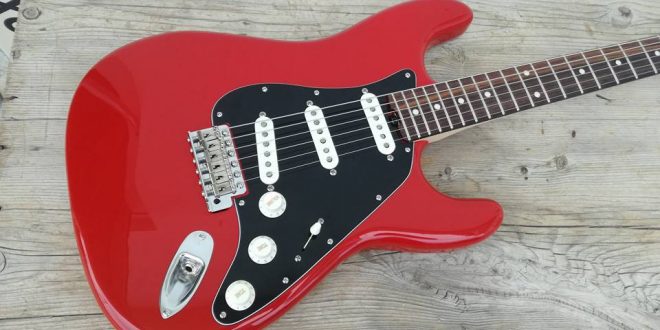
We are talking about a guitar from the stratoid family, so the design is well recognizable, but the quality of the raw materials is much higher and this guarantees a much more pleasant aesthetic result, starting with rosewood fingerboard with beautiful veins resting on satin maple neck.
Il body features a very modern bright red color, which winks at fiesta red, on a black three-ply shaped pickguard for easy extraction, white plastics and chrome hardware.
The glance is very pleasant, no exaggeration aimed at making the instrument more attractive, clean and necessary in its forms.
If I really have to find a fault, I admit that the paddle does not really meet my tastes, but it is a personal opinion rather than an objective criticism.
Clean, elegant and ready to use: promoted on the aesthetic side.

Technical considerations
Let's go through the manufacturer's data sheet a bit.
Bodysuit
- Polyurethane painted alder
Handle - Modern C shape satin maple
Keyboard - Rosewood
Nut - Graphite
Meccaniche - Kluson Vintage
Get up - Kluson
Number of keys - 22 Dunlop 6150 format
Radius Keyboard - 12
Pickup - Bertozzi guitar works classic 60
However, this is not enough to describe the plus of this guitar, since what makes it more suitable for the contemporary musician is the play of shapes, especially as regards the tummy cut, body-neck junction, general weight, heel adjustment with external nut.
The factors that make up the body alone are very important in making the neck areas accessible, the tummy cut is better shaped than the classic Strat, it rests well on the body, it is a sort of "trademark" of the house.
Il Bolt on is extremely interesting for the asymmetrical junction: the normal four square screws are not used to join the neck and body, but Alessandro has well thought of moving one of the screws higher, towards the handle, to have more stability of the instrument, following what is now becoming a standard in the construction of a functional guitar.
Another useful option is the ability to heel adjustment with external washer: access does not require any disassembly and can be carried out at any time.
Il handle is a modern C shape with frets Dunlop 6150: it is the perfect format for a guitar that must combine two very different worlds and various playing styles from very different eras. Accessibility does not suffer from particular flaws, I can access the final parts of the handle without effort.
Il nut I like graphite, it is a lasting solution, albeit not suited to a vintage sound, but it is a sacrifice that I am willing to make for an almost infinite yield and durability.
The rest of the hardware is all made in Kluson, functional and well built, nothing to report, as will be seen in the sound tests.
For electronics, on the other hand, we have a delightful set of 60's sound pick-ups, built by Bertozzi guitar works, hand-wound and with a very deep sound; I prefer the choice of using Italian pickups because we have many good manufacturers who produce handmade magnets at prices equal to those of Seymour Duncan or similar.
Analyzing them in detail, we see that they are single coils with impedance of approx 5.6 k 6k (increasing from neck to bridge) e 2.2 henries inductance; the poles are in alcohol 5 uploaded to 1100 1200 Gauss and they are all shielded with a copper foil around the filament then connected to the pickup ground; the sideburns are in vulcanized fiber and the thread is awg42 of Italian manufacture.
If I had to find a flaw, I would have opted for steel saddles with graphite housing, to match the vintage part and the modern part: of course you can request it when you order it.

Sound Considerations
On this instrument I have carried out the usual tests:
- Guitar-cable-amplifier only
- Guitar-cable-overdrive-delay-amplifier.
Guitar off
With the guitar off, the first thing that jumps to the ear is the actual vibration of the entire mass of the instrument.
It vibrates a lot, playing it when turned off becomes a pleasure, the naked and raw sound is very round, a discreet attack of the strings, not rattling, “calm”, if we can define it that way.
The reference sound spectrum follows the typical sound of the '60s Strat, less presence of high frequencies and a sound slightly more marked on the medium, medium-low and much more balanced.
By connecting the guitar to the amplifier, the electronics are faithful to the idea and the vintage heart of the instrument, the pick-ups are not excessively "bright", so much so as to make the mids sound "flooded" or in any case too strong, they are slightly dark (compared to the Texas specials I have on another Strat), however, they have well-defined components: the volume is somewhat higher, albeit slightly, compared to an industrial pick-up; the dynamic response is significantly higher than a foreign industrial “competitor” magnet and the frequency response is noteworthy.
I was very happy with these pickups, they have a nice vintage sound but also very precise, which denotes Bertozzi's expertise in construction and Alessandro in the choice of components.
The main timbre of this instrument is very close to the sincere and authentic blues, rock-blues, classic rock and to some fringes of the modern rock who still use the guitar's "Golden Age" sound.
The first clean test took place on the basis of a piece by BBKing, the instrument has a good exit from the general mix, has a bluesy soul but with a significantly more composed and more “tameable” dough.
The round sound is heard in all positions of the instrument, and not even positions 4 e 5 they turn out to be excessively nasal, it remains elegant without being intrusive.
I especially preferred positions 1, 2 and 4, because the sound at the neck is almost velvety and very creamy, a good attack, accompanied by a good presence of mid-bass that give a beautiful result on the clean; position 2 is not excessively compressed and squashed as it happens on the other Stratocaster, it is much more pleasant and less violent and present in the mix; the 4 instead is the one I prefer for the sound close to what you get at the bridge, without having it too much present.
By adding theoverdrive you enter the full atmosphere rock and roll.
I used the Masotti OD Box and Korg SDD 3000 which is my delay for almost 4 years now, which I still think is the best there is.
The overdriven guitar (I didn't go beyond the Masotti 6 drive) becomes a respectable rock ax; playing with the volume potentiometer, you go from a clean break-up sound to a slightly dirty sound, up to the typical sound of historical guitars played in the most famous concerts.
The instrument maintains a somewhat vintage oriented sound, but with due care, not only structural but also electronic, it performs well in genres such as Classic Rock, Blues, Blues-rock and Rock and Roll.
Can we therefore define it as a multifaceted guitar?
Enough, because as versatile as it is, it is not suitable for hardcore hard rock or heavy metal, since it does not have the right magnets for these genres.
Nevertheless, I feel I can reiterate that it is a rock instrument without a shadow of a doubt.
Economic Considerations
The model with the illustrated features has a selling price of 1589,00 €, they are not few, but not many if we compare them with what is needed to buy a current "standard" guitar.
Currently it costs as much as a Fender American Professional, but the pluses, which I personally consider not just, are the possibility of customization, the excellent choice of woods, the construction made to measure for the musician, the presence of durable modern accessories, the components top quality electronics.
It is therefore an excellent choice to diversify from the classic Stratocaster, not losing all the typical timbre and having the added value of a series of useful and modern reinterpretations, which make this instrument playable for a long time and above all comfortable.
My opinion, therefore, is fully positive also from an economic point of view.

Final considerations
Pro
Construction and weight tailored to the player
Excellent electronics
Optimal solutions for the durability of the instrument
Cons
Saddles too vintage compared to the choice of the graphite nut
Some may object to the lack of self-locking devices
Author's Note
This is the first model I have in my hands for more than a few hours, so I was able to understand all its peculiarities and then I found other Alessandro's guitars at the Milano Custom Shop at the Brbs stand.
Following his constructive philosophy, he manages to combine the functional and aesthetic factors in an excellent way; in the case of this model in particular, I personally would have opted for a configuration with a humbucker at the bridge, although I was aware that perhaps this would distort the typical sound of the instrument that Alessandro had in mind.
I had a lot of fun playing it, it vibrates considerably even when turned off and you hear all the instrument that accompanies you: it is a good feeling that only high-end guitars can give.
I have seen other models with good performance: a seven-string used by Matt Trojan has always been Vintage canvases used by James Pasquali, but even those I will have to try them calmly, not at the fair.
Do I recommend it?
From my point of view, yes, it is well made and the price is competitive compared to the Stratocasters: I think a lutherie guitar is preferable, which has the same price but a much higher yield.

Antonio Cangiano